


Breeding birds: 9,018 pairs
Wintering birds: 41,000
Family: Cormorants And Shag
Adult cormorants in breeding plumage are glossy black with bronze on the lower back, rump and wings, and blue-black on their upper back and tail. The plumage has a scaled effect. The underparts are black and there is a conspicuous white patch on the thighs.
The head and chin are black with bare, white skin on the cheeks and throat. There is a loose crest of elongated, white feathers on the nape, which may extend to the rear neck or fore neck. The thick, straight bill is horn-coloured with a yellow or orange gape, and hooked tip, the eyes are emerald-green, and the short legs and webbed feet are black.
Out of breeding plumage, cormorants have duller plumage and lose most of the white feathers. Males and females look similar, but the male is slightly larger with a larger bill.
Juvenile cormorants are mottled with a brown neck and white belly. By the second year they resemble adults but are browner.
Try our interactive bird identifier
Cormorants breed all year round depending on food sources and produce 1 brood a year. They breed in colonies of up to 2000 pairs on cliffs, or in trees and bushes. Both male and female build the nest which is made from twigs, sticks, reeds, seaweed, moss, and debris.
Cormorants lay 2-6 pale chalky-blue or green eggs, which are incubated by both parents for 27 to 31 days. They place the eggs on their large, webbed feet underneath their body to keep them warm. Chicks are blind and altricial and are covered in black down. They are fed by both parents with a regurgitated liquid for a few days and then solid food brought to the nest.
They fledge 50 days after hatching but remain with their parents for another 50 days and reach sexual maturity at 3-5 years.
Cormorants eat mostly fish but occasionally supplement their diet when in freshwater with crustaceans, amphibians or insects.
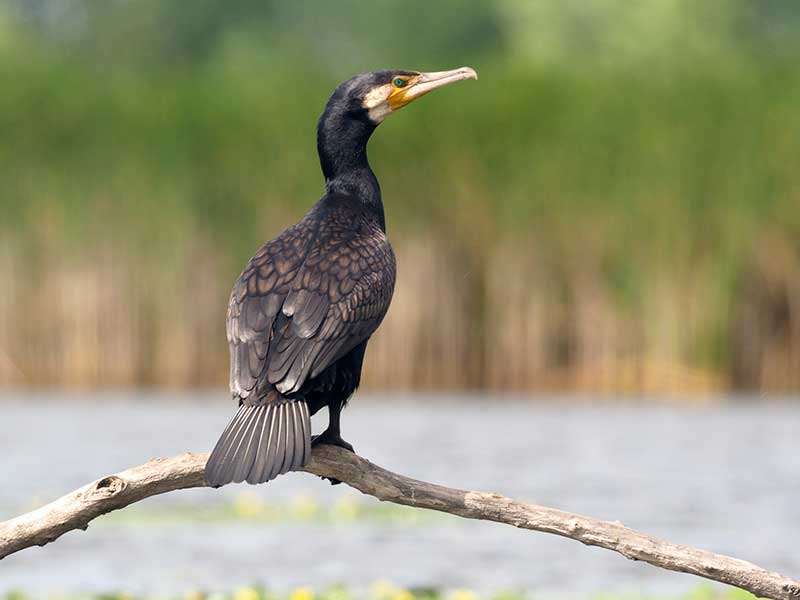
Cormorants are found around the coastlines of the UK on rocky shores, lagoons and estuaries. They can also spotted inland on lakes, reservoirs and gravel pits.
Britain's Birds
RSPB Handbook Of British Birds
Collins Bird Guide
In Norway cormorants are considered sacred birds and it is good look for cormorants to have them gather near your town or village.




One Response
Today I saw what I think is a large cormorant with a full white breast and black head and long beak.My camera wasn’t good enough to get a good photo, but I thought it unusual, I have only seen smaller black cormorants around here. Near the river Wey in Old Woking high up in a tree.