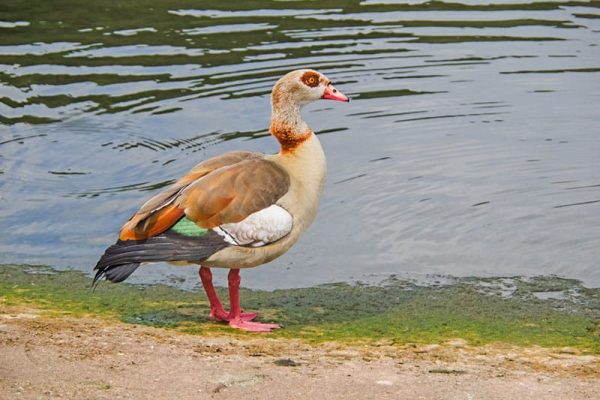
The eider is the UK’s largest and fastest-flying duck.
Breeding birds: 27,000 pairs
Wintering birds: 63,000
Family: Ducks, geese & swans
In breeding plumage, adult male eiders have white upperparts, wing coverts, and neck, and a pale pink or yellow wash on the breast. The flight feathers, rump, uppertail coverts, tail, and belly are black.
The head is white with a black crown that extends to the lores with a white stripe running through the centre. There is a green patch on the back of the nape. The bill is light blue-grey, the eyes are dark brown, and the legs and webbed feet are pale blue.
In eclipse plumage, males are dark with white patches on the upperparts and a pale brown forehead and crown.
Female eiders are brown or rust-coloured with black bars on the body, and dark flight feathers and tail. Juveniles are similar to females with finer black bars.
Try our interactive bird identifier
Eiders start breeding in April and May and produce 1 brood a season. They are monogamous and nest in colonies on small offshore islands and rocky coasts. The nest, built by the female, is situated on the ground. It is a shallow depression lined with vegetation and down plucked from her breast.
Eiders lay 4-6 smooth, glossy, grey, olive, or pale green eggs which are incubated by the female alone for 21-28 days. Chicks are precocial and covered in brown and white down. They leave the nest within 24 hours and can feed themselves and are able to dive shortly after entering the water. They fledge 65-75 days after hatching when they perform their first flight.
Eiders may lay eggs in the nests of relatives and share the work of raising ducklings, with individuals caring for creches of up to 150 ducklings. Most males leave the colony before the eggs hatch.
Eiders dive for food which includes shellfish in particular, mussels, clams, scallops and crabs, sea urchins and starfish. They will also eat insects.

Eiders can be seen all year round in breeding areas. They are found in the north of England, and the west coast of Scotland as well as Northern Ireland.
During winter they are also found on the east coast and south coast as far as Cornwall.
Britain's Birds
RSPB Handbook Of British Birds
Collins Bird Guide
Eiders are known as cuddy ducks after St Cuthbert, the patron saint of Northumberland, who made the eider ducks on The Farnes a protected species.