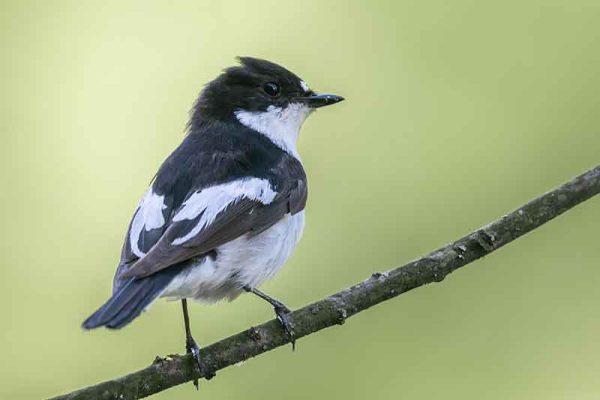
Breeding birds: 14-93 pairs
Family: Ducks, geese & swans
In breeding plumage male garganeys have dark brown backs with pale fringes on the feathers, and a grey-brown tail. On the upperwings there is a pale blue speculum with white borders above and below, while the upperwing coverts are pale slate-grey and the elongated scapulars have grey, dark green, black, and white stripes.
On the underparts, the breast is brown with black bars, the flanks are vermiculated grey, the belly is white, and the undertail is white with dark brown bars and spots.
They have a dark brown forehead and crown with a broad white band along the side of the head. The foreneck is rust-coloured with white flecks. The bill is dark grey, the eyes are brown, and the legs and webbed feet are grey.
Female garganeys are duller than males with a scaly pattern on the body, and pale spots on the flank. On the head, the cap is dark, there is a dark stripe through the eye and a pale stripe above, a dark stripe on the cheek, and a white spot near the bill. The bill is pale grey, the eyes are brown, and the legs and feet are olive-grey.
Males in eclipse plumage resemble females although they are less dull and show most of the breeding plumage pattern. The head markings are stronger, and they have a white chin.
Juvenile garganeys are similar to females with fine streaks and spots on the underparts.
Try our interactive bird identifier
Garganeys breed in April and May. They nest alone or in loose groups in thick vegetation and are strongly territorial. The female builds the nest which is a shallow depression in the ground lined with leaves, grass, and feathers.
Garganeys lay 8-11 buff or cream-coloured eggs which are incubated by the female alone for 21-23 days while being guarded by the male. The chicks have dark brown and pale yellow down. They fledge at about 35-40 days after hatching and are sexually mature at one year.
Garganeys eat mainly plant matter including seeds, pondweeds, grass, roots, and tubers. They will also eat aquatic invertebrates such as worms, crustaceans, molluscs, and insects, as well as small fish and amphibians.

Garganeys visit the UK from April to October from their wintering grounds in Africa. They are found in central and southern England in shallow wetlands, flooded meadows and ditches, and areas with lots of aquatic vegetation.
Britain's Birds
RSPB Handbook Of British Birds
Collins Bird Guide
Although the male garganey has a distinctive mating call, female garganeys are almost silent and can just about manage a feeble quack.