Breeding pairs: 430,000
Family: Finches, Euphonias, And Allies
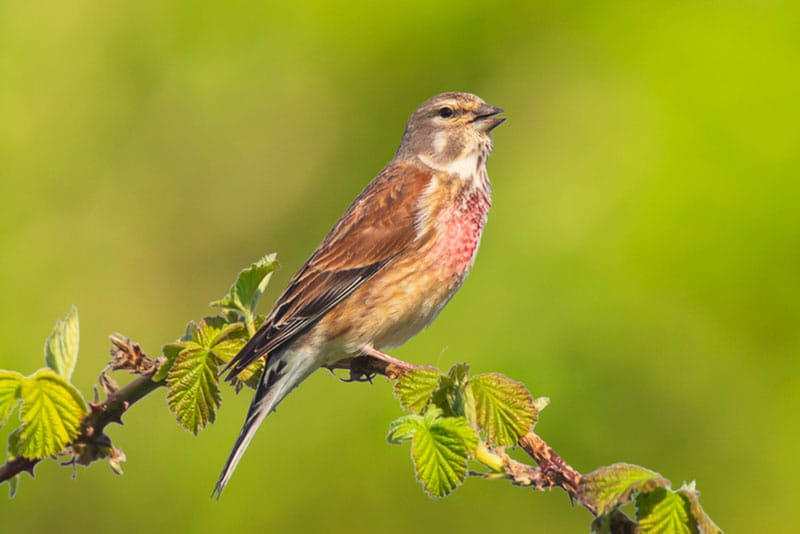
Adult male linnets in breeding plumage have chestnut upperparts with a paler pinkish lower back and rump. The tail and uppertail coverts are black with pale buff edges. The upperwing is mostly chestnut with black outer greater coverts with black fringes, and the primary coverts and flight feathers are black.
The upperbreast is crimson with a pale buff or pink centre. The sides of the belly and flanks are buffy-brown, while the lower belly and undertail coverts are whitish.
Linnets have a buffy-white chin and throat, the forehead, lores, and supercilium are pale buff, and the forecrown is crimson. The hind crown, neck sides, cheeks, and ear coverts are pale grey, with fine dark streaks on the crown. They have a pale buff submoustachial stripe, and brown-streaked malar stripe.
The bill is dark brown with a grey base, eyes are dark brown, and legs and feet are pinkish brown.
Out of breeding plumage male linnets are browner with a buff head and darker brown upperparts with fine black streaks. The breast is brown with darker streaks.
Females in breeding plumage are duller than males and don’t have the crimson patches on the breast and forecrown. The underparts are pale brown and dark brown streaks on the breast and flanks.
In non-breeding plumage female linnets are more heavily streaked.
Juveniles are similar to females but they are browner, and have dark streaks on their head and upperparts. The underparts are paler with sandy brown streaks.
Try our interactive bird identifier
Linnets breed between mid-April and early August. The female linnet collects nest material while the male guards her. She builds the nest alone near the ground in dense hedges, scrubs, or thorny trees, or occasionally in wood piles. It is cup-shaped made from twigs, roots, moss, and plant matter, lined with fur and feathers.
Linnets lay 4-6 smooth, pale blue eggs with purple and brown spots and streaks, which are incubated by the female alone for 11-13 days. The male feeds her during this period.
Both adults care for the chicks which stay in the nest for 10-14 days but depend on their parents for 2 further weeks after fledging.
Linnets produce 2 or 3 broods a year.
Linnets are mainly seed eaters, but will also eat flowers and buds, as well as some small invertebrates such as insects, larvae, and small snails.
Linnets can be seen all year round in the UK, although they are scarce in the upland regions of north west Scotland, and they are mainly concentrated along the east coast.
Look out for them on commons, heathland, rough ground, farmland hedges, and salt marshes. They will also venture into parks and gardens.
Britain's Birds
RSPB Handbook Of British Birds
Collins Bird Guide
During the Victorian era linnets were trapped and kept as caged songbirds because of their lovely song.