Breeding birds: 280,000-320,000 pairs
Family: Shearwaters And Petrels
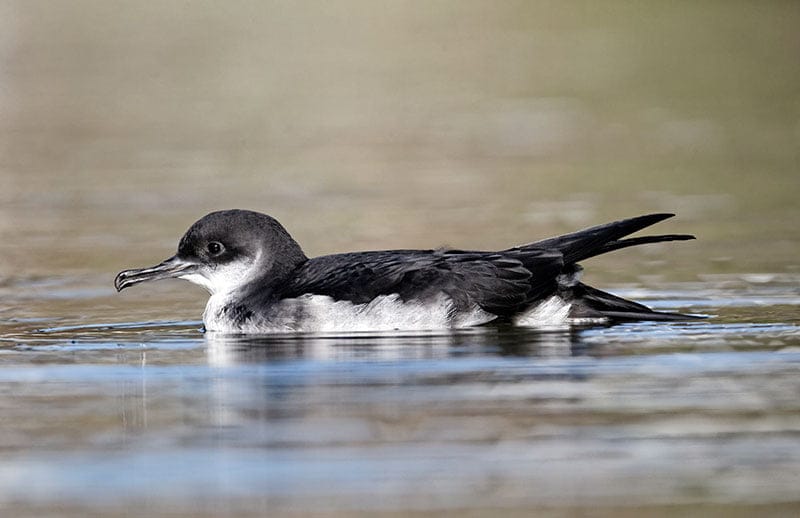
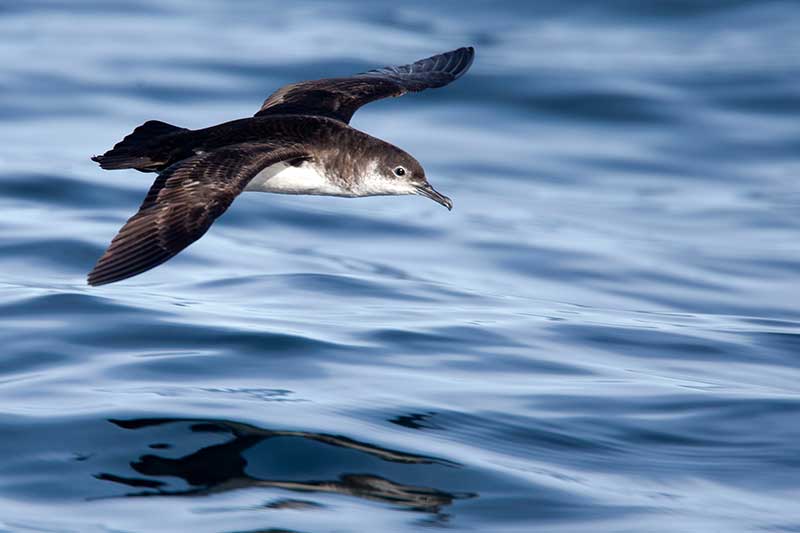
Adult Manx shearwaters have dark brown or black upper parts and white underparts, with a broad, darker, trailing edge on the underwing and a narrow, dark leading edge. There is a dark patch on the thigh.
The head is dark with a white chin and a white patch behind the ear coverts. The bill is dark grey with a pale base, the eyes are black, and the legs and webbed feet are pink with black toes.
Males and females look alike, while in worn plumage they are duller brown.
The juvenile is similar to the adult.
Try our interactive bird identifier
Manx shearwaters start breeding in March. They are monogamous and often mate for life, and produce one brood per season. They nest in colonies on grassy, offshore islands. The nest is a burrow abandoned by rabbits, or they may sometimes excavate it themselves, lined with leaves and grass.
Manx shearwaters lay one white egg which is incubated by both adults, taking turns of 4-8 days for a total of 47-66 days. The chick is covered in greyish-brown down. Both parents stay at the nest for a week and then visit at night for a further two months to feed it, after which they abandon it. Over the next 8 or 9 days the chick is not fed and loses weight until it leaves the colony and goes to sea to search for food. It reaches sexual maturity at 5 years.
Manx shearwaters eat mainly small fish such as herrings, sprats, sardines, and sand eels, but will also take squid and crustaceans. It forages by plunging into the sea from a low flight, or dives just below the surface while swimming.
Manx shearwaters arrive to breed in the UK in March. They can be seen on rocky islands off the west coast of Wales, Scotland, and Northern Ireland, as well as Cornwall and the Isles of Scilly.
In autumn, they can be seen on passage migration around the coasts of Scotland and northeast England.
Britain's Birds
RSPB Handbook Of British Birds
Collins Bird Guide
On the Scottish island of Rum there is a mountain called Trollval which was named by the Vikings who believed there were trolls living underneath it due to the eerie sound of Manx shearwaters cackling at night.