

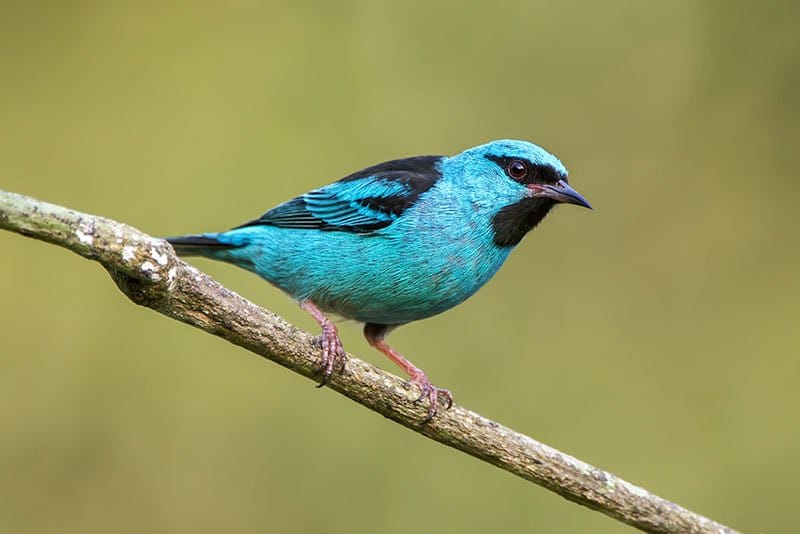
The blue dacnis also known as the turquoise honeycreeper is a small songbird found in parts of Central and South America and Trinidad. Despite its alternative name, it is not a honeycreeper which have longer bills. The male blue dacnis is turquoise with black patches around the eyes, on the throat and back, while the female has mostly green plumage with a blue head.
It inhabits forests and woodlands as well as parks and gardens, and feeds on insects and sometimes fruit such as berries, figs, and bananas.
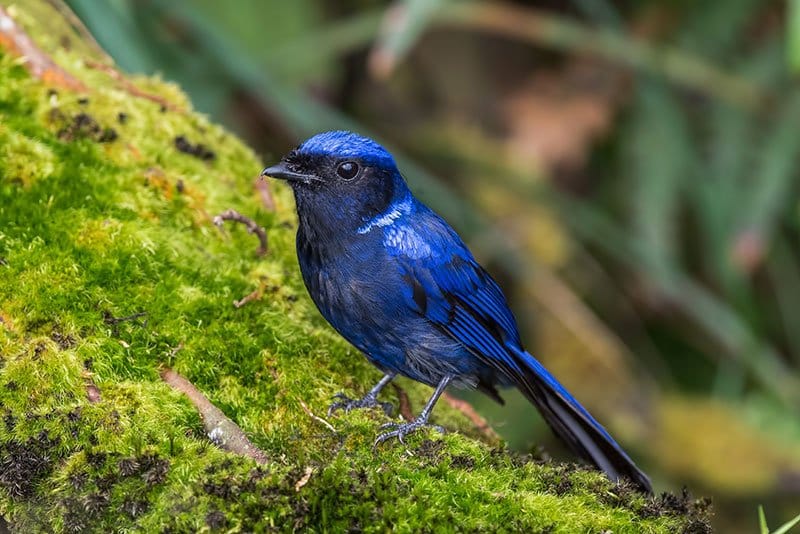
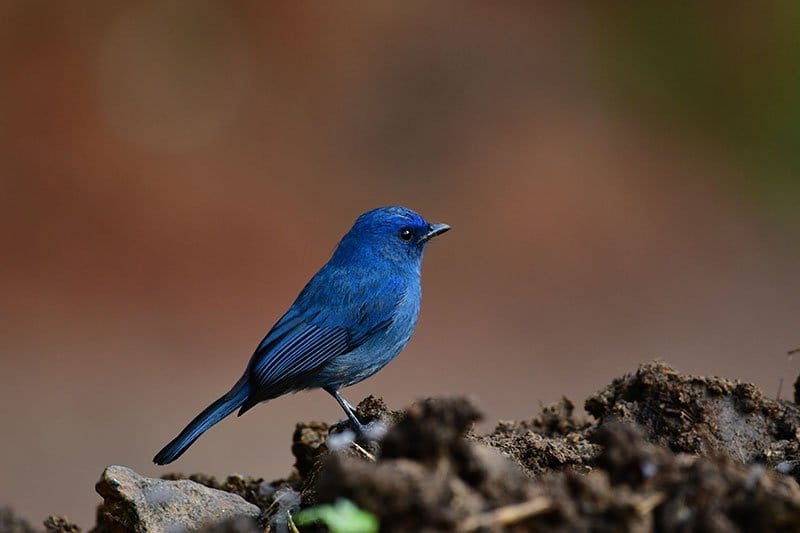
The large niltava is an Old World flycatcher found across Asia including Bangladesh, Bhutan, Cambodia, China, India, Indonesia, Laos, Malaysia, Myanmar, Nepal, Thailand, and Vietnam. The male has bright, purple-blue upperparts and dark blue lower parts with a darker face. The female has dark brown plumage with a blue patch on the neck.
It lives in subtropical and tropical montane forests, but can be round in rural gardens too, and eat insects and other invertebrates as well as berries.
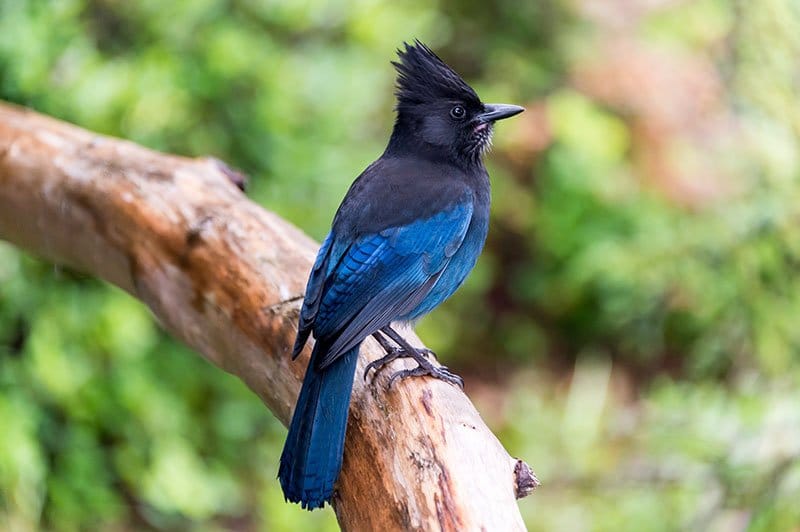
Closely related to the blue jay, Steller’s jay is a corvid found in western North America and mountainous areas of Central America. Its plumage shows considerable variation across its range with individuals in the north having dark heads which become bluer towards the south. The body is silvery blue while the primary feathers and tail are a richer blue. The sexes are similar although the female is slightly smaller.
It lives in evergreen forests, agricultural habitats, and residential areas, and has a omnivorous diet consisting of seeds, nuts, and berries, as well as insects, small rodents, and eggs and nestlings. There have been reports of Steller’s jay eating small reptiles such as snakes and lizards.
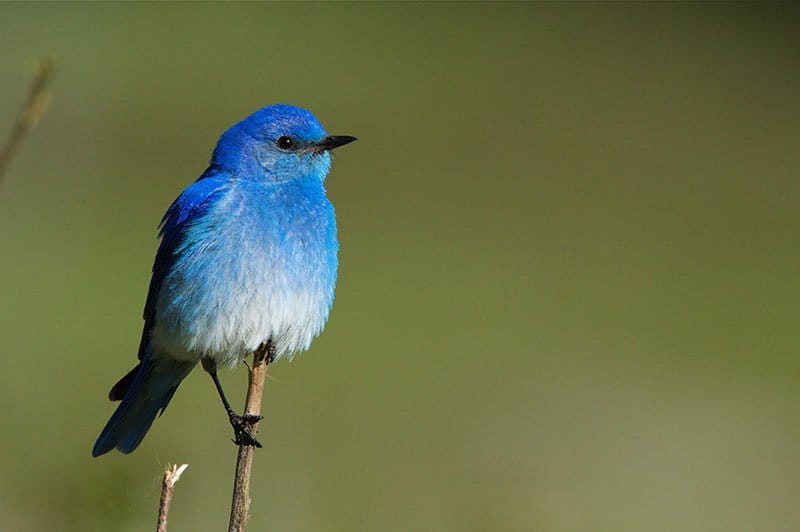
The mountain bluebird is a small thrush that can be found in open country and mountainous areas of western North America. The male has bright turquoise upperparts and lighter blue underparts with a pale lower belly. The female has grey-brown plumage with some patches of blue in the wings and tail. She sometimes has a pale orange wash on her breast.
They inhabit grasslands, prairies, and steppes where there are few trees as well as pastures and residential areas where they will nest in nest boxes. During the summer, the mountain bluebird’s diet consists mainly of insects while in the autumn and winter they eat mostly berries such as juniper and elderberry, as well as seeds

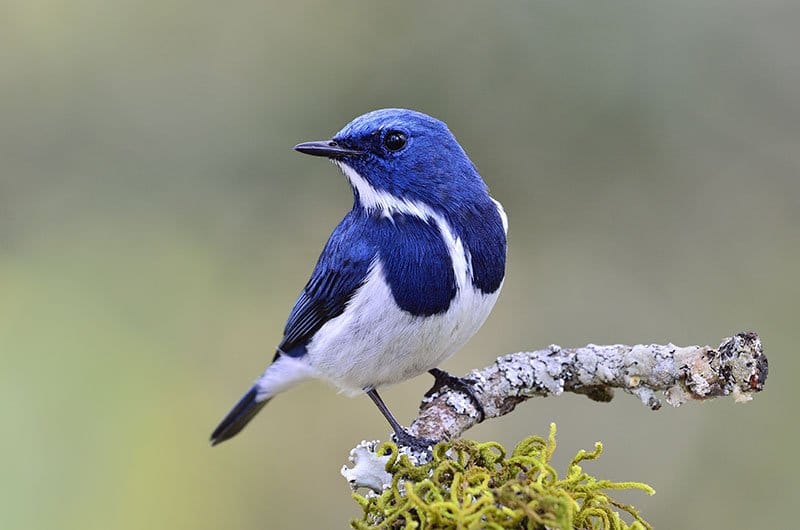
The Siberian blue robin is a songbird that was formerly classified as thrush but is now considered a member of the Old World flycatchers. It is found in Asia from Siberia to northern Mongolia, northeast China, Korea, and Japan. Larger than the European robin, the male has blue upperparts and a pure white belly with a line of black that runs from the eye to the middle of the wing. The female is brown with pale underparts and a blue wash on the rump.
It lives in the undergrowth of coniferous forests often near rivers and streams and will venture into parks and gardens. It eats small invertebrates such as beetles, ants, worms, spiders, and insect larvae, and occasionally berries and seeds.
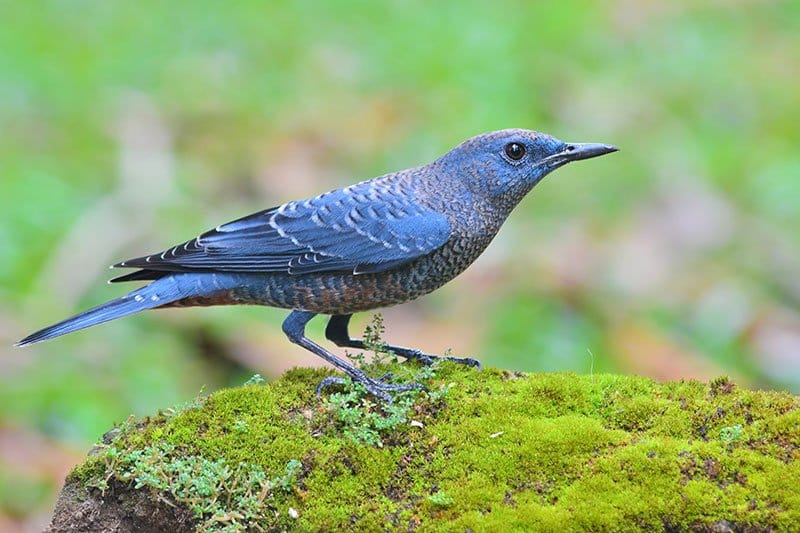
The blue rock thrush is a species of chat that is found in southern Europe, northwest Africa, and Central Asia. It is about the size of a starling with the male having blue-grey plumage with darker wings. The female is brown with darker upperparts and lighter, scaly underparts.
It lives in mountainous regions including cliffs, rocky coastlines and valleys, as well as ruined buildings, and eats a varied diet that includes insects, small reptiles, berries, and seeds.
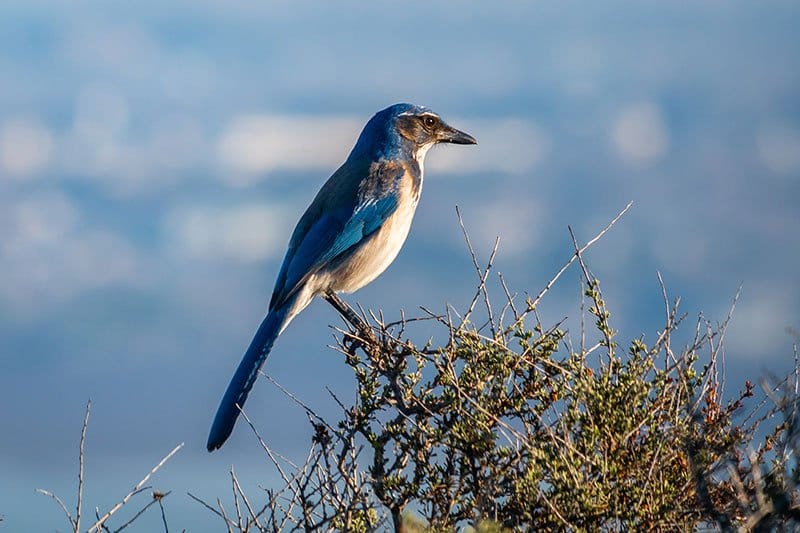
The California scrub jay is a bird native to western North America. It has a grey-brown back and grey underparts, with blue wings and tail. On the head, which is mostly blue, the throat is white with a blue necklace, and it has white eyebrows. Its generic name, Aphelocoma comes from Latinized Ancient Greek ‘apheles’ and ‘coma’, which translates as ‘no hair’, referring to the lack of striped feathers in the genus compared to other jays.
As its name suggests, it lives in areas of scrubland such as juniper forests, oak woods, mixed evergreen forests, as well as suburban gardens. It usually forages in pairs, hunting for small reptiles and amphibians, the eggs and chicks of other birds, insects, fruit, berries, grains, and nuts.
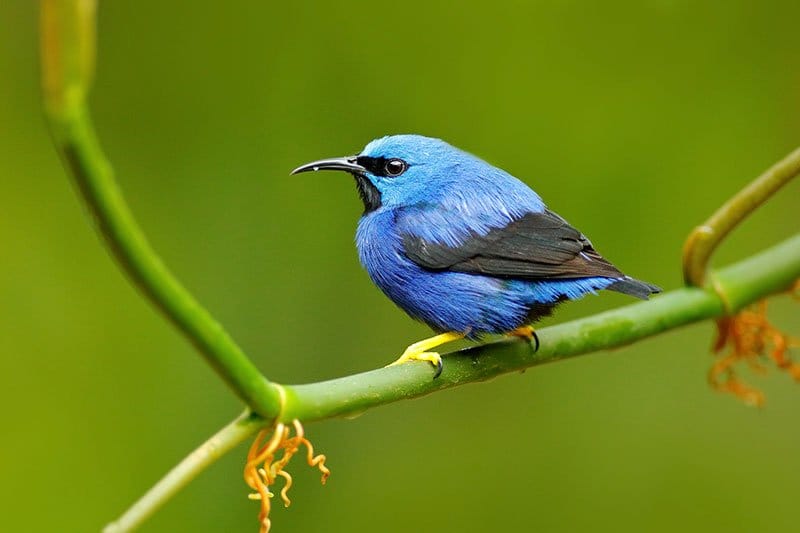
The shining honeycreeper, a member of the tanager family, the second-largest bird family in the world, inhabits the tropical forests of Central America. The male has bluey-purple plumage with black wings, tail, and throat, and bright yellow legs. In contrast, the female is predominantly green, with a greenish-blue head, buff underparts streaked with blue, and a buff-coloured throat.
It closely resembles the purple honeycreeper, which was once thought to be the same species. However, the male purple honeycreeper is darker in colour and has a smaller throat patch, while the female has no clear blue tinge on her head.
Shining honeycreepers are typically found in pairs or small family groups, foraging in the forest canopy. Their diet consists of nectar, berries, and insects.
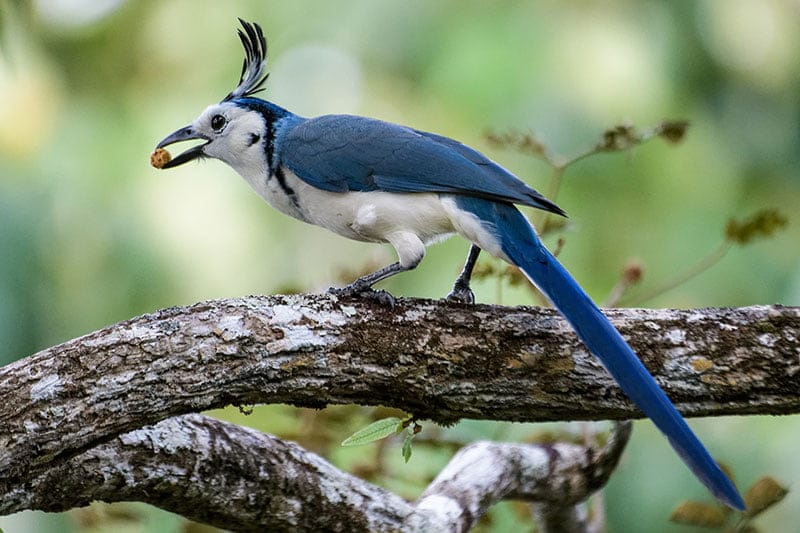
The white-throated magpie jay is a large species of magpie-jay native to the forests, woodlands, and coffee plantations of Mexico and Central America, including Costa Rica, Guatemala, El Salvador, Honduras, and Nicaragua.
It has long tail and slightly curved crest of feathers on its head. Its upperparts are blue with white-edged tail feathers, while the underparts are white. The face is white with a black crown and crest, with a narrow black band around the throat and a small black spot on the cheek. The eyes are black, the bill is grey, and the legs and feet are black. Males and females are similar in appearance, though females have duller upperparts, a narrower throat band, and a shorter tail. Three subspecies are recognised which have blue or white margins on the crest.
White-throated magpie jays are omnivorous, feeding on a wide variety of foods, including insects, caterpillars, frogs, lizards, the eggs and nestlings of other birds, as well as seeds, grains, fruit, and nectar.
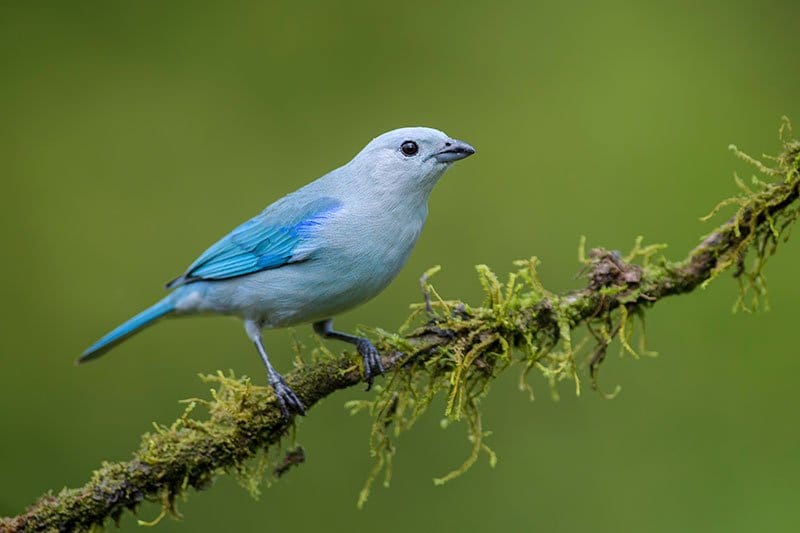
The blue-grey tanager is a medium-sized songbird found in woodlands and open areas across South America, ranging from Mexico to northeast Bolivia and northern Brazil, as well as throughout the Amazon Basin. It is also a frequent visitor to towns and gardens.
It has dark blue upperparts with a distinct shoulder patch in a contrasting shade of blue, and paler blue underparts. Its head is light blue, with beady black eyes, and a sturdy silvery-grey bill, and the legs and feet are slate-grey. There are 14 recognised subspecies, which show variations in the colour of their shoulder patches, such as turquoise, purplish-blue, lavender, or deep blue. Some subspecies also have white wingbars.
The blue-grey tanager primarily feeds on soft fruits, including bananas, papayas, tangerines, guavas, and peaches, as well as nectar, insects, and other invertebrates. These birds are typically observed in pairs, though they sometimes gather in small groups.
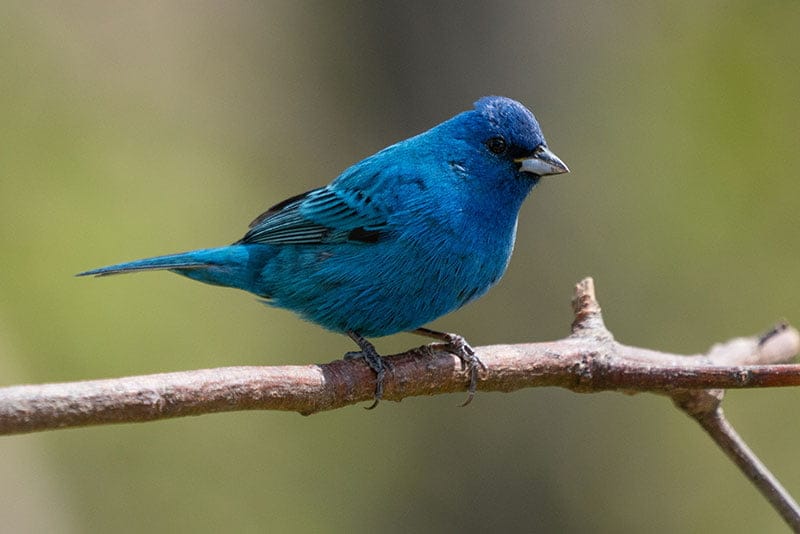
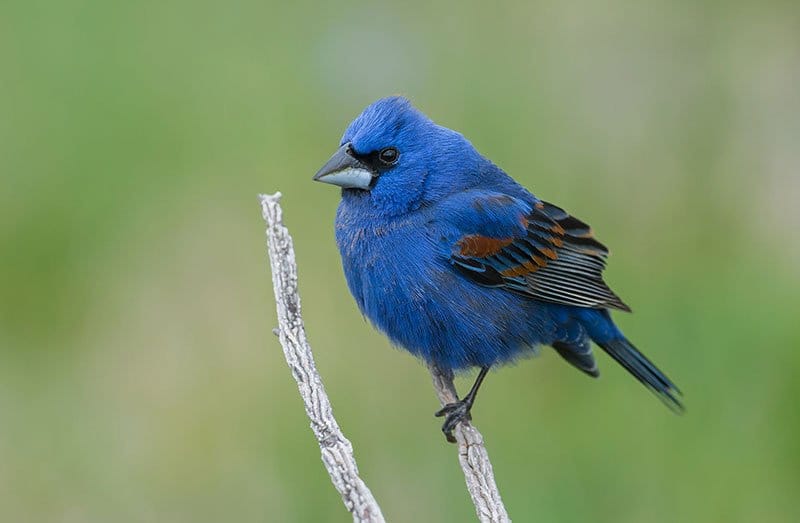
The indigo bunting is a small, stocky songbird from the cardinal family, found in woodlands, farmlands, and forest edges. It breeds in North America, ranging from southern Canada to northern Florida, and migrates to southern Florida and northern South America for the winter.
During breeding season, the male indigo bunting has brilliant blue plumage, black wings and tail with blue edges, and an indigo-coloured head. Its eyes are black, the upper part of its bill is brownish-black, the lower part is light blue, and its legs and feet are dark grey. Outside breeding season, the male’s feathers develop brown edges, creating a mottled blue and brown appearance. The female is predominantly brown, with paler underparts and faint streaks on the breast. She may have subtle hints of blue on her wings, rump, and tail. The indigo bunting is omnivorous.
During the breeding season, it feeds on a variety of grass and herb seeds, buds, berries, spiders, and insects such as caterpillars, grasshoppers, and beetles. In the winter, it switches to a diet of mainly seeds. It also frequents garden bird feeders, particularly favouring thistle and nyjer seeds.
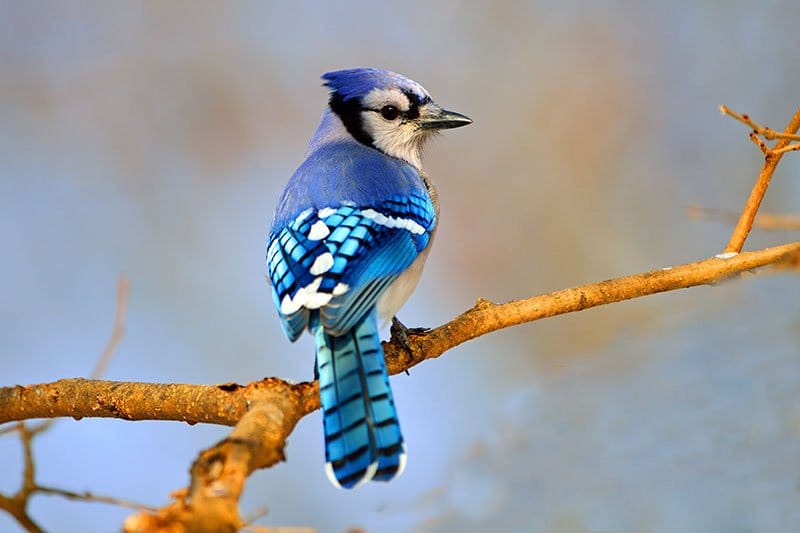
The blue jay is a medium-sized, crested corvid native to eastern North America, ranging from southern Canada through the eastern and central United States to Florida and northeastern Texas. It inhabits a variety of environments, including forests, mixed woodlands, and parks in towns and cities.
It has blue upperparts, wings, and tail with black markings and bars, along with a white wingbar. Its underparts are pale grey, and it has a black collar around its neck that extends to the sides of its head. The face is white with a black stripe through the eye, and the crest is blue. Its eyes, bill, and legs are black. While males and females appear similar, males are slightly larger. The patterns of black markings on the face vary between individuals, which may aid in recognition.
The blue jay is omnivorous, with plant matter making up about three-quarters of its diet. It consumes a variety of nuts, particularly peanuts and acorns, as well as beech mast, seeds, grains, fruits, and berries. It also feeds on small invertebrates, visits bird tables for kitchen scraps, and occasionally takes eggs and nestlings.
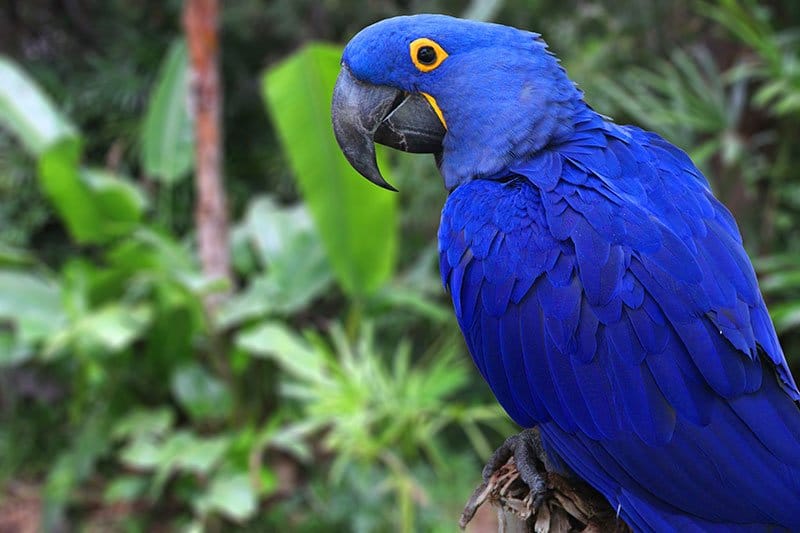
The hyacinth macaw is the largest flying species of parrot, although the flightless kākāpō of New Zealand weighs more. Native to central and eastern South America, it inhabits open woodlands, forest edges, savannah grasslands with palm trees, and swamps.
It has cobalt blue plumage, with slightly paler upperparts and occasionally greyish feathers on the neck. It has a distinctive yellow eyering surrounding its brown eyes, and a yellow, moon-shaped patch at the base of its grey bill.
The hyacinth macaw primarily feeds on palm nuts, but also consumes fruit, nectar, and seeds. Its powerful beak can crack open tough shells such as coconuts, Brazil nuts, and macadamia nuts. Inside its tongue is a bone that aids in manipulating and holding food, allowing the bird to tear into fruits, nuts, and seeds much like a human finger or thumb.
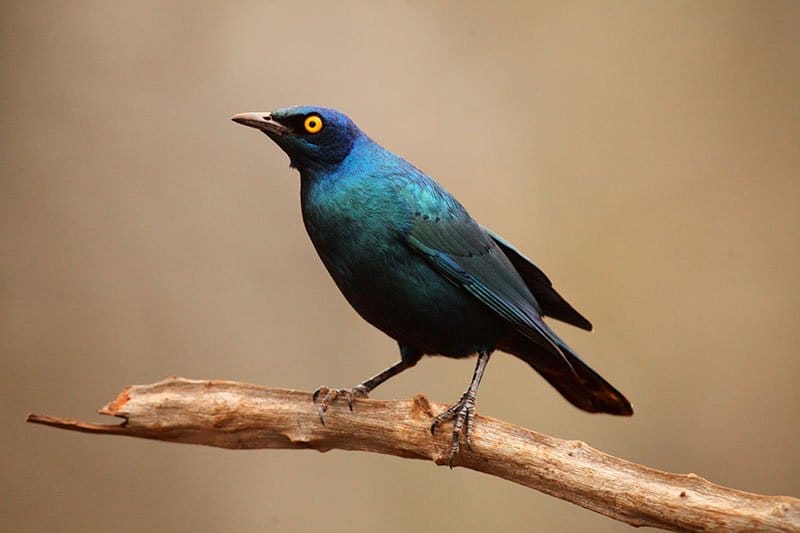
The Cape starling, also known as the Cape glossy starling or red-shouldered glossy starling, is native to southern Africa, including Zimbabwe, Botswana, Namibia, and South Africa.
It is commonly found in pairs or small flocks in open woodlands, plantations, grasslands, savannahs, parks, and gardens, anywhere with trees suitable for roosting and nesting. It has iridescent plumage with a metallic blue-green sheen, which appears purple under certain lighting. Its head is blue with darker ear coverts and bright yellow-orange eyes. Males and females look similar, though the male is slightly larger.
The Cape starling primarily feeds on fruit, insects, nectar, and small vertebrates. It also picks ectoparasites from the backs of animals and visits bird tables for scraps. It usually forages on the ground, often alongside other starling species, such as the pied starling, common starling, greater blue-eared starling, lesser blue-eared starling, wattled starling, and Burchell’s starling.
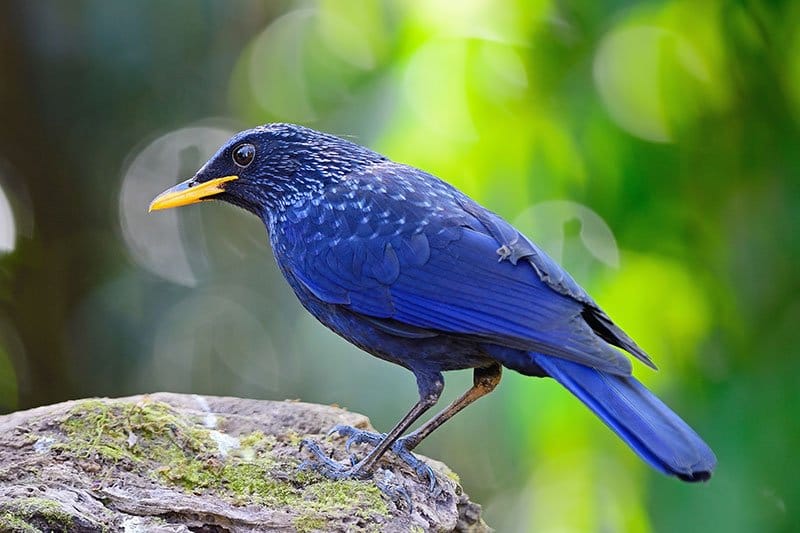
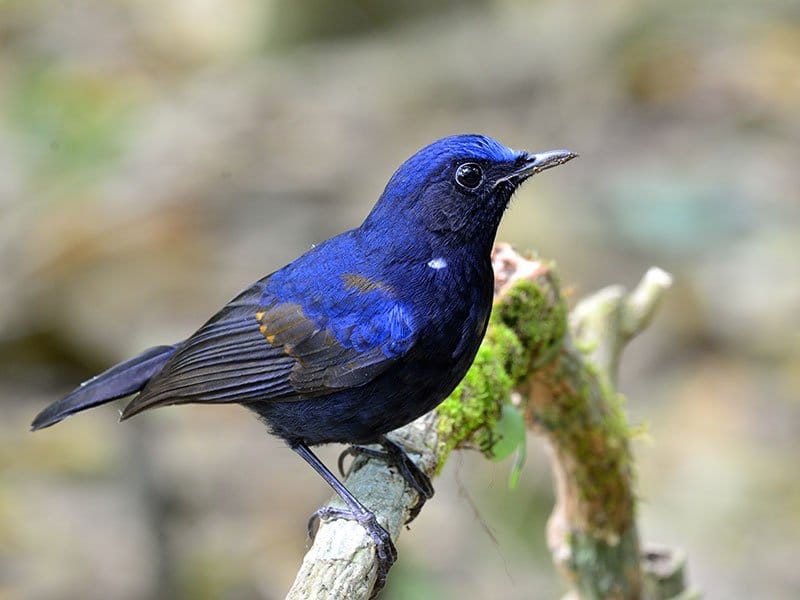
The blue whistling thrush, a member of the Old World flycatcher family, is found across Central Asia, South Asia, Southeast Asia, and China. It typically inhabits subtropical or tropical forested hills and mountains, often near streams and other bodies of water.
It has dark violet plumage with silvery spots on its head, back, and wings. Six subspecies are recognised, differing in the shape and colour of their bills. The nominate subspecies, found in central and eastern China, has a black bill, as do populations in parts of mainland Southeast Asia. In other regions, however, the bill is bright yellow.
The blue whistling thrush feeds on crabs, snails, fruit, and worms, usually foraging alone or in pairs. It uses rocks to smash open snails and crabs, allowing it to access the food inside.
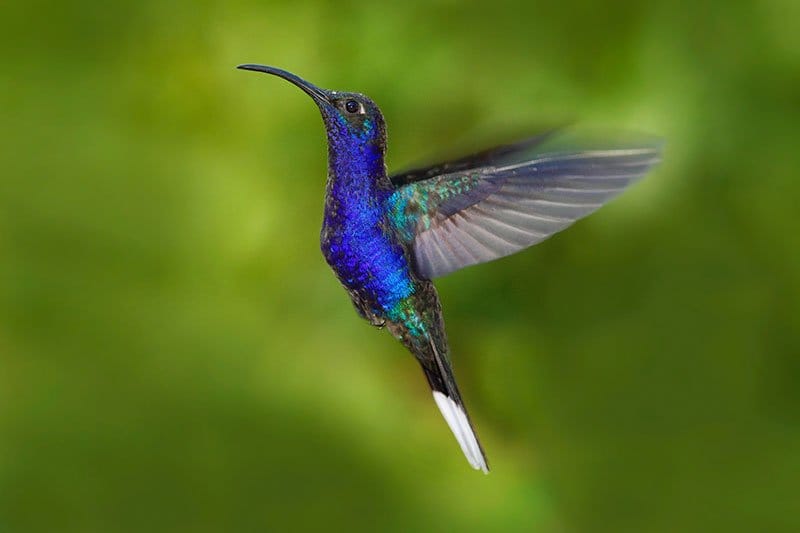
The violet sabrewing is a species of hummingbird belonging to the “emeralds” tribe. It is the largest hummingbird in Mexico and Central America, with a range that includes Guatemala, Belize, Honduras, El Salvador, Nicaragua, and Costa Rica.
The male’s upperparts hve a metallic violet-blue upper back, a metallic green lower back, and bluish-black tail feathers tipped with broad white bands. Its underparts are violet-blue, becoming bluer on the belly, and its head is also metallic violet-blue. The long black bill is curved downwards.
The female differs in appearance, with metallic green or bronze upperparts and a bluish-green rump. Her central tail feathers are bluish-green, while the others are darker with wide white tips. The underparts are grey with a white belly, metallic green spots on the flanks, and green undertail coverts. Her crown is dusky, and her throat is violet-blue.
The violet sabrewing feeds on nectar, following a pattern of visiting specific flowering plants, a behaviour known as trap-lining. It also consumes arthropods gleaned from foliage and visits sugar feeders in gardens.


2 responses
Hi!
There is a pair of slender blue headed, backed, tailed, white belly & chest with little pinkish throated birds visiting my bird feeders here in Western by Southwestern, NM at about 8,000′ above see level that I can find no reference to…….I’ve been somewhat of a birder with many “Bird Books” and have referenced all over the internet trying to ID t to no avail.
Any suggestions?
I have seen a bright blue little bird while weighting for my son at school whitch is by a small cut witch has reids, i have never seen this bird before in north west wales and im really fasinated to know why its here as its the first time ive seen this bird i have seen many birds in my life time but this bird really caught my eye, can you possibly help me identify the bird as the websites i have visited have not been able to give me an answer