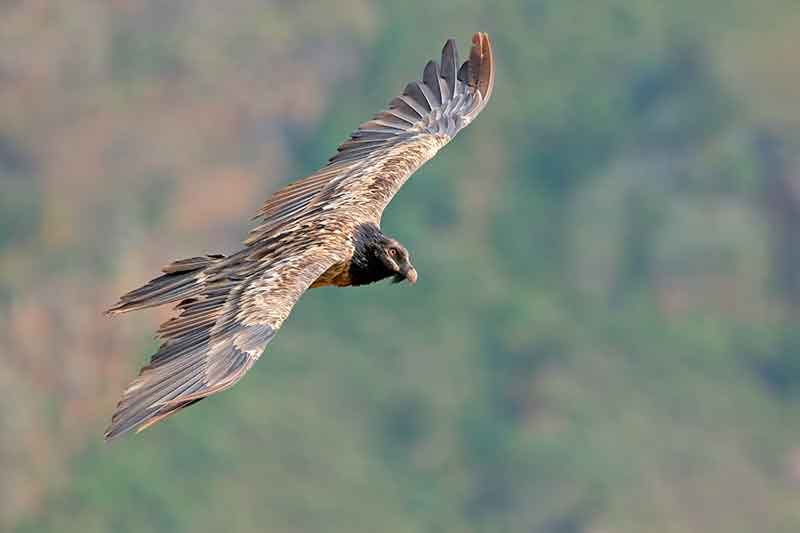
Adult bearded vultures have black wings and tails and bright rust-coloured underparts due to rubbing themselves against ferric oxide particles whilst dust-bathing, or from drinking mineral-rich water. They have relatively small heads and unlike most vultures which are bald bearded vultures have reddish or white plumage on their crowns and a distinctive black ‘beard’ of feathers underneath their bills.
It is thought that the orange colour doesn’t have any practical purpose and is merely a status symbol. Scientists have observed that the intensity of the colour directly correlates to a bird’s age and size so bearded vultures with the brightest feathers have had the time and resources to find suitable places to bathe.
Captive birds also rub their feathers to colour them which suggests the behaviour is instinctive, rather than learned.
<h2Bone breakers
The bearded vulture spotted in the UK is a juvenile approximately two years old. Younger birds look quite different from adults with paler, buff underparts, taking about 7 years to reach full adult plumage.
The missing tail feathers meant that the distinctive lozenge-shaped tail which is unusual in birds of prey was not obvious but also meant that this bird was recognisable as the same bird that had been spotted over the Channel Islands on the 20th May, The Netherlands near the German border on the 30th May, and Belgium on the 18th June.
After the first sighting in the UK it made its way north spending some time in Derbyshire and Yorkshire before arriving in the Peak District where it is making regular use of a roosting site in the north of the Peak District National Park.
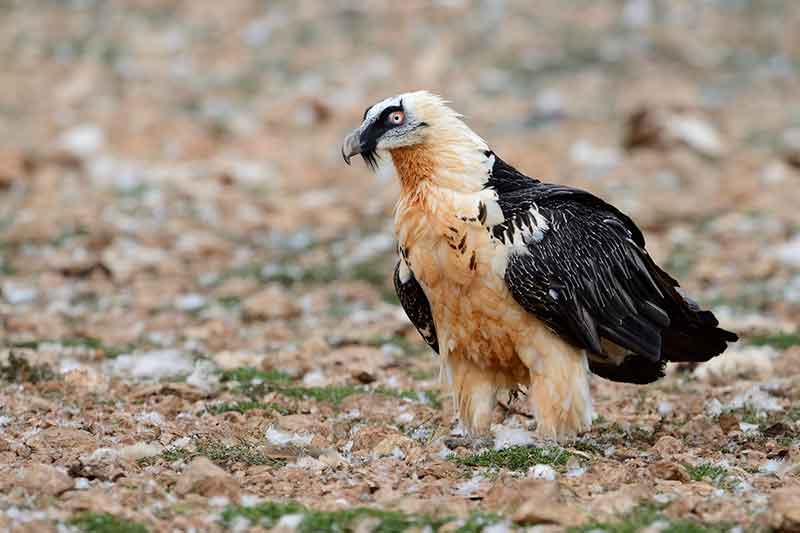
The rocky ridges and gritstone cliffs mimic its European homeland and the area has a plentiful supply of sheep carcasses on which bearded vultures prefer to feed. Lammergeier originates from a German word for ‘lamb vulture’ but despite its reputation and the fears of some local residents bearded vultures don’t often take live prey.
In fact, they tend to ignore the actual meat on a carcass and live on a diet that is about 90% bone marrow, the only species of bird known to do so. Bearded vultures have a long, narrow tongue covered in grooves which they use to scrape out the marrow from a bone. If they are unable to get at all the marrow they will bite through or swallow whole bones as large as 25 cm long and 3.5 cm wide.
To prevent damage from swallowing bones bearded vultures have an thick, elastic oesophagus which can stretch to accommodate the pieces of jagged bone. It also lacks a crop, used by most bird species to store food, where splinters of bone could get stuck, causing internal injuries.
Larger bones are carried to a height of 150 m above the ground from where they are dropped onto areas of flat rock to break them into smaller pieces. If the bones don’t shatter on the first attempt the bearded vulture will repeat the process several times. The skill requires extensive practice and can take up to 7 years to perfect. This habit gave rise to the bearded vulture’s old name ossifrage which comes from the Latin for ‘bone-breaker’.
On occasion bearded vultures have been observed trying to break bones by hammering them into rocks while perched. They will also drop tortoises from a great height to crack open their shells to get at the meat inside, and golden eagles have been observed despatching of tortoises in the same way.