

Although ornithologists are experts on the subject of birds, they’re a bit rubbish when it comes to ancient mythology.
Like many other birds of prey, the sparrowhawk is used in falconry and is popular with falconers in Ireland, Georgia, Turkey, and Tunisia. It is believed to have been the favourite bird of Akbar the Great, the Emperor of the Mughal Empire from 1556 to 1605, who kept them in his court and fed them seven sparrows twice a day. This seems a bit excessive when you consider a pair of sparrowhawks only needs about 2,200 house sparrows in a year, or 6 a day between them, to survive.
Despite this, many falconers say that the sparrowhawk is a difficult bird to train, in particular the male. In the Book of St Albans, the female sparrowhawk is listed as the priest’s bird, while the male sparrowhawk, or musket, is listed as the holy water clerk’s bird, placing them right at the bottom of the social hierarchy of raptors.
Although courageous, it is said to be hysterical, nervous, demanding, and hard to tame, and is known to become so persistent in chasing quarry that it doesn’t pay attention to its own safety. However, falconers who are able to train a sparrowhawk will find it excels at catching small prey, such as blackbirds, thrushes, starlings, and quail, and has a beautiful flight while doing so.
The sparrowhawk’s sublime hunting ability has also brought it into conflict with humans including game keepers and pigeon fanciers.
When the Game Laws were passed in 1831 to protect game birds and limit the season in which they could be legally killed, one of the requirements was that shooting estates employ gamekeepers to help protect the birds. Part of their role was to cull vermin such as foxes, magpies, and birds of prey.
At the same time advances were being made in gun technology with the addition of a second barrel and the refinement of the percussion cap firing system. The introduction of a fully functional hinged breech in the 1830s and cartridges with reliable firing pins gave birth to driven shooting was we know it today. Huge areas of the countryside were transformed as the sport increased in popularity and gamekeepers went to extreme lengths to ensure as many game birds as possible were available to be shot by paying visitors, driving some species of birds of prey almost to extinction.
At the 1870 annual meeting of the British Association for the Advancement of Science it was noted that, “The sparrowhawk is perhaps only the true enemy of the game-preserver; though at the same time it is probable that if the good and evil it does were justly weighed, the balance would be in favour of the hawk, its favourite quarry being the wood pigeon, which is now increasing to an extent injurious to agriculture.”
Female sparrowhawks can take birds up to the size of wood pigeons and an article in British Birds published in the 1930s confirms that wood pigeons were one of the most frequently taken birds.
When thousands of gamekeepers were conscripted for the First and Second World Wars, birds of prey had some respite from persecution and the numbers of sparrowhawks increased significantly. However, gamekeepers do still occasionally kill sparrowhawks and there have been several successful prosecutions in recent years.
Some racing pigeon owners are also concerned about the impact sparrowhawks have on their hobby. Sparrowhawks not only kill pigeons but also cause injury and disruption to pigeon flocks.
However, studies have shown that the numbers of pigeons lost to sparrowhawks and other birds of prey are small (14% of losses) when compared to other causes such as straying and exhaustion (36%), and collision with buildings or overhead wires (34%). Of the pigeons taken by birds of prey many of them had already strayed from the loft and become feral by the time they were killed.
Slips from the eye-corner – overtaking
Your first thought.
Through your mulling gaze over haphazard earth
The sun’s cooled carbon wing
Whets the eyebeam.
Those eyes in their helmet
Still wired direct
To the nuclear core – they alone
Laser the lark-shaped hole
In the lark’s song.
We find the earth-tied spurs, among soft ashes.
And maybe we find him
Materialised by twilight and dew,
Still as a listener –
The warrior
Blue shoulder-cloak wrapped about him,
Leaning, hunched,
Among the oaks of the harp.
As for the impact sparrowhawks have on songbirds, it is now generally accepted that the effects are minimal and that sparrowhawks will tend to move into areas where there is a surplus of songbirds, and keep the population stable. You can find out more about that here.
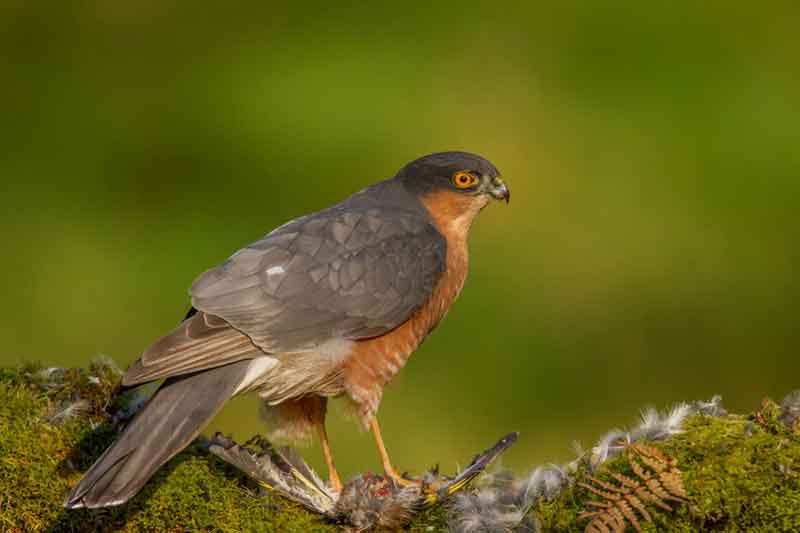
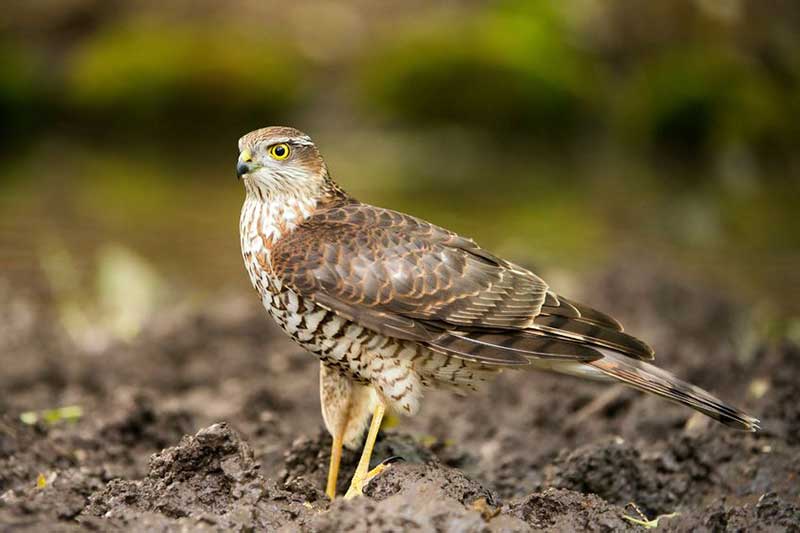
The sparrowhawk is one of the most incredible British birds that has adapted perfectly to its environment. It has evolved a long tail for tight steering, rounded wings for manoeuvring through forests, keen eyes under ridged brows for aerodynamic flight, and strong legs and powerful talons that allow it to snatch its prey in a matter of seconds.
A straw poll on our social media channels showed that the vast majority of people are more than happy to welcome sparrowhawks into their gardens, and although they will get upset if they see one take a much-loved garden bird, understand this beautiful bird of prey’s place in the food chain. In fact, the only creatures that definitely aren’t welcome are wasps. We’re inclined to agree – after all a wasps’ nest in your Christmas tree would be an even worse surprise than whatever hornets’ nest UKGov are about to unleash on us.

3 Responses
Just had one of these magnificent birds in my tiny garden, he comes for the songbirds and is rarely successful but I can often tell when he’s here as the sparrows operate a great (and very noisy!) alarm system. Have had a female too, who bagged herself a pigeon and neatly stripped out the breast meat leaving me to dispose of the rest. Fascinating article, thank you.
Bit out of date now with a reference to a potential Christmas lockdown.
Check the date ya muppet. Do you go commenting on all newspapers telling them there articles are out of date!!