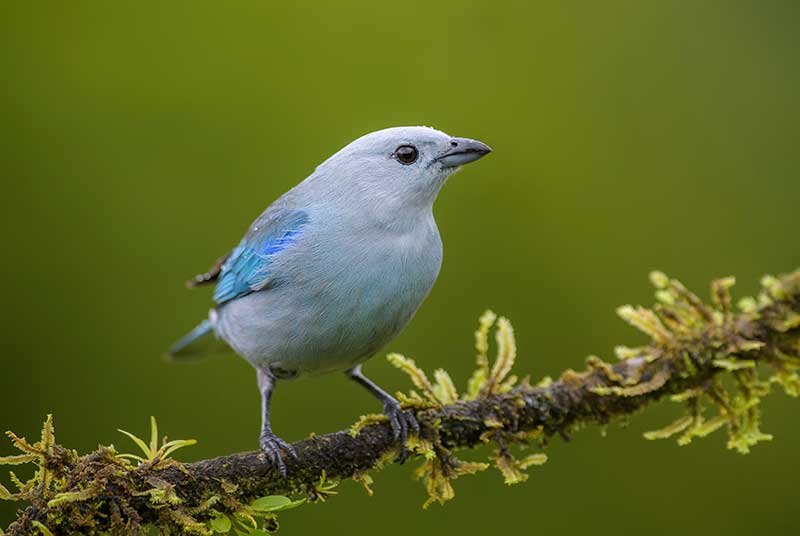
The resplendent quetzal is the national bird of Guatemala, but one of the best and most beautiful places to see them is in the cloud forest of Costa Rica. A bird watching holiday to this part of the world will reward you with the opportunity to spot unique wildlife in lush rainforests, jungle waterways and stunning white sandy beaches.
The Monteverde Cloud Forest Biological Reserve is considered the most well known cloud forest in the world with a rich variety of biodiversity. The cloud forest houses 2.5% of the world’s species, including 755 species of trees and 500 species of orchids including 34 that were discovered in the reserve as new to science.
A 5 hour drive away is Manuel Antonio National Park, home to the magnificent frigatebird as well as toucans, tanagers and brown pelicans, while to the north is Arenal Volcano National Park, one of the most majestic volcanoes in Costa Rica and popular with birders and wildlife watchers because of its interesting flora and fauna.

One of the highlights of any bird watching holiday to the Costa Rica cloud forest is the chance to catch a glimpse of the rare and beautiful jewel-toned resplendent quetzal, and tour guides will be keen to point them out. Their feathers shimmer in sunlight showing patches of red, gold and silver and they have green iridescent tail feathers that are 3 feet long. Quetzals were considered sacred by the ancient Aztecs and Mayans and there are many myths and legends associated with this spectacular bird.
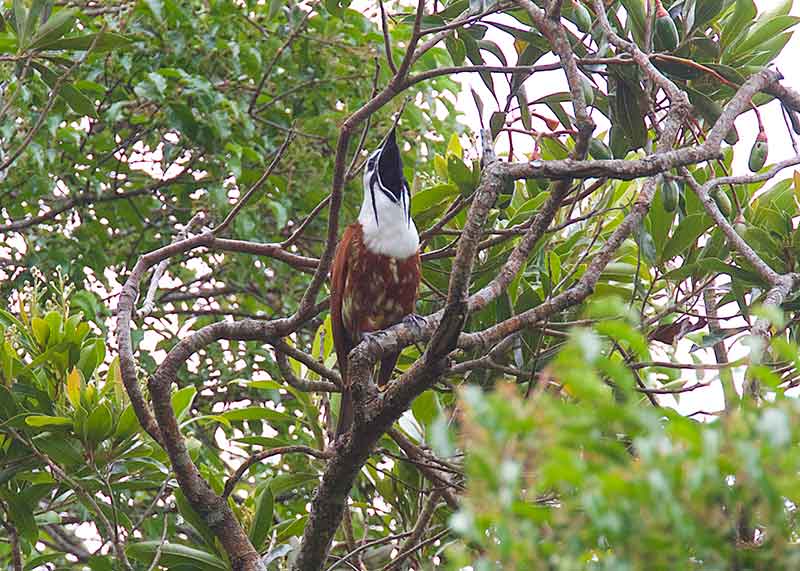
The three-wattled bellbird is a rare bird whose conservation status is listed as ‘vulnerable’. Male birds are chestnut brown and white while females are duller in appearance. It gets its name from the 3 wattles that hang from the base of its bill. The wattles look a bit like worms and can extend up to 10 cm, although they remain flaccid when extended and they are not controlled by muscles. Three-wattled bellbirds are secretive and can be hard to spot, but they can be identified by their distinctive song; a bell-like call which gives the bird its name.
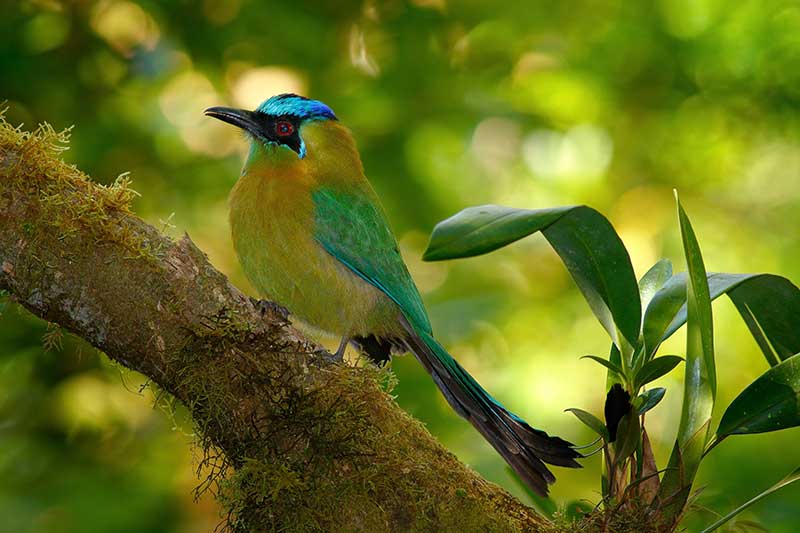
Of the 6 species of motmot living in Costa Rica, the blue-crowned motmot is the most common. It has colourful turquoise, green and yellow plumage and a black crown with a bright blue border. Like many motmots, blue-crowned motmots have two long tail feathers that they swing in a pendulum-like motion which has earned them the nickname ‘clock birds’. Motmots can be found in trees near the forest floor, usually under 10 feet of the ground and can be identified by their low, husky call.
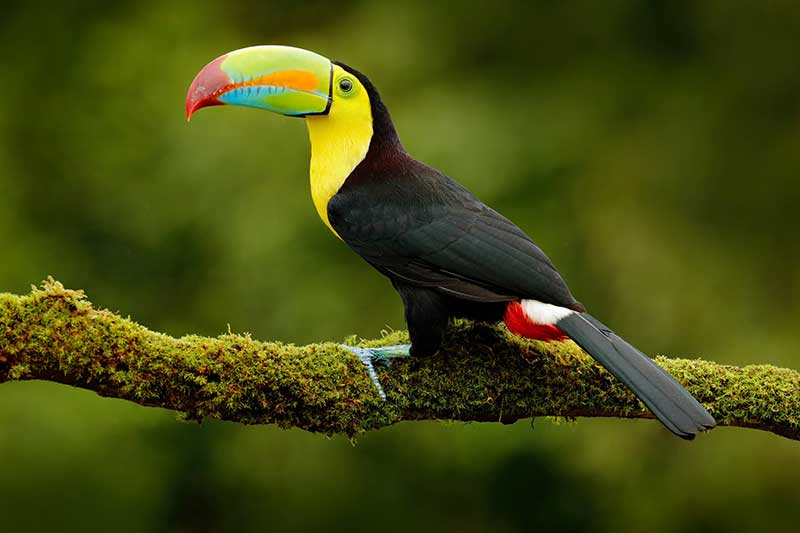
The keel-billed toucan can be seen throughout Costa Rica. It inhabits lowland and mid-elevation forests and is commonly spotted in the Monteverde Cloud Forest. Also, known as the rainbow toucan, the keel-billed toucan has yellow and black plumage with a multi-coloured bill with a scarlet tip. Like most toucans, keel-billed toucans are social birds and rarely found alone. Look up to see flocks of up to 15 birds, shrieking as they fly overhead. You may also see them flinging fruit at each other in pretend fights.

The scintillant hummingbird is the smallest Costa Rican hummer weighing just 2 grams and measuring 6-8 cm. It is only slightly larger than the world’s smallest bird, the bee hummingbird. The male has bronze-green upperparts, a rust and black-striped tail and a bright red-orange throat. Females are similar but her throat is pale with green spots. Despite its small size, the scintillant hummingbird is difficult to miss and the hum of its wings can be heard from some distance. They are found on the edge of forests, in coffee plantations and will occasionally venture into gardens.