Breeding birds: 2,400,000 territories
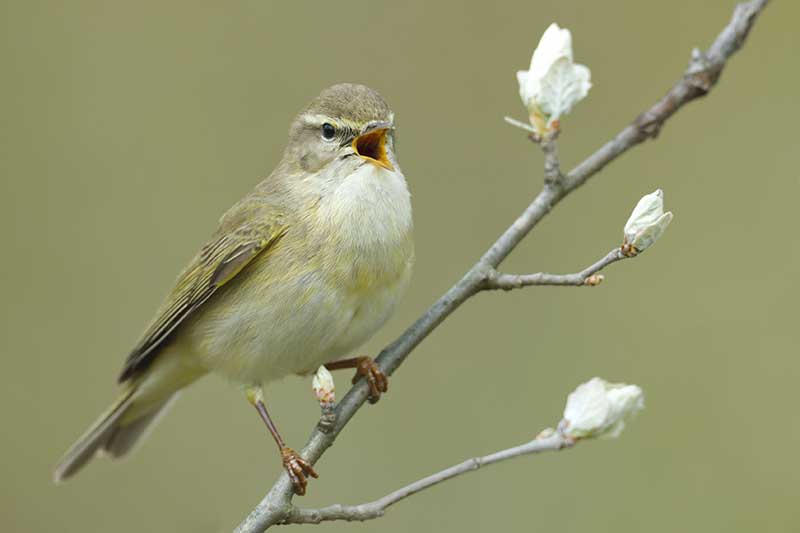
Willow warblers look very similar to chiffchaffs but can be identified by their different song and call. They are more slender than chiffchaffs and their bills are longer and more pointed.
Adult willow warblers have olive green upperparts and brighter flight feathers with greenish-yellow edges. Their underparts are pale yellow and their throats and breasts are streaked with yellow.
Willow warblers have olive-green crowns and a narrow cream stripe (supercilium) that extends from the base of the bill to above the ear coverts. They have dark eye stripes of a similar length. Willow warblers have dark brown bills and eyes, and pale brown or pink legs and feet.
Juvenile willow warblers have pale yellow superciliums and pale yellow on the upperparts, their chins are paler and the breast is pale buff.
Try our interactive bird identifier
Male willow warblers collect materials for the nest which the female builds. It is positioned on or near the ground hidden in vegetation. The nest is ball-shaped constructed from dry grass, leaves, roots, moss, animal hair and feathers.
Willow warblers lay 4-8 smooth, glossy, white eggs that are marked with reddish-brown speckles. The eggs are incubated for 12-14 days after which the chicks are fed by the female. They fledge 11-15 days after hatching and are independent 12-16 days after leaving the nest.
Willow warblers eat a variety of insects, their eggs and larvae, spiders and small snails. They will also eat fruit and berries in autumn.
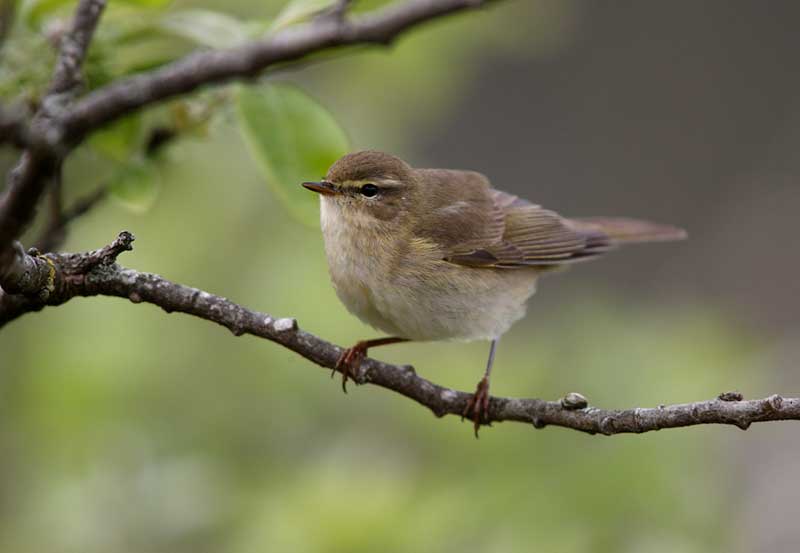
Willow warblers arrive in the UK in April and leave in September. They can be found all over the country in woodland, farmbland, scrubs, heathland, parks and gardens.
Britain's Birds
RSPB Handbook Of British Birds
Collins Bird Guide
Unusually for birds, willow warblers moult their feathers twice a year, once at their breeding grounds and again at their wintering grounds.