Despite its name, the great spotted woodpecker is not that big at only about the size of a starling. It has stiff tail feathers which it uses as a prop when hopping up trees and to assist with grip, and a long, sticky tongue for extracting insects and larvae from crevices in trees. The characteristic drumming noise is a good identification feature and is used, like a bird’s song, to claim territory.
Breeding pairs: 140,000
Family: Woodpeckers
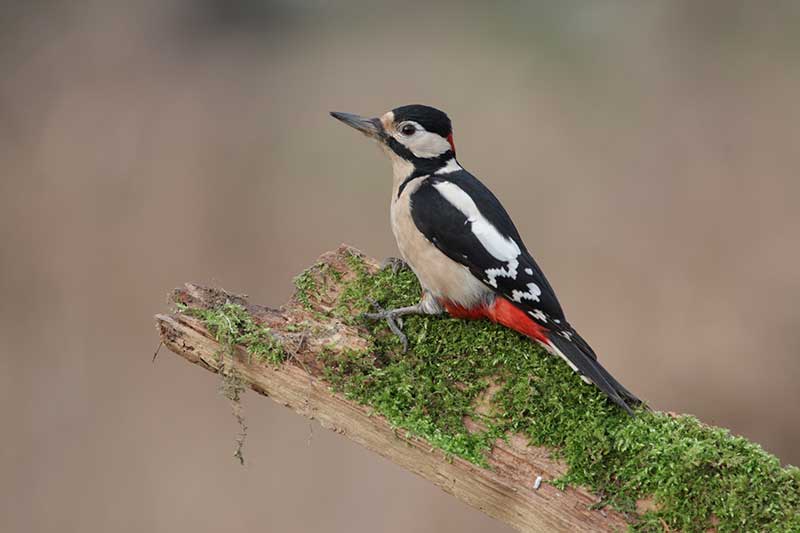
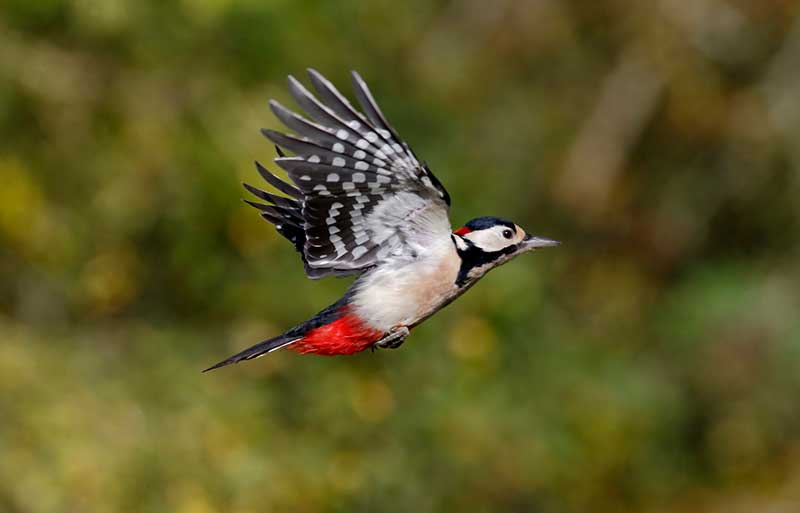
Male great spotted woodpeckers have black upperparts with white patches on the wings and white edges on the primaries. The tail is black with white spots on the outer feathers.
The underparts are white with a broad black collar on the upper breast and a red vent.
On the head, the crown is black, the forehead is pale buff, and the cheeks, throat, and sides of the nape are white. There is a red patch on the back of the nape and a black moustache which extends to the nape and down to the chest. The strong, pointed bill is black, the eyes are dark with a fine white stripe surround, and the legs and feet are grey. The feet are zygodactylous and have two toes pointing forwards and two toes pointing backwards.
Female great spotted woodpeckers are similar but lack the red patch on the back of the nape.
Juveniles are duller and browner with blotchy patches on the wings. Both sexes have some red on the crown.
Try our interactive bird identifier
Great spotted woodpeckers start breeding in mid-April and produce 1 brood a season. They are monogamous and nest in old trees in forests, parks, and gardens, using a new site each year. Both male and female excavate a hole with their bill and line it with wood chips.
Great spotted woodpeckers lay 4-7 glossy white eggs which are incubated for 12-16 days by the female during the day and the male at night. Chicks are altricial and are fed by both parents. They fledge at 18-21 days after hatching but are dependent on their parents for another week, and are sexually mature at 1 year.
During breeding season great spotted woodpeckers feed mainly in trees probing for insects, ants, and beetles. Over winter they will also eat tree sap, nuts, berries, and seeds. In spring they will take the eggs and young of other birds from their nests.
They will often visit gardens eating peanuts, sunflower seeds, and suet from bird tables and feeders.
Great spotted woodpeckers can be found all over the UK except for the very far north of Scotland, and have recently been reintroduced to Ireland.
They can be found in forests and woodlands with mature trees, in particular oak and horn bean trees, as well as parks and gardens. They can also be spotted in cities wherever there are tall trees.
Britain's Birds
RSPB Handbook Of British Birds
Collins Bird Guide
Great spotted woodpeckers will strike a tree with their bill over 40 times a second to create their distinctive drumming sound.