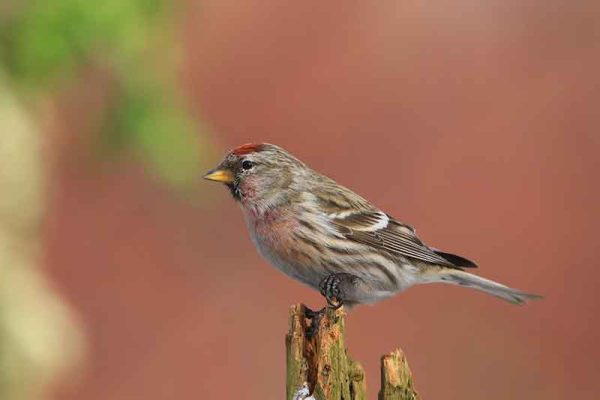
Breeding birds: 2,000-15,000 pairs
Family: Pheasants, Grouse, And Allies
Adult male ptarmigans in winter are almost entirely white except for black lores and bright red eye combs. They have a black triangular patch on each side of their tails which shows in flight. Their bills and eyes are black, and their legs and feet are covered with white feathers.
Female ptarmigans are similar but lack the red eye combs.
In spring when the snow beings to melt, ptarmigans developed mottled brown and grey spots on their plumage so they can blend into the background.
During the summer male ptarmigans have grey heads, upperparts, throats, necks, and breasts. Their chins and the underparts are white as are their legs and feet. Their red eye combs get larger.
Female ptarmigans in summer have pale buff plumage with black spots on their upperparts, and white bellies with black spots and streaks on the lower flanks. They have a narrow red eye comb.
In the autumn both sexes become greyer on their heads and upperparts with white bellies and legs.
Juvenile ptarmigans are similar to females with brown tail patches and dark brown eyes.
Try our interactive bird identifier
Ptarmigans breed in June. Their nest is a shallow depression in the ground close to a shrub or a large stone, and lined with grass, twigs, leaves, and feathers.
Ptarmigans lay 5-8 creamy eggs spotted with dark brown which are incubated by the female for 21-24 days. Chicks are able to walk at 1 day old, fly at 10 days and are independent 3 months later. They reach sexual maturity at 1 year.
Ptarmigans eat mostly plant matter such as buds, twigs, leaves, flowers, and berries. Chicks will also feed on insects.

Ptarmigans can be found all year round on the highest mountains of the highlands of Scotland.
Britain's Birds
RSPB Handbook Of British Birds
Collins Bird Guide
The thick feathers on a ptarmigan’s feet act as snowshoes so they can walk on top of very soft snow. Their leg feathers help protect them from the cold.