


Breeding birds: 0-4 pairs
UK wintering: 81 birds
Family: Ibises And Spoonbills
Adult male spoonbills in breeding plumage have a white body, wings, tail, and head. There is a yellow collar around the neck and the top of the breast and an orange-yellow patch around the base of the bill. The chin and throat are bare and bright orange and a pale yellow conspicuous crest on the head.
Spoonbills have a long, black, spatula-shaped bill with an orange-yellow tip. The eyes are red, and the legs and feet are black.
Out of breeding season spoonbills have less orange skin on the chin and throat, the yellow on the neck and breast is reduced and the crest is absent. The bill becomes duller with a yellower tip.
Male and female are similar but the female is slightly smaller.
Juvenile spoonbills resemble adults in non-breeding plumage but the lores and bill are pink and the primaries have black tips.
Try our interactive bird identifier
Spoonbills start breeding in April in small colonies. Both male and female build the nest with the male collecting material that he brings to the female. The nest is a platform made from sticks, twigs, reeds, and grass stems lined with finer grass and leaves. It is placed on the ground on islands in lakes or rivers, or in a tree or a bush about 5 metres above the ground.
Spoonbills lay 3-4 white eggs with reddish-brown splodges and speckles which are incubated by both adults for 24-25 days. Chicks are covered with white down and have a soft, fleshy bill that begins to flatten at 9 days and develops into the spatula bill by 2 weeks.
They fledge 45-50 days after hatching and are sexually mature at 3-4 years old.
Spoonbills eat aquatic insects, dragonflies, locusts, worms, crustaceans, molluscs, frogs, tadpoles, small fish, and algae. It forages in groups, walking slowly through shallow water and sweeping its bill from side to side to dredge and filter out the food.
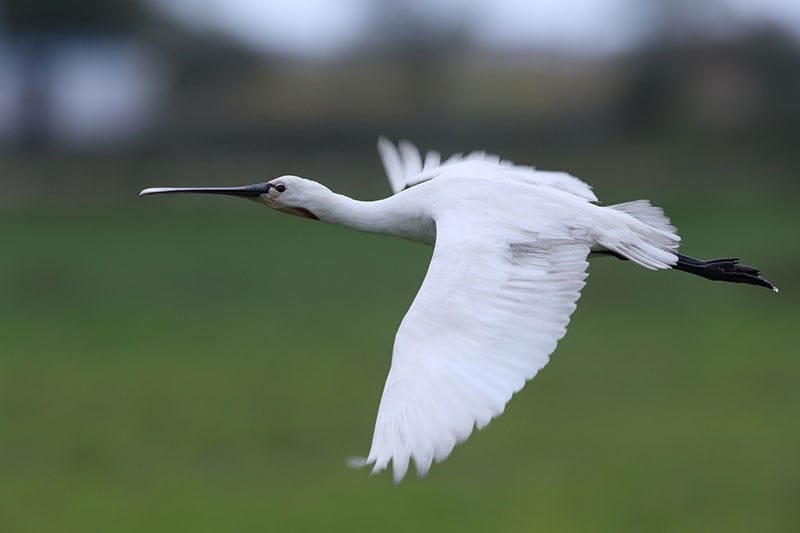
Spoonbills are still rare in the UK. They can be seen all year round on coastal sites in the north-west, south-west, and east of England.
Britain's Birds
RSPB Handbook Of British Birds
Collins Bird Guide
Spoonbills were a common sight in Britain in medieval times. They were classified as a gamebird and would often feature in royal banquets.


