

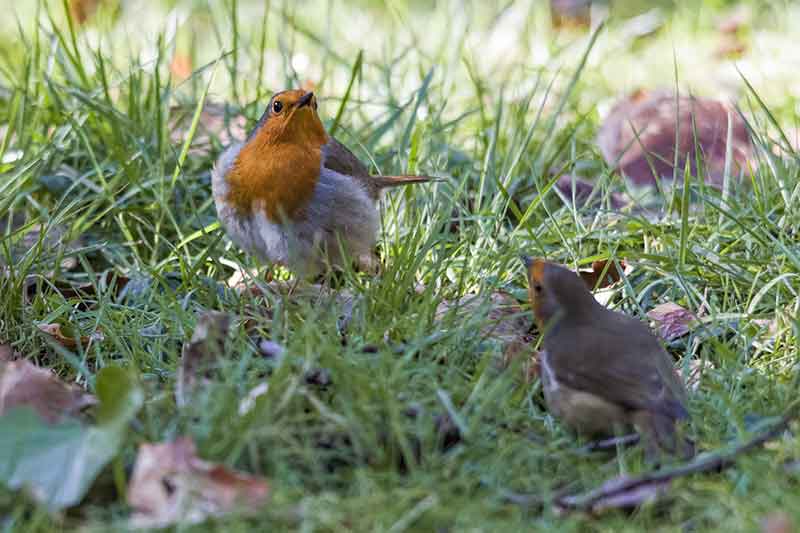
Robins are one of Britain’s favourite birds, yet their sweet, friendly nature belies a sinister undertone. For these little redbreasts are highly territorial and aggressive with it.
Robins are one of the few species of UK birds that defend a territory all year round. In autumn when robins are controlling territories for food the size varies between 650 and 5,000 square metres. In spring males defend a much larger territory for breeding purposes; anything from 1,600 to 8,500 square metres. The exact size depends on the quality of the habitat and how many birds there are in the area. For example, in high pinewoods where there are few trees and shrubs densities can be as low as just 10 pairs per square kilometre. Low woodland where there are more trees can support up to 300 pairs per square kilometre.
Like all birds, robins need a good supply of food to see them through the winter months so controlling a territory is essential for survival. Song is an integral part of territorial defence and robins are one of the few birds to sing throughout autumn and winter to warn intruders of their presence. Both male and robins sing to defend their territories although the male’s song is more complex.
If the song is not enough to stop a rival bird entering its territory and the robin perceives it to be a threat, it will go on the attack not only against other robins but also against other species of birds that have similar diets such as dunnocks and tits. They have also been observed attacking small birds without apparent provocation, will even attack their own reflection as well as stuffed robins, red feathers, and even dead robins.
In spring the male robin’s song changes becoming bolder and brighter indicating that the song is used to also attract a mate. Male robins will become even more aggressive during this period as their levels of testosterone increase. A dispute usually starts with two or more male robins singing at each other, and they will search for a perch that shows off their red breast most effectively. For one of the things we find most endearing about robins is actually a threat colour, and another tactic they use to see off territorial intruders.
If this posturing doesn’t cause one of the robins to back down, then they will challenge each other to a fight. Much of the fighting is for show only but sometimes it gets much more serious with a robin lashing out with its claws and pecking at its rival’s neck in an attempt to sever the spinal cord. An estimated 10% of all adult male robin deaths and 3% of female deaths are caused by other robins attacking them.
Female robins also have red breasts for the same reason males do; it is not a secondary sexual characteristic but a trigger for territorial aggression. Robins have evolved to only develop a red breast a few weeks after they have hatched. This protects juveniles from attack by adult robins including their own parents. As a male robin gets older his red breast gets slightly larger showing rivals that he has honed his survival skills well and an indication to stay well away.
A University of Southampton study found that artificial light and noise appears to have an impact on robins’ levels of aggression. Using a fake robin and recorded robin song the researchers tested how aggressively a population of robins in a city park defended their territory.
Robins that lived closed to well-lit paths and noisy roads were much less aggressive towards the fake robin than those that lived in quieter darker areas.




10 responses
That was quite the journey, are they UKs birds or from Britain ??
In the 8 years we have lived in our pine wood in Catalonia, we seem to have successive generations of robin. It normally follows the same pattern: a robin that becomes more and more tame, eventually eating out of our hand. It mates (we see it feeding the female), nests, then dissapears. It is then is replaced by 2 robins (we assume siblings) who fight for territory, one wins, then the pattern begins again. This year, we still have our current tame robin but it’s fighting with a baby robin. Neither wants to give way. Should we stop feeding our tame robin?
I have 3 robins one of them interacts with me all the time,it stands at my feet and looks up at me and sometimes almost catches me when it flys past. He’s very friendly and sits watching when I garden obviously waiting for me to unearth worms. I fed them through out the winter. I always talk to him.
I have a Robin that visits at the same time everyday. It has just appeared the past couple of months. My mother passed away and this is a great comfort to me. I have been leaving breadcrumbs but wanted to ask what else I could leave for it and should I put up a bird house and what about water ?
Raisons and pieces of apple…even frozen blueberries they will eat. Im sorry for your loss, you will feel her presence in nature. Stay well x
Oh…and worms from the pet store!! 🙂
What a lovely thing to say.
Definitely all year round offer a supply of fresh water, a shallow flat-bottomed bowl is adequate, I ALWAYS feed my Robins with dried mealworm (All Robin’s fave food!) But as far as a birdhouse Robin’s are renowned for notvusing them……I would still put one up if you can, who knows who will eventually nest in there?!
In my garden I have 3 robins. They are definitley not baby robins so do you think it’s two males and a female or two females and a male. Seems strange that they are altogether but I have seen them all through the Spring although they don’t seem to be around any more
It’s funny you say this as we’ve had about three robins before who sometimes visited around the same times for the live mealworms. This was in winter, and I think one was a paired couple perhaps. I’m thinking that, with the massive loss of habitat going on around the country (and *cough*HS2*cough*), it’s making it that robins are crossing paths more. Add to this what I think will have been an increase in successful births last year and this year due to Covid creating leas disturbances and an increase in people working from home and feeding the birds… There just seems to be more around lately.
In my garden, we currently have a regular baby robin visitor that our live mealworms had contributed to making, haha! One of his parents deposited him/her here and it stayed. 🙂
But we also have an adult that dive-bombs into the garden to grab the worms in a place it would only have known about if it was one of the parents! They both fight, so they are currently learning to visit at different times. The baby one will always visit around 8pm for his worms, like clockwork. No idea how it knows. (It’s not like they have watches!)