|
|
Do Birds Have Ears?

Do Birds Have Ears?

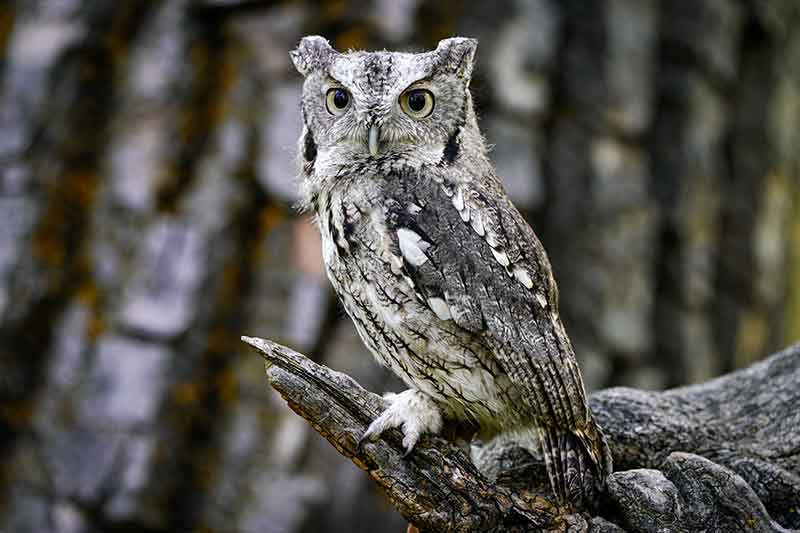
Western Screech Owl

Yes, birds do have ears!

In fact, most birds have an excellent sense of hearing and can hear a much wider range of sounds than humans. However, they have no outer ear structure like an ear lobe or external pinnae and in most species the entrance to the ear is covered in a circle of soft loose-webbed feathers which overlap the ear known as the auricular or ear coverts.

What is the structure of the avian ear?

Birds have ears that are very similar to lizards. They are usually located just behind and slightly below the eye and each earhole can be as big as the eye. The ear coverts help protect the ear from the noise of the wind as the bird flies and keep out dust and water, but because they have no barbs, they don’t obstruct any sound entering the ear.

Just like humans, birds have three parts to their ears; the outer ear, the middle ear, and the inner ear.

The outer ear channels air onto the eardrum, or tympanic membrane, and consists of a short passage, called the meatus. Most birds have a muscle in the skin around the meatus that can partially or completely close the opening.
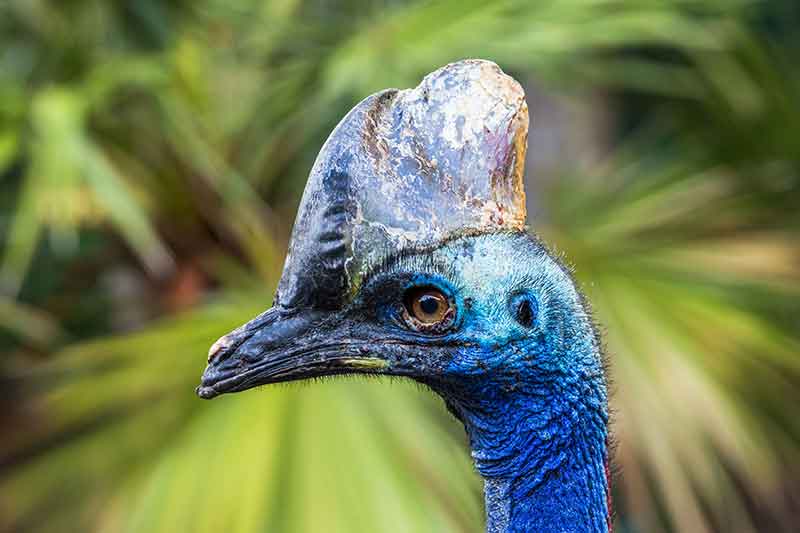
Cassowary Ear

The middle ear sends the vibrations from the eardrum via an ossicular chain to the columella bone and the cochlea in the inner ear where they are carried by nerve receptors to the brain and interpreted as sound.

The cochlea of birds is like that found in crocodiles. It is a short, slightly curved bony tube measuring between 2.5 and 4.5 mm in most birds but up to 10 mm in owls.

How well can birds hear?

Despite not having a complex ear structure birds have well-developed hearing and it is the second most important sense after vision. They need good hearing to be able communicate with each other with songs and calls, and many species also rely on sound for hunting prey, and warnings of danger.

Some birds, such as flamingos and penguins, have such acute hearing that they are able to identify members of their family from their calls, even when they are among thousands of other individuals in a noisy flock.

Your next read

How Do Owls See In The Dark?
Do Birds Have A Sense Of Smell?
Do Birds Have Teeth?
Do Birds Blink?

Birds have a full hearing range from about 100 Hz to 14 kHz, which is slightly narrower than humans who can hear as low as 20 Hz and as high as 20 kHz depending on age, but it is most sensitive from 1 kHz to 4 KHz.

No species of birds have been shown to hear ultrasonic sounds above 20 kHz and although sensitivity to infrasound or frequencies below 20 Hz has not been studied much, some species such as pigeons, appear to show behavioural and physiological responses to very low frequencies.

It has been suggested that birds may migrate and navigate long distances using infrasound as a cue. In 1997 nearly a third of a flock of 60,000 homing pigeons were lost during a race across the English Channel when their flight path crossed that of Concorde. It is thought that the supersonic jet generated a sonic boom which prevented the birds from hearing the low frequency sounds needed to find their way home.

Evidence also suggests that birds can hear infrasound to predict storms, volcanos, and earthquakes, which causes them to change their behaviour to escape from bad weather and other natural disasters.

And some birds, notably the nocturnal oilbird and some species of swiftlets, use echolocation, a technique to determine the location of objects using reflected sounds, just as bats, dolphins, and whales do. These birds live and hunt in dark caves and use sharp, audible clicks and rapid chirps to help them navigate in low levels of light and find insects to eat.

Part of the function of a human’s external ear is to help us identify sounds coming from different elevations. But because birds don’t have external ears, for a long time it was thought that birds were unable to determine where sound was coming from.

However, a study conducted in 2014 by a team from a university in Germany found that birds are also able to tell whether the source of a sound is above or below them, or at the same level, and they do this due to the shape of their heads.

Depending on where sound waves hit a bird’s head they are reflected, absorbed, or diffracted. The head screens out sounds coming from certain directions while other sound waves pass through the head and trigger a response in the opposite ear.

The bird’s brain is then able to identify whether a sound is coming from above or below from the different volumes of sound in each ear. It is a highly accurate system and they can identify lateral sounds at an angle of elevation from -30° to +30°.

The phenomenon is most obvious in owls who have the most sensitive hearing of all birds. They have concave shaped facial discs that direct sound to their ears and they can alter the shape of the disc with muscles in their face. Because an owl’s bill points downwards this increases the surface area over which sound waves are collected.

Some species of nocturnal owl, such as the barn owl, have ear openings that sit unevenly on either side of their head. This helps them pinpoint even more accurately where sound is coming from. For example, in the barn owl the left ear opening is higher than the right so if a sound is coming from below the owl’s line of sight it will be louder in the right ear than the left. The sound signals coming into the brain via the ears give owls a mental picture of the space around them and where the sound is coming from.

Why do some birds look like they have ears?

Some species of birds, such as the horned lark, stitchbird, black-necked grebe, the eared pheasants, various penguins, and about a third of all owls, have what look like ears on the top of their heads.

However, these are just tufts of feathers and have nothing to do with hearing. They are used for camouflage, courtship, and communication, and to signal aggression to other birds. Sometimes they are only visible when raised but they have no connection to the skeletal structure of the ear and aren’t used to direct sound to the opening of the ear.

Share your thoughts

One Response

Leave a Reply

Your email address will not be published. Required fields are marked *

Herring Gulls
Is It Wrong To Call Gulls Seagulls?
Mute Swan
Do Swans Sing A Song Before They Die?
Waxwing Eating Berries
Can Birds Get Drunk?
Ostriches With Male Showing His Penis
Do Birds Have Penises?
Garden Birds At A Feeder
Why Have All My Garden Birds Disappeared?
Black-Headed Gull
Why Do Gulls Perform A Rain Dance?
Manx Shearwater
Why Are Seabirds Black And White?
Common Swift
Is It True Swifts Can’t Take Off From The Ground?
Bird Flying Into House
What Does It Mean If A Bird Flies Into Your House?
Great Spotted Woodpecker
Why Don’t Woodpeckers Get Headaches?