The macaroni penguin is a large, crested penguin and the most abundant penguin species, with a population of nearly 12 million pairs. Its name comes from an 18th-century fashion subculture known as “macaroni,” in which young men adopted flamboyant and androgynous styles.
It has black upperparts with a bluish sheen that fades to brown as the penguin ages, and white underparts. The head is black, with a striking yellow crest that stretches from the forehead to the nape. It has a large, bulbous orange bill, red eyes, and a patch of pink skin between the eyes and the base of the bill. Its legs and feet are pink. Males and females are similar in appearance, though males are slightly larger.
The macaroni penguin has a wide range, inhabiting parts of South America, much of Antarctica and the Antarctic Peninsula, as well as regions in Brazil, Australia, New Zealand, and South Africa. Its diet consists of fish, squid, and crustaceans, with the proportions varying depending on the foraging region. The species is also known to swallow stones, a behaviour thought to provide ballast for deep-sea diving.
Females begin breeding at a younger age than males due to the larger male population, allowing females to choose more experienced mates. Male courtship displays involve bowing, stretching the head and neck backward, and producing loud throbbing and braying calls. Macaroni penguins lay two eggs, although the much smaller first egg rarely survives. Both parents take turns incubating the eggs, but after the chick hatches, the male guards it while the female brings food every few days. Chicks are also cared for in groups called crèches.

The royal penguin is a crested penguin closely related to the macaroni penguin, with some experts considering them a single species. Although the two occasionally interbreed, other penguin species also form mixed-species pairs and sometimes hybridise.
Similar in appearance to the macaroni penguin, the royal penguin has black upperparts and white underparts but is distinguished by its white face and chin.
Endemic to Macquarie Island and the nearby Bishop and Clerk Islets in Australia, it spends much of the year on rocky beaches. Once numbering around 3 million pairs, the species was heavily hunted for oil in the late 19th century, with about 150,000 birds killed annually until hunting was banned in 1919. This led to a significant population decline, but conservation efforts have since boosted numbers to approximately 850,000 pairs. The royal penguin feeds on small fish, krill, and minor amounts of squid.
The royal penguin breeds in colonies and typically lays two eggs, though only one usually survives. Mothers often abandon the first egg just before the second is laid. Both parents share incubation duties, and after hatching, the male cares for the chick while the female forages for food.
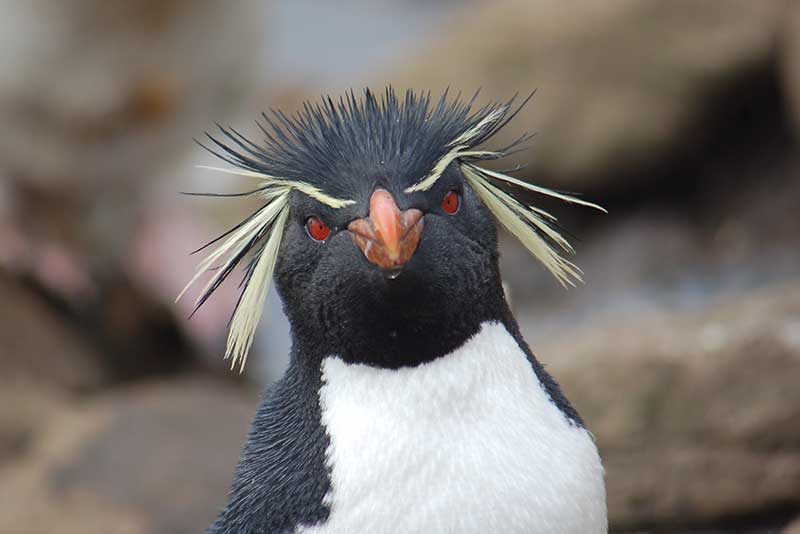
The northern rockhopper penguin, also known as Moseley’s penguin, is a medium-sized penguin named in honour of Henry Nottidge Moseley (1844–1891), who visited Gough Island aboard the H.M.S. Challenger. Its common name reflects its behaviour: unlike other penguins that slide on their bellies or climb using their wings, rockhoppers jump over boulders and cracks to navigate obstacles.
It has slate-grey or black upperparts, white underparts, and a black head with a yellow stripe and crest above each eye. Spiky black feathers adorn the back of its head. Its bill is brown, its eyes are red, and its feet are pink. Males and females are similar, though males are heavier and have larger bills.
It inhabits the southern Indian and Atlantic Oceans, with most of the population breeding on Tristan da Cunha and Gough Island. Occasionally, vagrants are spotted in Australia. Its diet consists of fish, krill, crustaceans, squid, and octopus.
Northern rockhopper penguins breed in colonies and form pair bonds that often last for several seasons. Their courtship ritual is complex, involving trumpeting, squealing, and barking, accompanied by head-nodding and bowing. They lay two eggs, with the second being larger than the first, but as with other species of penguin only the first survives.
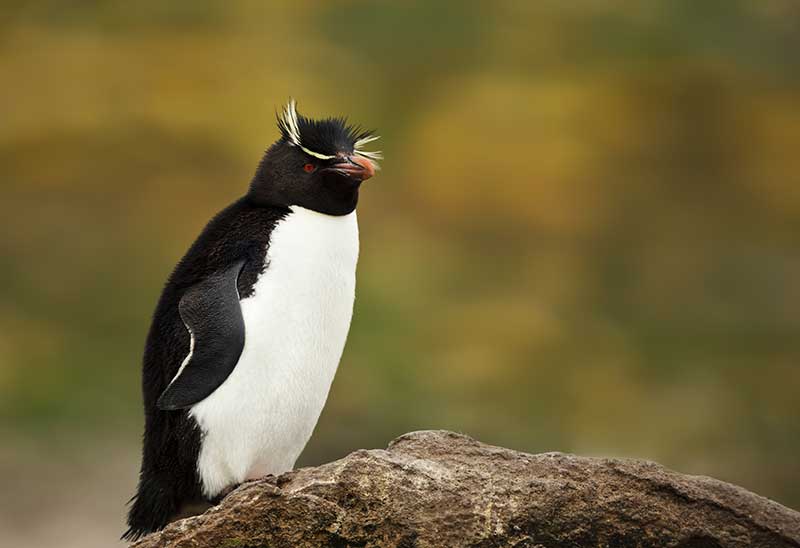
The southern rockhopper penguin is closely related to the northern rockhopper but is recognised as a distinct species. It has two subspecies: the eastern rockhopper (Eudyptes chrysocome filholi) and the western rockhopper (Eudyptes chrysocome chrysocome).
Physically, southern rockhoppers are smaller than northern rockhoppers, though there is some overlap in size, making visual identification unreliable. They also differ in the colour patterns on the undersides of their flippers, the size of their eye stripes, and the length of their head crests, which are shorter in southern rockhoppers. They breed at different times of the year and have distinct song characteristics. It is thought that the rockhoppers’ reproductive isolation happened relatively recently, and the two species are known to hybridise.
Southern rockhopper penguins are found in subantarctic waters of the western Pacific and Indian Oceans, as well as along the southern coasts of South America. Approximately two-thirds of the population belongs to E. c. chrysocome, which breeds on the Falkland Islands and islands off Patagonia. Their diet consists of fish, krill, squid, octopus, crustaceans, and plankton.
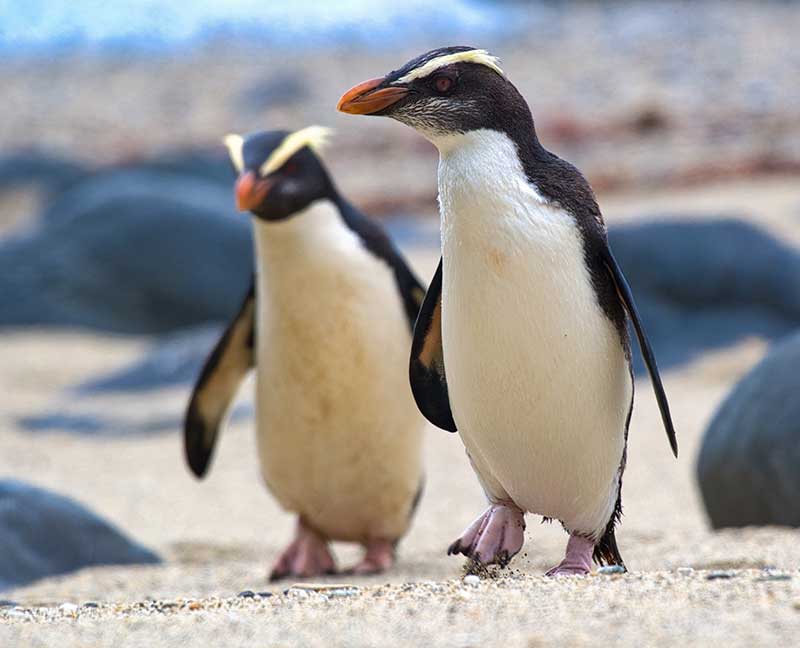
The Fiordland penguin is a medium-sized crested penguin endemic to New Zealand. It is sometimes referred to as the New Zealand crested penguin.
It has dark blue-grey or black upperparts and white underparts. Its head is black with a broad yellow crest that begins above the bill, extends past the eye, and droops down the neck. When excited, 3–6 white cheek stripes may become visible. The large bill is orange with a small strip of black skin at the base, the eyes are brownish-red, and the legs and feet are pale pink. Males and females look alike, though males are slightly heavier and have larger bills.
Fiordland penguins breed on remote headlands and islets along the southwestern coast of South Island and Stewart Island, with occasional sightings in Australia. They primarily feed on squid, supplemented by crustaceans, krill, and fish.
Nesting in small colonies, Fiordland penguins lay two eggs, the first smaller than the second. Typically, only one chick survives, although in favourable years about 10% of pairs successfully raise two chicks. Both parents take turns incubating the eggs, and after hatching, the male initially cares for the chick while the female forages at sea. Later, chicks are raised in crèches.
With a population of fewer than 2,500 pairs, Fiordland penguins are classified as near-threatened. Their primary threats include introduced predators such as dogs, cats, rats, and stoats, as well as human disturbance, which can cause them to abandon their nests.

The Snares penguin, is another crested penguin endemic to New Zealand, that closely resembles the Fiordland penguin but can be identified by the pink skin around the base of its bill and narrower eye crests. Unlike the Fiordland penguin, it lacks white markings on its face.
This species breeds exclusively on the Snares Islands, a group of islands south of mainland New Zealand. During winter, Snares penguins have been sighted off the coasts of Tasmania, southern Australia, Stewart Island, and occasionally mainland New Zealand. Their diet consists primarily of krill, along with fish and squid.
To court a mate, males adopt an upright stance, spread their wings, and pump their chests in display. The penguins lay two eggs, with the second being nearly twice the size of the first. The larger chick from the second egg typically hatches first and outcompetes the smaller chick from the first egg for food, leading to the smaller chick’s failure to survive.
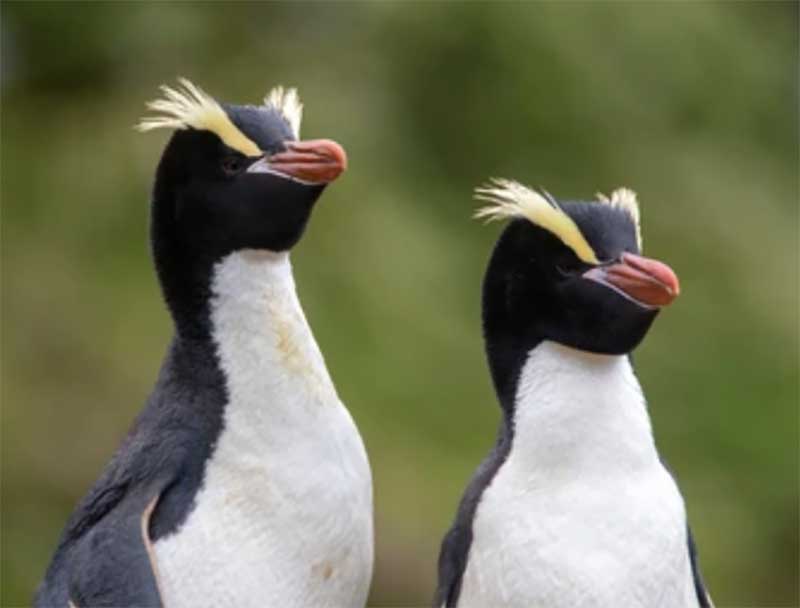
The erect-crested penguin is the third crested penguin species endemic to New Zealand. It closely resembles the Snares and Fiordland penguins but can be distinguished by its slightly smaller bill and bluish-white skin at the base. Its yellow eye crests are positioned higher on the head, forming roughly parallel, and less V-shaped lines when viewed from the front, when compared to the te other two species.
Most erect-crested penguins breed on three islands in the Antipodes Island group and eight islands in the Bounty Islands. Smaller numbers have been recorded nesting on Campbell Island, Disappointment Island, and Auckland Island. Like other crested penguins, its diet consists of small fish, krill, and squid.
Erect-crested penguins breed in large colonies, often alongside Salvin’s albatross. They lay two eggs, with the second egg being nearly 80% larger than the first. The first egg is typically lost shortly after the second is laid, often through deliberate actions such as a parent lifting it out of the nest bowl or pushing it out with its bill.
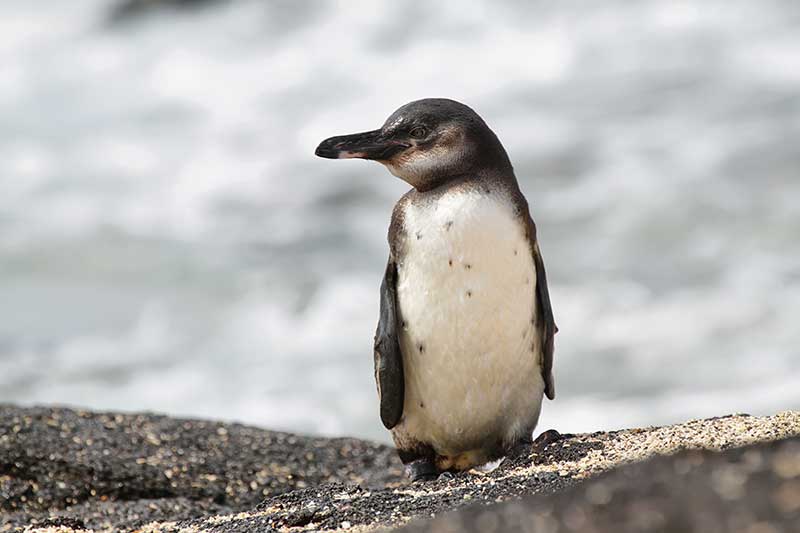
The Galapagos penguin is the second smallest penguin species and the only one found north of the equator. It has black upperparts, white underparts, and a black head with a white border that arcs from behind the eye, around the ear coverts and chin, and joins at the throat. Its bill is black with pink on the lower mandible. While males and females look similar, females are generally smaller.
Endemic to the Galapagos Islands, most of these penguins inhabit Fernandina Island and the western coast of Isabela Island. Their diet consists primarily of small schooling fish, such as mullet, sardines, pilchards, and anchovies, as well as occasional crustaceans, playing a vital role in controlling marine populations.
Galapagos penguins are monogamous and mate for life. Their courtship involves rituals like bill duelling, flipper patting, and mutual preening. They lay one or two eggs in caves or crevices, ensuring the nests are shaded from the sun. Both parents take turns incubating the eggs and caring for the chicks, alternating feeding trips that last several days. Unlike other penguin species, Galapagos penguins moult twice a year rather than just once.
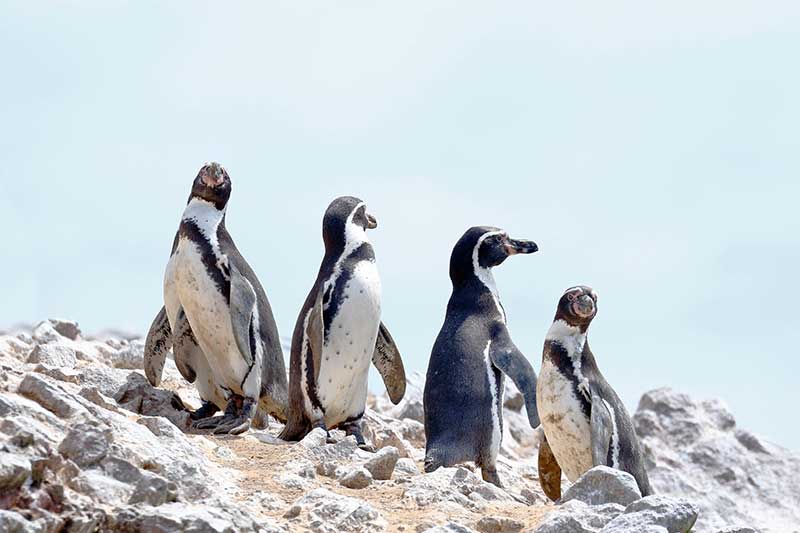
The Humboldt penguin is a migratory species native to South America, named after German explorer Alexander von Humboldt. In Peru, it is called “pájaro-niño,” meaning “baby bird,” due to its waddling gait and the way its small wings are held out, resembling a toddling infant.
It has blackish-grey upperparts and white underparts with a black breast band that runs down the flanks to the thighs. Its head is black with a broad white stripe that extends from behind the eye, around the ear coverts and chin, and meets at the throat. The bill is dark with a fleshy pink base. Males and females look alike, but males are larger and have longer bills.
The Humboldt penguin is found along the west coast of South America, breeding from southern Chile to the subtropical Isla Foca in northern Peru. It migrates north in search of food, with vagrants occasionally spotted in Ecuador and Colombia. It sometimes shares mixed colonies with Magellanic penguins. Its diet consists mainly of schooling fish such as saury, garfish, anchovies, herring, and pilchards, as well as squid and crustaceans.
Before breeding, Humboldt penguins perform courtship displays, bowing their heads, exchanging mutual glances, and then extending their heads, flapping their wings, and braying like donkeys. They nest in loose colonies and typically lay two eggs, with half of the pairs producing two broods a year. Both parents share responsibilities equally, alternating foraging trips, incubation, and chick care.
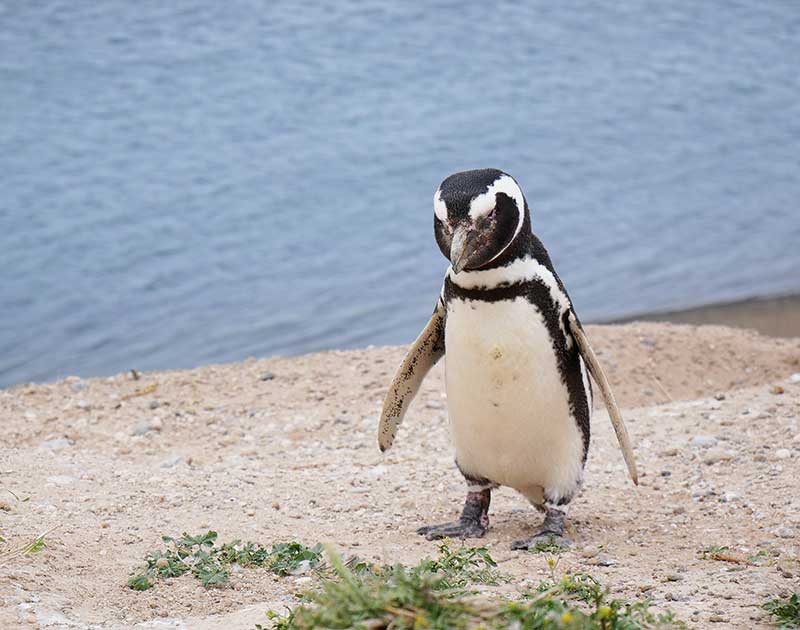
The Magellanic penguin is a medium-sized South American penguin named after Portuguese explorer Ferdinand Magellan. However, the species was first recorded by Antonio Pigafetta, an Italian who accompanied Magellan during his 1520 expedition to circumnavigate the globe.
Magellanic penguins have black upperparts and white underparts, with two distinctive black bands across the upper breast. Their heads are black with a broad white stripe that curves from behind the eye, around the ear coverts, and connects at the throat. Males and females look similar, but males are slightly larger.
They breed in Argentina, Chile, and the Falkland Islands, with some migrating to Brazil and Uruguay. Vagrants have occasionally been spotted as far afield as Antarctica, Australia, and New Zealand. Their diet includes small fish, cuttlefish, squid, jellyfish, and crustaceans.
Magellanic penguins nest in large colonies, constructing burrows or nesting under bushes. They lay two eggs, which are incubated by both parents in alternating 13-day shifts for around 40 days. The second egg is typically larger and warmer, although the first egg is more likely to survive. Under favourable conditions, both chicks can be successfully raised. Both parents share the responsibility of caring for the chicks.
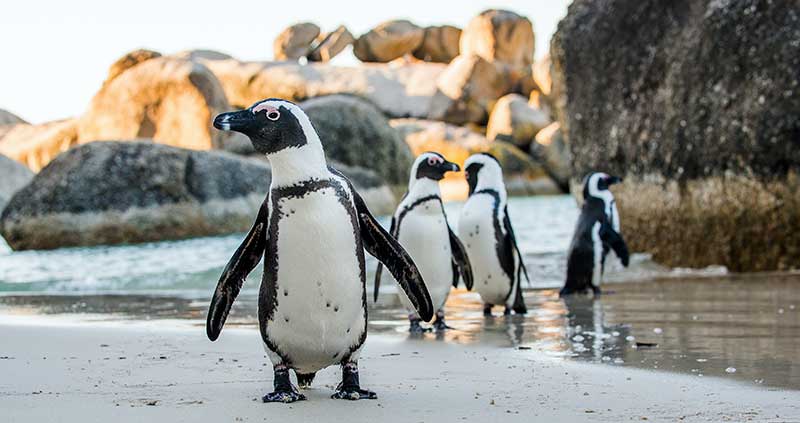
The African penguin, also known as the black-footed penguin or jackass penguin, due to its distinctive braying call, is the only penguin species native to the Old World. Its genus name, Spheniscus, is derived from the Ancient Greek word σφήν (sphēn), meaning “wedge”, a reference to the bird’s thin, wedge-shaped flippers.
It has black upperparts and white underparts, marked by a black stripe and a unique pattern of black spots on its chest, akin to a human fingerprint. Its black head has white, C-shaped patches on the sides. Above the eyes are sweat glands that become pinker as temperatures rise, due to increased blood flow for thermoregulation. While males and females look similar, males are slightly larger and have longer beaks.
African penguins inhabit the southwestern coast of Africa, forming colonies on 24 islands between Namibia and Algoa Bay, near Port Elizabeth, South Africa. They are the only penguin species that breed in Africa, giving their name to the Penguin Islands, a chain of islands and rocks scattered along 355 kilometres of Namibia’s coastline. Their diet consists mainly of fish such as sardines, mackerel, herrings, and anchovies, along with shrimp, krill, and squid.
They are monogamous and return to the same colony to breed each year, laying two eggs in burrows or nests built in sand under boulders or bushes. Both parents share incubation duties. After hatching, one parent guards the chicks for about a month before they join creches.
Historically, African penguin eggs were considered a delicacy and were still being harvested for sale as late as the 1970s. Hunters would smash eggs found shortly before collection trip to ensure only freshly laid eggs were sold, which led to a sharp population decline.
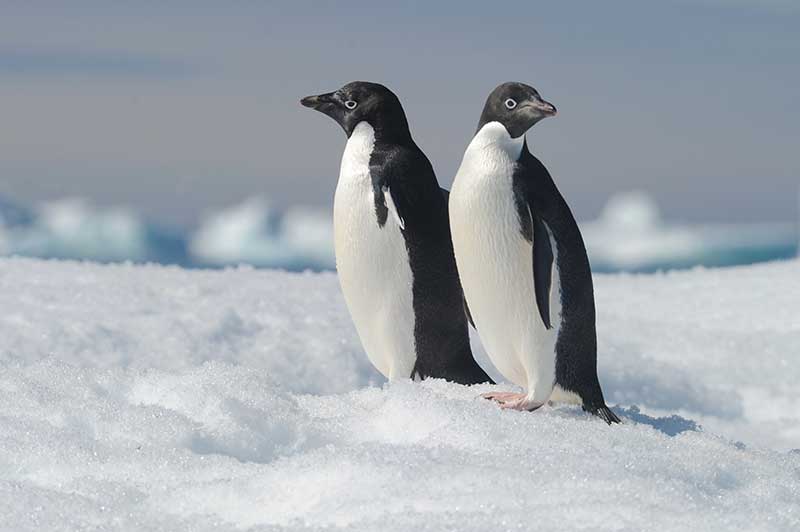
The Adélie penguin is the most widely distributed of all penguin species, found along the Antarctic coastline. It is named after Adélie Land, which itself is named in honour of Adèle Dumont d’Urville, the wife of French explorer Jules Dumont d’Urville, who first identified the species in 1840.
A medium-sized penguin, the Adélie has black upperparts and snowy white underparts. Its upperwings are black a white trailing edge, while its underwings are whti with a black edge and a small black tip. The head is black, with a white eyering surrounding its dark eye. The beak is black and covered with feathers, leaving only the tip exposed, which is generally black but may display reddish-brown markings. Its legs and feet are pink. Males and females look alike but the female is smaller with a shorter beak and wings.
Adélie penguins establish breeding colonies along the coasts of Antarctica and on several sub-Antarctic islands. While they are seldom found north of the 60th parallel south, they have occasionally been observed as vagrants in Australia, New Zealand, and southern South America. Their diet mainly consists of krill, supplemented by fish, squid, and jellyfish. Fossil records indicate a shift in their diet from primarily fish to a krill-based diet around 200 years ago, likely because of the decline of the Atlantic fur seal and baleen whale, which previously competed with the penguins for krill. Krill has since become a more accessible food source than fish.
The Adélie penguin lays two eggs, which are incubated for approximately 32 days. The parents take turns incubating the eggs in 12-day shifts. During incubation, the parent on the nest remains there without eating or defecating, instead projecting faeces away from the nest. Inexperienced young penguins may misinterpret social cues during breeding season. For example, they may attempt to mate with other males, young chicks, or even deceased females.
Interestingly, some adult Adélie penguins also engage in homosexual behaviour. In one well-documented case from 1996, two male penguins were observed courting each other, taking turns mounting and copulating. This reciprocal behaviour suggests that both individuals were aware they were interacting with another male. Researchers speculated that this behaviour might be a form of practice for heterosexual encounters or a response to heightened sexual drive in the absence of females.
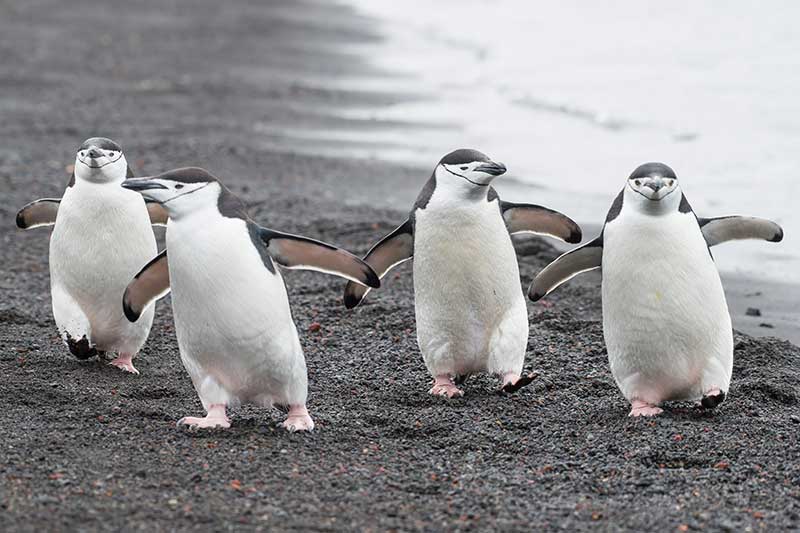
Closely related to the Adélie penguin, the chinstrap penguin is found across a numerous islands and coastal regions in the Southern Pacific and Antarctic Oceans. This species has black upperparts and white underparts. Its upper wings are black with a white trailing edge, while the underside is entirely white. The face is white with a distinctive narrow black band that runs under its bill, which gives the chinstrap penguin its name. Its eyes are reddish-brown, the bill is black, and its legs and feet are pink.
Chinstrap penguins form some of the largest colonies, with over 100,000 pairs on certain islands. They are found in Antarctica, Argentina, Bouvet Island, Chile, the French Southern Territories, and the South Georgia and South Sandwich Islands. Vagrant individuals have also been recorded in New Zealand, the islands of Saint Helena and Tristan da Cunha, and South Africa. Their diet consists mainly of small fish, krill, shrimp, and squid, which they dive as deep as 70 metres to catch. However, most of their food is obtained in quick dives of about 30 seconds in the top 10 metres of the ocean. Unusually, they often dive at night.
Chinstrap penguins build their nests from stones and lay two eggs, which are incubated for approximately 37 days. During this time, the parents take turns incubating in 6-day shifts. In a notable event in 2004, two male chinstrap penguins named Roy and Silo, residing at Central Park Zoo in New York City, formed a pair bond and alternated incubating a rock. Eventually, a zoo keeper replaced the rock with a fertile egg, and the pair successfully hatched and raised a chick.
Chinstrap penguins also display a behaviour known as “microsleep”. They take over 10,000 microsleeps daily, each lasting around 4 seconds. These sleep bouts can be either bihemispheric (both brain hemispheres sleeping) or unihemispheric (one hemisphere sleeping at a time), with each hemisphere accumulating over 11 hours of sleep per day.
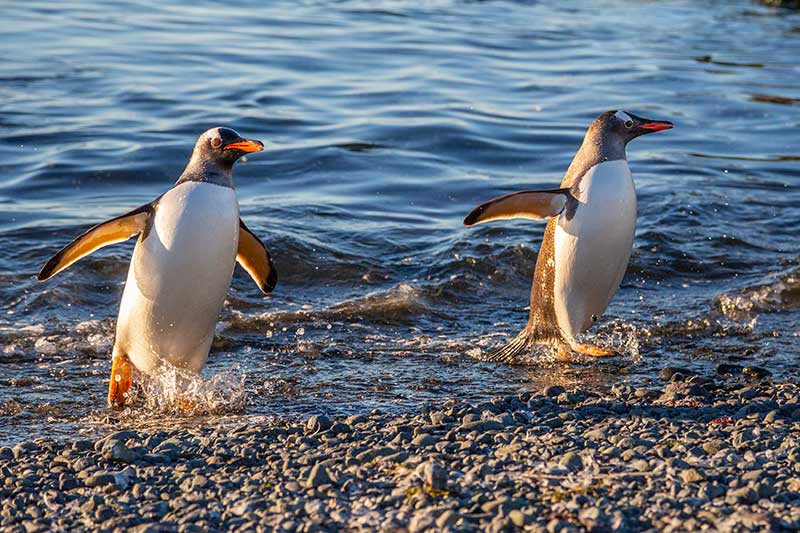
The gentoo penguin lives on the Antarctic Peninsula and various sub-Antarctic islands, favouring ice-free habitats such as coastal plains, rocky beaches, sheltered valleys, and low-lying cliffs. It has black upperparts, white underparts, and distinctive white patches above the eyes that extend toward the crown. The bill is bright orange-red bill and the legs and feet are pink. Gentoos have the longest tail of all penguin species, which sweeps from side to side as they walk.
The origin of the name “gentoo” is unclear. In Anglo-Indian terminology, “gentoo” was used to distinguish Hindus from Muslims, and some speculate the white patch on the penguin’s head resembles a turban. Another theory traces the name to the Portuguese word gentio, meaning “pagan” or “gentile”. It might also derive from “Johnny penguin”, a nickname for the bird, with “Johnny” being the Spanish diminutive “Juanito”, which sounds similar to “gentoo”. The striated caracara, a predator of gentoo penguins in the Falkland Islands, is called the “Johnny rook”, possibly after the Johnny penguin.
The main colonies of gentoo penguins are found on the Falkland Islands, South Georgia and the South Sandwich Islands, and the Kerguelen Islands, with smaller colonies on Macquarie Island, Heard Island, the Crozet Islands, the South Shetland Islands, and the Antarctic Peninsula. Gentoos are opportunistic feeders, consuming a varied diet of fish, krill, shrimp, squid, octopuses, and squat lobsters.
Gentoo penguins build their nests out of stones, which are highly prized and jealously guarded. Females value these stones so much that a male can win a mate by offering her one as a gift. The female lays two eggs, which both parents take turns incubating over a period of 34–36 days, swapping duties daily. After hatching, the chicks remain in the nest for around 30 days before joining other young penguins in the colony to form crèches for safety and socialisation.
Gentoo penguins are remarkable swimmers and hold the title of the fastest swimming birds in the world. Their agility and high performance in the water inspired the name of the Gentoo Linux operating system, which aims to be a high-performance platform.
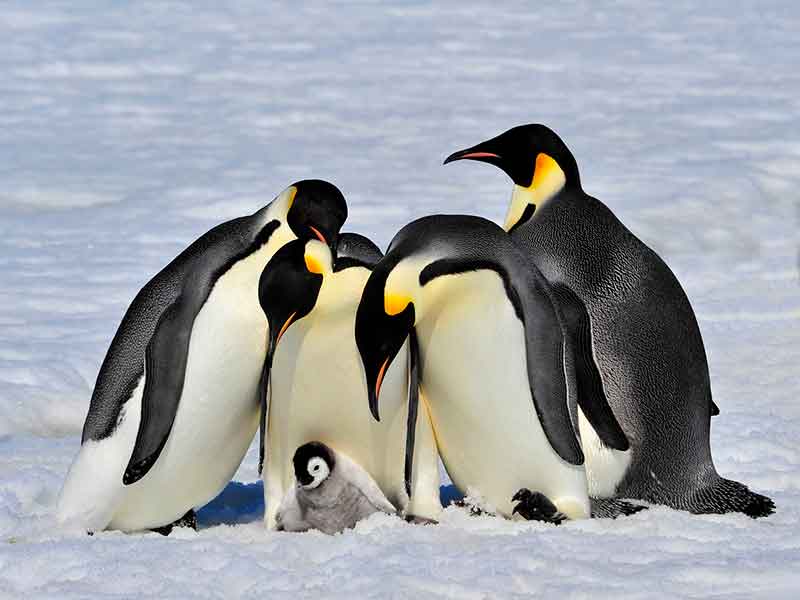
The emperor penguin is the tallest and heaviest penguin species and one of the largest birds in the world. It has black upperparts that contrast sharply with its lighter underparts. The underparts are white with a pale yellow tinge on the upper breast, while the head is black with bright yellow ear patches. Its bill has a black upper mandible and a pink, orange, or lilac lower mandible. Males and females look alike.
Native to Antarctica, emperor penguins are found almost exclusively between latitudes 66° and 77° south. Their diet primarily consists of fish, crustaceans, and squid.
Despite common misconceptions, emperor penguins do not mate for life but are serially monogamous, staying with one partner per breeding season. Each year, they lay a single egg, which the male incubates by balancing it on his feet and covering it with a feathered skin flap called the brood patch. While the male incubates the egg, the female heads to sea to hunt and restore her energy. She returns about two months later to feed the chick with regurgitated food. During this time, the male survives without eating, relying solely on the fat reserves he built up during summer to endure the harsh winter fast.

The king penguin is the second-largest penguin species, found across the subantarctic and Southern Ocean north of 60°S. It has black upperparts and white underparts with an orange wash on the upper breast. The head is black, with a bright orange teardrop-shaped patch on each cheek that extends as a thin line around the neck. The bill is black with a slight downward curve, an orange stripe along the lower mandible, and a pink base. Males and females look alike, though males are slightly larger. However, this difference is not a reliable way to distinguish them due to overlapping sizes.
The king penguin can be distinguished from the similar emperor penguin by its longer, straighter bill, larger flippers, and sleeker body. In the wild, emperor and king penguins rarely inhabit the same areas, except for occasional vagrants at sea.
King penguins breed on subantarctic islands between 45° and 55°S, at the northern areas of Antarctica, as well as Tierra del Fuego, the Falkland Islands, and other temperate islands in the region. The total population is estimated at 2.23 million pairs and is increasing. Their diet consists mainly of fish, supplemented by squid and krill.
The king penguin has an unusually long breeding cycle, lasting 14–16 months from egg-laying to fledging. It lays a single egg, incubated for around 55 days with both parents alternating shifts of 6–18 days. Like the emperor penguin, the king penguin balances the egg on its feet and covers it with a “brood pouch”. Hatching takes 2–3 days. After hatching, the chick is cared for by both parents, with one guarding the chick while the other forages for about 40 days. Chicks then form crèches but do not fledge until they are 10–13 months old. Due to this extended breeding cycle, king penguins produce two chicks every three years.
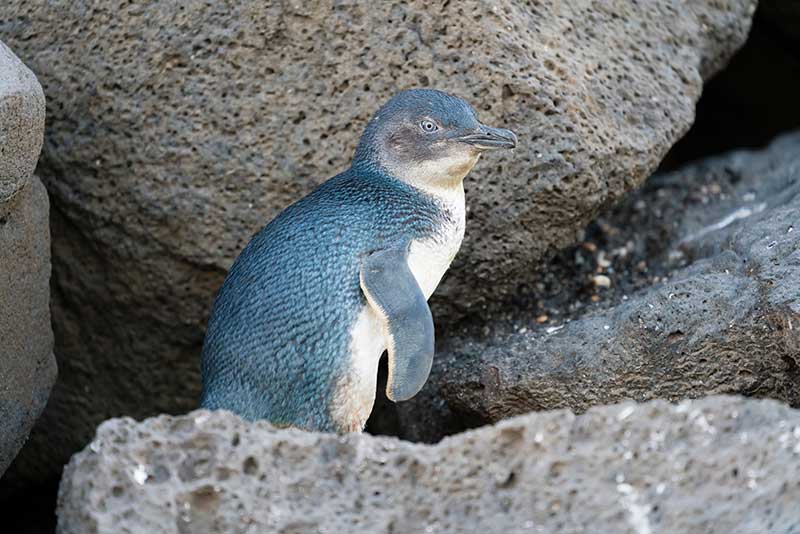
The little penguin, also known as the fairy penguin, blue penguin, or little blue penguin, is the smallest penguin species in the world and originates from New Zealand. It stands about 30 cm tall and weighs around 1.5 kg. Its plumage has slate-blue upperparts, white underparts, and blue flippers. The head is slate-blue with grey ear coverts that fade to white under the chin. It has pale silvery-grey or hazel eyes, a dark grey beak, and pink feet with black soles and webbing.
There are several subspecies of the little penguin. One of these, the Australian little penguin (Eudyptula novaehollandiae), is sometimes considered a separate species due to differences in its braying calls, shape, and size. However, the International Union for Conservation of Nature (IUCN) classifies them as two genetically distinct clades within the same species.
E. minor breeds along the coastline of New Zealand, while E. novaehollandiae is found in Australia and the Otago Peninsula in southern New Zealand. They inhabit offshore islands, particularly those with rocky shorelines, as well as mainland sites near or within urban areas. They forage at sea during the day, feeding on small schooling fish, squid, krill, and plankton, and return to their burrows onshore at dusk, making them the only penguin species that is nocturnal on land.
Little penguins are monogamous, and pair separations are rare, usually occurring only after unsuccessful nesting attempts. They typically lay two eggs, which are incubated in shifts by both parents. Unlike other penguin species, older little penguin chicks remain in their nests during the day rather than forming crèches with other chicks while both parents hunt. E. novaehollandiae has been observed engaging in double brooding, where a second clutch of eggs is produced after the first chicks have fledged. This behaviour is influenced by factors such as sea surface temperature, age, and food availability.
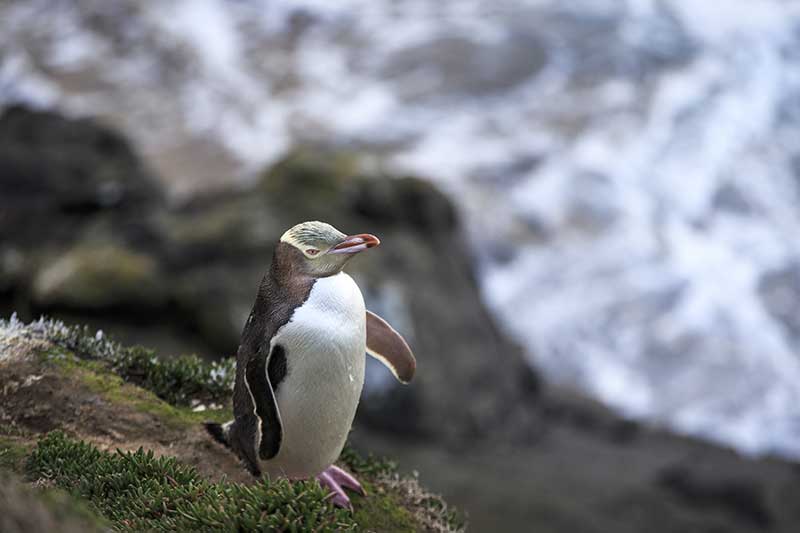
The yellow-eyed penguin, native to New Zealand, is a species previously thought to be closely related to the little penguin. However, genetic research has revealed that it is more closely related to the crested penguins. Its Māori name, hoiho, meaning “noise shouter”, refers to its shrill call.
Its upperparts are slate-blue-black, while its underparts are white. The forehead, crown, and sides of the face are slate-grey with golden-yellow streaks, and the sides of the head are brown. A band of pale yellow feathers circles its yellow eyes and extends to the back of its head. Its long, slender bill has a reddish-brown upper mandible and tip, with a pale pink lower mandible. The feet are pink with black soles. Males and females are similar in appearance, but males are slightly larger.
Yellow-eyed penguins inhabit the southeastern coast of New Zealand’s South Island – known as the mainland population – and the southern Auckland Islands. Genetic evidence suggests that this species expanded its range to include mainland New Zealand only within the past 200 years. Its diet mainly consists of fish, along with jellyfish and crustaceans like krill.
They form long-term pairs and typically lay two eggs. Incubation, lasting 39–51 days, is shared by both parents, who take turns sitting on the eggs. For the first six weeks after hatching, one parent remains with the chicks during the day while the other feeds at sea. After this period, both parents leave the chicks unattended to forage at sea. The chicks fledge at around 14 weeks.
Contrary to its Māori name, the yellow-eyed penguin is mostly silent. It does, however, produce a braying call at its nesting and breeding sites.