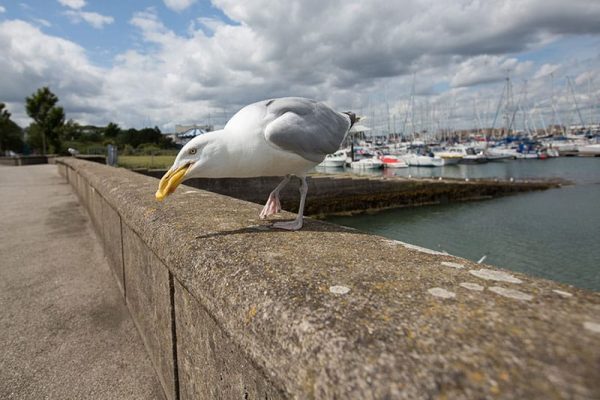
These include gulls, grebes, herons, cormorants, kingfishers, terns, corvids, dippers, shrikes, swallows, songbirds, and shorebirds.
Ravens, for example, produce pellets which contain a wide variety of remains such as lizard, snake, and bird bones, as well as the seeds from fruit and berries they have consumed.
A gull’s pellet might include fish scales and bones, bird and mammal bones, feathers, fur, and teeth, as well as all sorts of manmade products such as plastics, netting, and string, while an insect-eating songbird will cough up a pellet formed mainly of insect exoskeletons.
The pellet from a barn owl will mainly contain the bones of small mammals such as mice, voles, shrews, and rats. Occasionally it may contain some more unusual remains such as those from a weasel, mole, or rat, as well as its own feathers. It is grey and fairly solid, and feels smooth to the touch, and measures between 3 cm and 7cm in length.
A tawny owl’s pellet is paler grey and less ‘furry’ than that of a barn owl. It is also smaller, measuring between 2 cm and 5 cm, and is long and narrow with a taper at one end. It crumbles fairly easily and often disintegrates in the rain. The pellet may contain the remains of small mammals, and birds, as well as amphibians and large insects.

Although the colour of a bird’s pellet depends on what it has eaten, when expelled, they are usually black. As they dry, they tend to end up grey or brown and are often be mistaken for droppings. However, unlike faeces, pellets don’t smell although they can carry diseases and bacteria from rodents consumed by birds. There have been at least two reports of a breakout of salmonella in a school after the dissection of owl pellets.
They also range in size. A hawk or owl pellet measures between 2.5 cm and 5 cm long, a black-headed gull’s pellet is about 5.5 cm long, while a songbird’s pellet is just 1.2 cm in length.
Apart from getting rid of undigested food, regurgitating pellets help scour and cleanse the digestive tract and gullet removing pathogens and improving the health of the bird.
Some birds, particularly those that lay their eggs in cavities, including owls and kingfishers, use pellets in their nests. After choosing a suitable nesting site, they cough up pellets and break them, before lining the floor of the cavity and digging a shallow scrape.
The pellets not only provide a soft layer for the chicks and eggs but also perform another important function – absorbing poo.
A kingfisher’s pellet is formed from fish scales and fine fish bones. It is only about half a centimetre long and is very fragile and crumbles easily. The chambers in riverbanks in which kingfishers build their nests are often very damp and once the chicks are born there is nowhere for their faeces to go. So the female kingfisher lines the nest with pellets and shreds them with her long beak, to provide a soft, absorbent lining where she lays her eggs. Once she’s laid the eggs, she continues to add more pellets which she coughs up after feeding.
Regurgitated pellets also provide food and shelter for flies, insects, larvae, and fungi. This can have an important effect on the local ecosystem. For example, the flies attracted to a pellet provide food for spiders, which in turn are eaten by insectivorous birds.
In falconry, some hawks are fed on a diet of only pure meat, where the skin and bones have been removed beforehand. In this case, falconers must supplement the hawk’s diet with additional roughage so they can digest food properly and produce pellets, in a process called casting.
Falconers use two types of material for roughage: cotton or plumage. Cotton roughage is made from soft, fine cotton formed into a small ball and pushed into the hawk’s throat after a meal. Plumage casting involves feeding a hawk feathers from chicks or game birds, or rabbit fur in addition to its regular food.
After a few hours, the hawk will cast the pellet in the same way as birds regurgitate pellets in the wild, and it is examined by the falconer to assess the state of the bird’s health.
The practice of casting is described in Hawking or Faulconry, part of Richard Blome’s classic work, The Gentleman’s Recreation, published in 1686, and considered an important milestone in the early history of falconry.
Casting usually happens in the evening with the pellet cast in the morning. It is essential for hawks kept in captivity as it clears out the crop and cleans bacteria from the walls of the gullet.
Owl pellets are usually found under a tree where they roost or nest and over time many may accumulate in the same spot.
If you find an owl pellet you are allowed to take it home to analyse it but be careful not to disturb any nearby owls particularly if they are sitting on eggs or caring for chicks. You can also buy pellets online that have been sterilised ready for dissection.

Pellets can be frozen or kept in an airtight container until they are ready for dissection, and they can be analysed wet or dry. It is easier to dissect dry pellets but if you want to be sure to extract all the small bones intact, you can soak the pellet in water for about 24 hours.
Before you start, lay out some newspaper or paper towels and put on rubber gloves
Using tweezers or your fingers, carefully pull the pellet apart. You can use a cocktail stick or needle to probe further. Gently place whatever you find on a piece of white paper and use a magnifying glove to examine the remains.
You should be able to work out what the owl has been eating from the shape of the bones, using a skeletal diagram as a guide.