Hibernation is how animals conserve energy so they can survive adverse weather conditions or periods when food is scarce.
Although hibernation is most commonly associated with animals going to ‘sleep’ over winter, in hot climates some animals go into a form of hibernation called aestivation. Aestivation allows them to survive very high temperatures, drought, or a lack of food.
During hibernation, physiological changes occur in an animal. They are similar to the changes that happen during normal sleep but are amplified. An animal’s breathing and heartbeat slows, and its body temperature drops, which reduces its metabolism and allows it to conserve energy.
Animals that hibernate tend to be small and have a fast metabolism. In the UK, there are only 3 true hibernating animals; hedgehogs, dormice, and bats. Some animals, such as the badger go into a state of winter lethargy when it spends most of the time underground. It may eat less, and its body temperature may drop but this isn’t true hibernation.
Hibernation can last for several weeks or months depending on the species, during which time animals will lose a significant proportion of their bodyweight. They may wake up for brief periods to eat, drink, and defecate, but in the main they remain in a state of low energy for as long as possible.
Waking up from hibernation can take a few hours or even days and animals expend a lot of energy doing so.
Torpor is similar to hibernation in that it is a state of decreased physiological activity to conserve energy and heat. However, unlike hibernation torpor only occurs for only short periods of time and appears to be an involuntary reaction to external conditions.
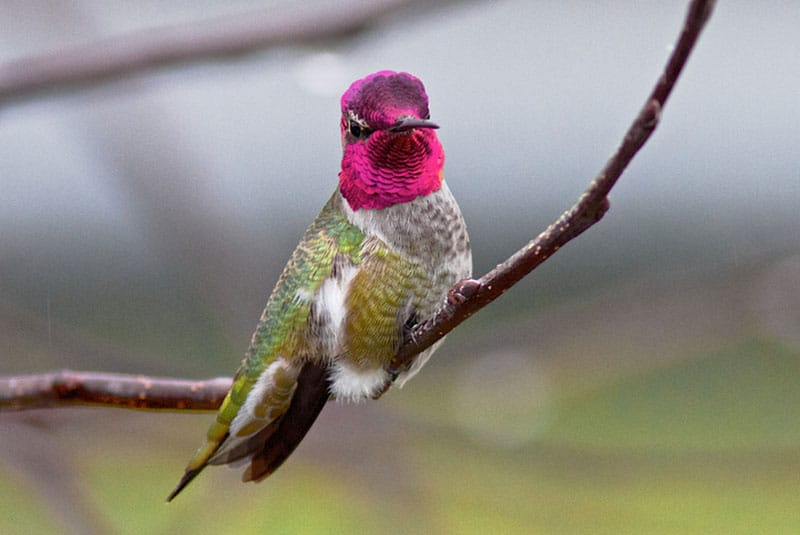
Several species of birds go into torpor, notably hummingbirds, swifts, and nightjars. During torpor they face an increased risk from predators and arousal from torpor incurs a significant energy cost. It usually lasts about an hour and involves violent shaking and muscle contractions as the bird wakes and heat itself up. However, the energy savings from torpor are essential for survival so as with almost all evolved behaviours the benefits outweigh the costs.
Recent research shows that there may be many more species of birds that exhibit torpor but so far only one has been shown to practise true hibernation.
The common poorwill is a member of the Caprimulgidae or nightjars family. It is a nocturnal bird found in western Canada and the United States, and northern Mexico in dry, open habitats with grasses and shrubs.
Like other nightjars, it is a small, compact bird with a relatively large head, wide, stubby bill, and short, rounded wings. It is highly camouflaged with a ‘dead leaf’ pattern so during the day they can remain hidden on the ground.
At night, it can be heard calling continuously, a monotonous ‘poor-willip’, that gives the bird its name.
It feeds mainly on insects, such as moths, beetles, grasshoppers, flying ants, and flies, which it catches in its wide gape, usually at dusk and dawn. However, during winter, the cold nights mean there are fewer insects about and so the common poorwill goes into an extended state of torpor sometimes for weeks or even months.
The first known record of this behaviour dates back to 1804. In the previous year, President Thomas Jefferson had commissioned an expedition to map out the newly acquired territory of Louisiana from the French Republic.
The expedition known as the Lewis and Clark expedition, was undertaken by a group of U.S. Army and civilian volunteers under the leadership of Captain Meriwether Lewis and Second Lieutenant William Clark. They set off from Camp Dubois in Illinois in May 1804.
As well as establishing an American presence in the territory, a secondary goal of the expedition was to study the area’s plants, animals, and geography, and begin trading with local Native American tribes.
Throughout the trip Lewis and Clark collected hundreds of plant specimens and were the first European Americans to discover several species of animals. These included mammals, such as the grizzly bear, swift fox, and mule deer, and birds such as the greater sage-grouse, Clark’s nutcracker, and Lewis’ woodpecker.
The pair took meticulous notes, and on October the 16th when they had reached North Dakota, Lewis wrote in his journal:
This day took a small bird alive of the order of the [blank] or goat suckers. it appeared to be passing into the dormant state. on the morning of the 18th the murcury was at 30 a[bove] 0. the bird could scarcely move.— I run my penknife into it’s body under the wing and completely distroyed it’s lungs and heart— yet it lived upwards of two hours this fanominon I could not account for unless it proceeded from the want of circulation of the blo[o]d.— the recarees call this bird to’-na it’s note is at-tah-to’-nah’; at-tah’to’-nah’; to-nah, a nocturnal bird, sings only in the night as does the whipperwill.— it’s weight—1 oz 17 Grains Troy
Lewis’s cruel experiment with the bird showed the typical response given by a hibernating animal, including a drop in blood circulation and respiration. But despite his passion for and knowledge of the natural world, Lewis didn’t realise that he hadn’t come across an eastern whip-poor-will (Antrostomus vociferus), but an entirely new species of poorwill and was observing a behaviour unique in the avian kingdom.
It wasn’t until 1844 that the common poorwill was officially described by John James Audubon from a male common poorwill collected from the bank of the Missouri River in South Dakota. He gave it the scientific name Phalaenoptilus nuttallii after his friend, the English botanist Thomas Nuttall, who worked in America from 1808 to 1841 and followed the route of Lewis & Clark’s expedition collecting plant specimens. The genus name is from the Ancient Greek phalaina meaning “moth” and ptilon meaning “plumage”

For over a century, the poorwill’s behaviour was virtually ignored by the ornithological community until the phenomenon was observed again by a well-respected member.
Dr Edmund Jaeger was an American biologist primarily known for his work on the natural history of deserts. Apparently unaware of the journals of the Lewis and Clark expedition, in the winter of 1946, he was hiking with two friends in the Chuckwalla Mountains east of the Coachella Valley.