|
|
The Impact Of Wind Farms On Migrating Shelducks

The Impact Of Wind Farms On Migrating Shelducks

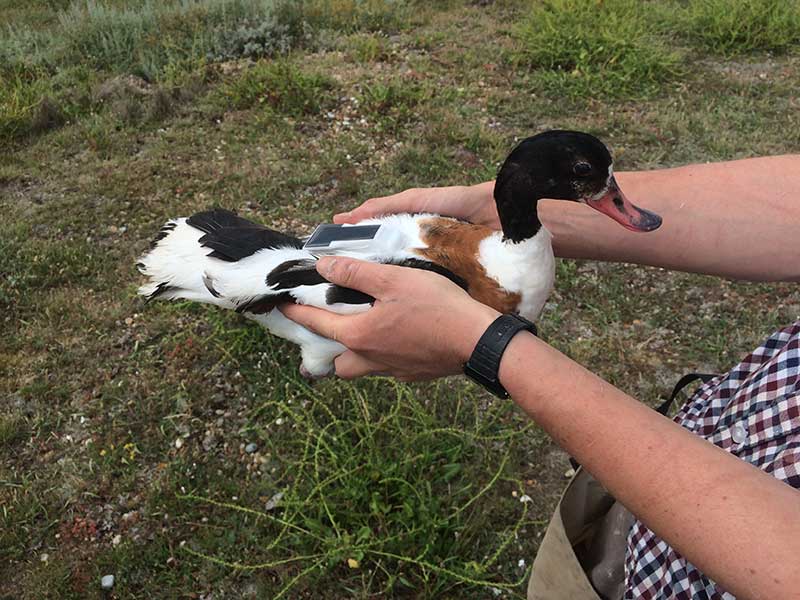
Tagged Shelduck

A new study by the British Trust for Ornithology (BTO) has revealed for the first time the migration routes of the shelduck, as part of a study to investigate how birds and wildlife interact with wind turbines.

The shelduck is one of the UK’s largest ducks, with colourful, contrasting patches on its otherwise white body and on males a bright red, knobbed bill. It has a wide range and is found across Europe from the north west of Scandinavia to the warmer climes of the Mediterranean as well as central Asia and south towards Iran and Afghanistan.

They are renowned for their spectacular moult migrations when tens of thousands of shelducks fly to the tidal mudflats of Germany’s Wadden Sea, as well as areas in the Netherlands and Denmark, at the end of the breeding season. The sites chosen have a plentiful supply of food and few predators so they can safely replace their flight feathers, before returning to Britain when the moult is complete.

Your next read

Bird Spotter Sheets For Kids
10 Record Breaking Birds
Shop Squirrel Proof Feeders And Baffles
Rufous-Tailed Scrub Robin ID Guide

To complete their moult migration, shelducks must cross the North Sea, navigating a growing number of wind farms on the way. Offshore wind farms are an important part of the government’s strategy to reduce carbon emissions in the fight against climate change. It has set an ambitious target of net zero emissions by 2050 and part of the plan is to generate enough clean wind energy to power every home in the country by 2039.

This means a lot of wind farms need to be erected, so it’s important to understand any possible impact they may have on wildlife. Evidence suggests that without proper planning safeguards they can harm birds in three ways; disturbance, habitat loss, and collisions

Wind farms situated on important migratory routes pose a threat to birds from the risk of collisions, and if they act as a barrier that birds need to fly around, from the extra energy a bird must expend in doing so.

A previous study published in 2012 showed that pink-footed geese appear to avoid newly-built offshore wind farms when they arrive in the UK from their wintering grounds. Scientists from the Food and Environment Research Agency (FERA) started monitoring the migrating geese with radar during the early stages of construction of two wind farms off the coast of Skegness.

Over 3 years they tracked over 40,000 birds and found that they altered their course to take them around the wind farms. By 2010 81% of the geese flew outside the wind farm area, and of those still flying through it, 90% changed their flight to climb above the turbines and avoid colliding with the rotating blades.
North Sea crossing

To measure the potential impact of wind farms in the North Sea, scientists from the BTO attached solar-powered GPS-GPM tracking devices to four shelducks from the Alde-Ore Estuary Special Protection Area on the Suffolk coast. The state-of-the-art tags meant that the birds could be tracked in almost real time allowing the researchers to follow their migratory paths in great detail.

They tracked them to the Wadden Sea and discovered that each bird took a separate route and used previously unreported stopover sites in the Dutch Wadden Sea, before continuing to moult sites in the Helgoland Bight off the coast of Germany. During the crossing the ducks flew at speeds of up to 55 knots and up to 354 m above the sea’s surface.

They also discovered that one of the birds travelled back and forth between the Dutch and German Seas four times adding an additional 1,000 km to its journey. At the time of writing the reason for this is not yet known.
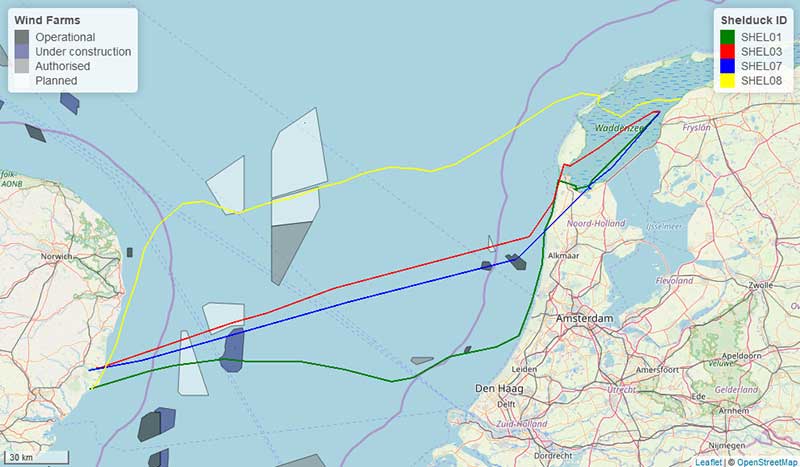
Shelduck Migration Route

During the study the birds’ movements recorded apparent interactions with several wind farm sites, although most of these are currently only at the planning stage. Just one data point was recorded within an operational wind farm when a bird flew within the Egmond aan Zee wind farm.

This particular shelduck was flying at a height of 85 m, which would place it at potential risk of collision with the wind farm’s spinning turbine blades, which sweep an area of between 25 m and 139 m above sea level.

In fact, all four shelducks’ flew at a height of less than 150 m for the majority of their journeys placing them in the ‘collision risk zone’ of many of the offshore wind farms they may pass through. The BTO team plans to extend the tracking project and collect more data to find out whether shelducks are really at risk of collision, or whether the population can adapt to this essential, renewable energy infrastructure, like the pink-footed geese of Lincolnshire did.

Share your thoughts

Leave a Reply

Your email address will not be published. Required fields are marked *

More notes and news

Birds And Bees Gift Set
Father’s Day Gifts For Bird Lovers
May 27, 2025
Flock Of Twites
Twites In England Are Nearing Extinction
November 6, 2021
Cuckoo
The Mystery Of The Very Early Cuckoo
March 25, 2020
European Robin
Will The Real Christmas Robin Please Stand Up
December 24, 2020
Manchester Blue Tit
Celebrating 10 Years Of The Manchester Blue Tit
August 15, 2021
Blue-Grey Tanager
We Went All The Way To Costa Rica …
February 22, 2020

Secure your bird watchig break for just £10

Secure your bird watchig break for just £10

Secure your bird watching break for just £10