When Robbins returned to the island in 2002 he recaptured as many birds as he could in the hope that some of them would be the “old-timers’. It was only when he returned to his office in Maryland that he discovered he’d recaptured a real old-timer, Wisdom, who was then a sprightly 51.
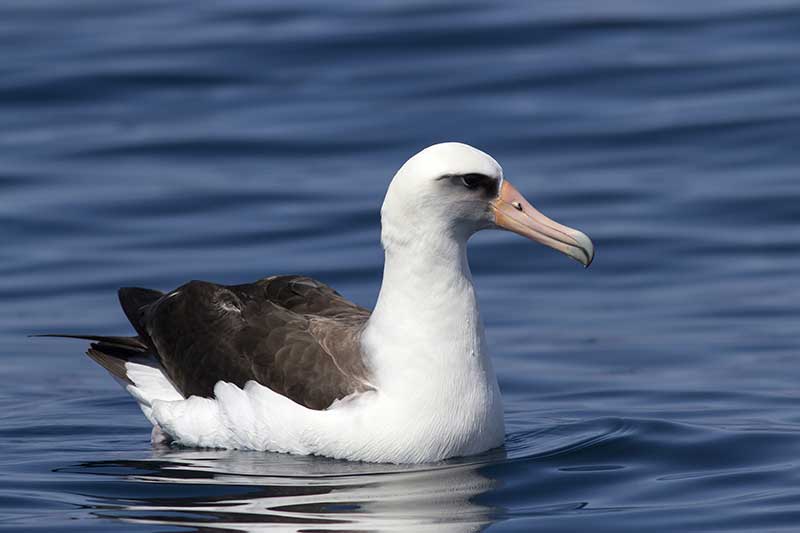
The Laysan albatross is a gull-like albatross and the second most common seabird in the Hawaiian Islands. At about 82 cm in length and with a wingspan of up to 2 metres, it is a large seabird but one of the smaller albatrosses. The wandering albatross by comparison measures up to 135 cm in length and has an average wingspan that ranges from 2.5 to 3.5 metres.
They have white underparts and lower rump and dark grey upperwings, mantle, back, and tail. The head is white with a black smudge around the eye and the thick, hooked bill is pink with a dark tip. Males are larger than females.
Like all albatrosses the Laysan albatross can stay aloft for long periods of time without flapping its wings so can fly for thousands of miles without expending much energy. The United States Geological Survey (USGS) estimates that Wisdom has flown over 3,000,000 miles in her lifetime, the equivalent of 120 times round the circumference of the Earth.
Layan albatrosses are mostly monogamous and return to the same nesting site each year to reunite with their mates. Wisdom has been with her current partner, Akeakamai, since at least 2012 but it’s likely she had previous partners that she has outlived.
The breeding cycle of the Layan albatross is long with incubation typically lasting 65 days. They only lay one egg a year and will occasionally skip years. Both parents share incubation duties and once the chick has hatched they will care for it together, feeding it regurgitated fish eggs and squid. It will be another 160 days before the chick fledges.
Juveniles return to the colony 3 years after fledging and over the next few years will come and go performing elaborate courtship dances in search of a mate. They do not begin breeding until they are typically 7 or 8 years old, and the time investment required to produce a chick may explain this long courtship. Both parents want to be sure that they have chosen a suitable mate with whom they will have reproductive success.
But what’s a Laysan albatross to do if there is a shortage of suitable mates? On the island of Oahu, where for every 3 female Laysan albatrosses there are only 2 males, they’ve employed a novel strategy.
Known as reciprocity, unrelated females form pairs and cooperate to help raise offspring. Each member of the pair finds a male to mate with and returns to the nest to lay an egg. Just like male-female pairs they’d take turns between incubating and searching for food at sea working in 3-week shifts. This means that they can only incubate one egg each year so if both females laid one, one of the eggs would die.
Husband and wife team Eric VanderWerf and Lindsay Young of Pacific Rim Conservation spent 14 years studying this behaviour on Oahu and found that up to 31% of nests are female-female pairs. They also discovered that the couples stay together for multiple years so each can have a go at reproducing every other year.
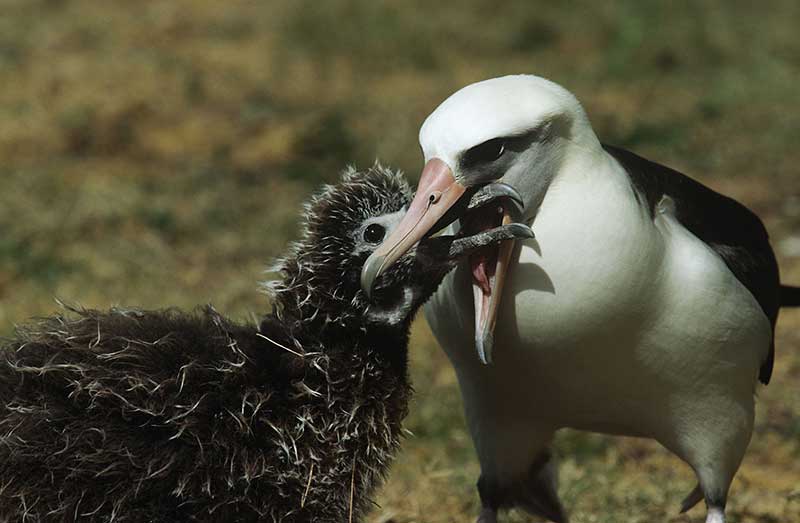
Because of their arduous breeding cycle, all albatrosses tend to have a fairly low rate of reproduction. They also sometimes skip a breeding season, and many albatross chicks die in their first year.
However, female-female pairs successfully fledge far fewer chicks than even male-female pairs. Over a ten-year period, a female in a same sex pair will raise one offspring whereas a female in a mixed sex pair will raise 2.14 over the same period.
It is not clear why the rate of success is so much lower. One reason may be because the females are themselves more at risk of dying. In mixed sex pairs once a female has laid an egg the male takes over incubation duties so the female can return to the sea to find food. But in same sex pairs the female who lays the egg also takes the first incubation shift so she has to wait 3 weeks before she can go in search of food, putting her own health at risk.
Young and VanderWerf also found that female pairs don’t necessarily stick together for life. At the beginning of each breeding season some female pairs will take male partners and some females will abandon males for females. And the switches aren’t random. Females who had a successful breeding season are more likely to swap to a male partner. The team didn’t find a single instance of a female albatross who had failed to reproduce who switched to a male partner the next year.
Males in this situation are getting the best of both worlds. They’re choosing to pair up with fertile females and put in the effort of incubation and feeding where reproductive success is more likely. But by mating with females who form same-sex pairs they’re also producing offspring while making no effort at all.