


Although, killdeers are classed as shorebirds, they are usually found far from the shore or even water. They are ground-dwelling birds commonly found in open landscapes such as grazed fields, meadows, and gravel roads, and even in urban areas like car parks, airports, and golf courses. They thrive in habitats with minimal vegetation, where their mottled brown plumage provides excellent camouflage. During non-breeding season, they move to coastal wetlands and rocky shorelines.
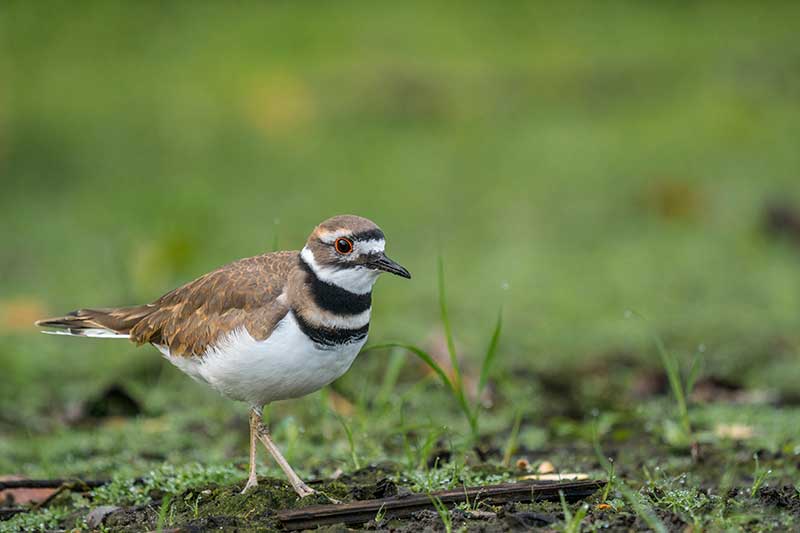
Although native to North and Central America, killdeers have a reputation as long-distance migrants, travelling as far as South America during the winter months. Their adaptability to a variety of environments has made them one of the most widespread and resilient plovers.
However, what truly sets the killdeer apart is its dramatic and theatrical behaviour during the broken-wing act.
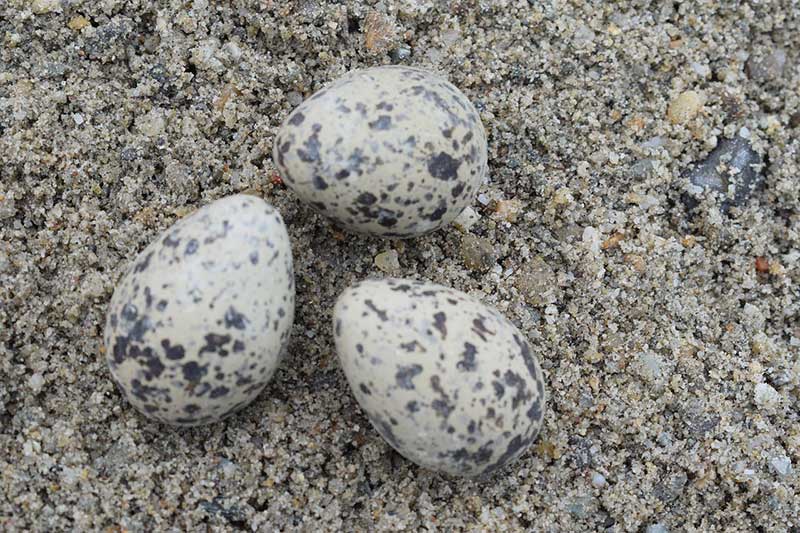
Like many ground-nesting birds, killdeers don’t build elaborate nests. Instead, they create simple scrapes in the ground, often lined with small stones or grass, where they lay 4-6 well-camouflaged, speckled eggs. They sometimes nest on rooftops or expansive lawns. The lining of the nest often includes white materials, which help reflect heat and keep the nest cool. Killdeers can lay up to five clutches a year to replace lost eggs, typically producing two successful broods annually.
Both parents share incubation duties, which last 22–28 days. In extremely hot climates, or around midday in temperate regions, the parents don’t sit directly on the eggs. Instead, they stand over them to provide shade. To further cool the eggs, killdeers sometimes soak their belly feathers in water and then stand over the clutch, allowing the evaporation to reduce the temperature.
Killdeer chicks are well-adapted for survival in their open habitat. They hatch precocial, and are born relatively large, fully feathered, and able to walk within a few days. Once hatched, the parents quickly lead the chicks away from the exposed nest to areas with more vegetation where they can hide if threatened. Both parents take an active role in raising the chicks, with one always present to attend to them while the other defends the nest. As the chicks grow, the attending parent gradually spends more time foraging. The young fledge about a month after hatching.
The killdeer’s broken-wing act is as clever as it is convincing. When a predator or intruder approaches its nest, the bird springs into action, moving a short distance away from its eggs or chicks and beginning its dramatic performance. It flutters awkwardly, dragging one wing as if injured, and emits loud distress calls, creating a general disturbance to capture the predator’s attention.
Once the predator’s attention is secured, the bird turns its tail toward the threat, exposing the bright orange colour of its rump as a warning signal. It then crouches, droops its wings, and lowers its tail. As the situation escalates, the bird intensifies its display by raising its wings higher, fanning its tail, and lowering it even more dramatically.
The predator, lured by the promise of an easy meal, locks onto the seemingly helpless bird and follows it. However, just as the predator gets close, the killdeer miraculously “recovers” and flies away, leaving the would-be attacker empty-handed. Meanwhile, its nest remains hidden and safe from harm.
Another defensive tactic employed by killdeers is the “ungulate display”. In this manoeuvre, the adult raises its wings, exposes its rump, lowers its head, and charges at the intruder. Although highly effective in some situations, this display can be dangerous and even fatal for the parent bird.
The intensity of these defensive responses varies throughout the breeding season. During egg-laying, killdeers often respond to threats by quietly slipping away from the nest to avoid drawing attention. Once incubation begins, their protective behaviour intensifies, peaking after the chicks hatch when their survival becomes most critical. As the young grow and become more independent, the parents gradually scale back their defensive efforts, until they return to a more standard response.
Despite their camouflaged eggs, cooling techniques, attentive care for their chicks, and the clever broken-wing act, killdeers still face a nest failure rate of 50 to 60%.
The broken-wing act is just one example of a broader category of bird behaviours known as distraction displays. These tactics are used to mislead predators and protect vulnerable eggs, chicks, or nests.
These displays aren’t learned tricks but instinctive behaviours, shaped and perfected over generations of evolutionary pressure. Birds that effectively fool predators ensure the survival of their young, passing this crafty trait on to the next generation. However, exactly how these elaborate performances came to be, remains a topic of debate among experts.
Some scientists suggest that distraction displays evolved from a tug-of-war within the bird itself, a parent’s conflicting instincts to confront a predator, stay near the nest, or flee from danger. Others believe these behaviours arose directly as predator-defence strategies, becoming more refined over time in species heavily exposed to threats. In either case, one thing is certain: fear drives these performances. Tame birds, unafraid of intruders, don’t display them, and birds that grow used to harmless disturbance, whether from predators or researchers, may stop performing them altogether.
The timing and intensity of these displays depend on how much parents have invested in their young. Birds with helpless, altricial chicks often give their most dramatic and risky performances just before their young are ready to fledge, when the parents’ investment is at its peak and it’s too late in the season to try again. For species with precocial chicks, the most daring displays occur right after hatching, when the parents’ commitment to their offspring has reached its height. As the chicks grow more independent and require less care, the displays diminish in both frequency and intensity.
The killdeer might be the poster child for distraction displays, but it’s far from the only bird to use this clever tactic. Snowy owls, alpine accentors, mourning doves, and many other plovers and waders also rely on similar strategies. The broken-wing act is also just one of many ingenious methods birds use to protect themselves and their offspring.
False nests: Birds pretend to incubate non-existent nests, drawing predators away from their actual eggs by leading them on a wild goose chase.
Rodent runs: The bird drags its wings, creating the illusion of a second pair of legs, erects its feathers, providing some resemblance to fur, and “squeals” while it runs between imaginary barriers pretending to be a small mammal.
Distraction calls: After laying an egg in a reed warbler’s nest, the common cuckoo emits a call that mimics the sound of a sparrowhawk. This clever tactic startles the reed warbler, luring it away from the nest and giving the cuckoo’s newly deposited egg a better chance of going unnoticed by the host mother


