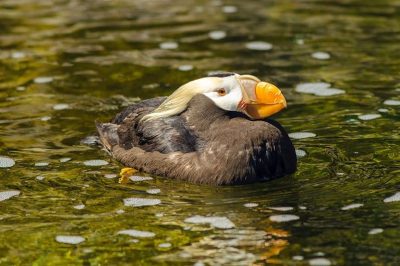
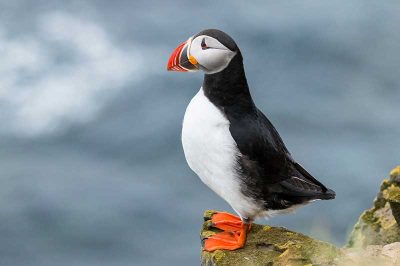
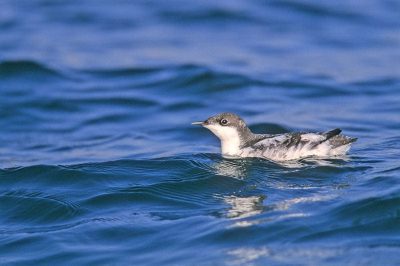
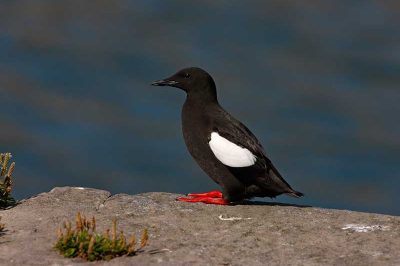
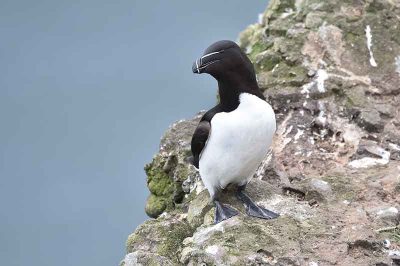
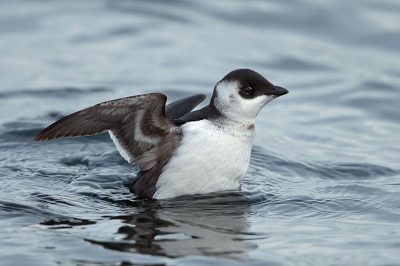
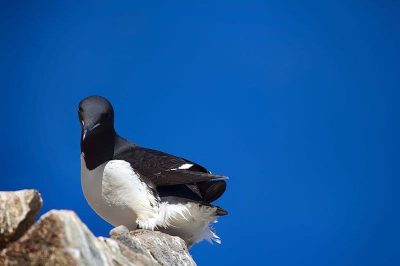
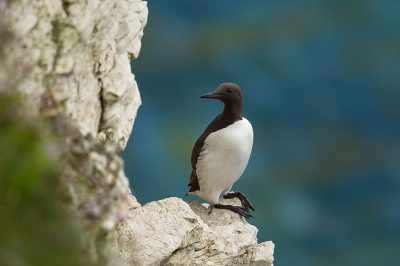
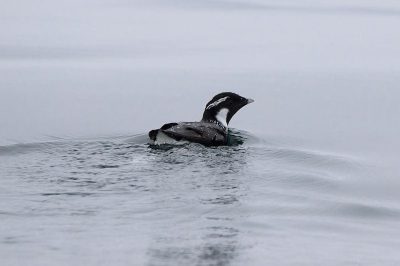
Auks, murres, and puffins are a small family of seabirds that, while similar in appearance to penguins, are not closely related. Instead, they are considered an example of convergent evolution. Auks are predominantly black and white, with an upright posture and small wings. Like penguins, they are excellent swimmers, using their short legs, positioned far back on their bodies, and flipper-like wings to dive and propel themselves underwater in pursuit of fish. However, this adaptation makes them rather clumsy on land and in flight.
Auks are found across the Northern Hemisphere and are known by different names in North America, where the two species of guillemot are called murres, and the little auk is referred to as a dovekie. They breed on rocky cliffs and islands but spend the rest of the year at sea.
They forage in the ocean, with some species diving to depths of up to 100 metres. Strong-swimming auks hunt fast, schooling fish, while weaker swimmers tend to feed on krill.
Auks are monogamous and form long-term pair bonds. They breed in large colonies or small groups, nesting on cliff edges or in burrows. Typically, they lay one or occasionally two eggs, which are incubated and cared for by both parents.
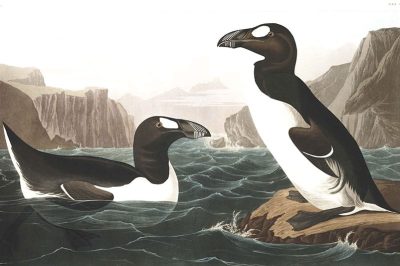
The Great Auk was the only flightless member of this family. Sadly, it is now extinct, becoming the only British-breeding bird species to appear on the British List after its extinction.
There are 24 extant species of auks, murres, and puffins worldwide, 9 of which are found in the UK.
Species marked with a are occasional visitors.