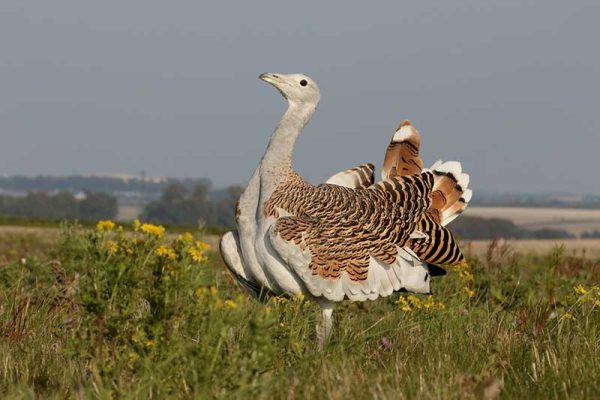
The European bee-eater is a brightly-coloured bird that typically breeds in southern and central Europe, northern and central Africa, and western Asia. Apart from the resident population in southern Africa, most European bee-eaters are highly migratory, spending the winter in tropical Africa.
Their diet primarily consists of European honey bees, which can make up to 80% of their food. However, their impact on local bee populations is minimal, consuming less than 1% of the worker bees in the areas they inhabit.
UK passage: 75 birds
Family: Bee-eaters
In breeding plumage, the adult male bee-eater displays vibrant colours. Its mantle is a bright chestnut, while the scapulars and rump are pale yellow. The upperwings are blue-green, and the tail, streamers, and uppertail coverts are green. The underparts are also blue-green, with pale grey underwings and undertail feathers.
On the head, the throat is yellow with a thin black band, the forehead is blue-green, and the crown is dark chestnut brown. The lores, which extend through the eye to the ear coverts, are black, bordered by pale blue-green. A white patch is present above the base of the bill. The pointed black bill has a subtle downward curve, the eyes are deep red, and the legs and feet are grey.
Out of breeding season, the bee-eater takes on a greener, duller appearance. The crown, throat band, and scapulars gain a green tinge, and the mantle, back, and rump are predominantly green.
The female bee-eater differs slightly from the male. Her scapulars and lower back are green, with less yellow, and her wings and underparts are paler and duller. She also has shorter tail streamers.
The juvenile bee-eater is paler overall than the adults and has brown eyes instead of the deep red seen in mature birds.
Try our interactive bird identifier
The bee-eater breeds on the male’s natal grounds, in cliffs, sandbanks, riverbanks, and quarries. It often nests in loose colonies but can sometimes be a solitary nester. Bee-eaters are monogamous during a breeding season, and in sedentary species, pairs may remain together for multiple years. Migratory bee-eaters, however, tend to find a new mate each season.
Both the male and female excavate a horizontal burrow, often with assistance from other pairs or juveniles. The burrow is usually 70–150 cm long and 7–9 cm in diameter. Digging the burrow involves removing between 7 and 12 kg of earth, a process that takes 10–20 days.
Bee-eaters lay 4–10 smooth, glossy white eggs, which are incubated by both parents for 13–20 days, depending on the region. The chicks hatch over a span of 2–6 days and are altricial, requiring parental care. As their juvenile feathers grow, they may become aggressive. Chicks are fed by their parents as well as by other adults in the colony. They fledge approximately one month after hatching but continue to be fed by their parents for several more days. Bee-eaters reach sexual maturity at one year; while females may breed at this age, males typically wait until they are two years old.
Bee-eaters primarily feed on insects such as bees, wasps, hornets, flies, dragonflies, butterflies, and grasshoppers. When raising their young, they may consume over 200 bees per day.
They catch their prey mid-flight and kill it by striking it against a hard surface to remove the sting.

Bee-eaters are scarce visitors to the UK, but have been spotted as far north as Scotland.
They are most likely to be seen in late summer and autumn. Look out for them in open country, woodland, and farmland where bees and other flying insects are abundant.
Britain's Birds
RSPB Handbook Of British Birds

Collins Bird Guide
Bee-eaters spend much of their time exhibiting comfort behaviour including sun, dust, and water bathing, stretching, bill scratching, and wing-flapping.