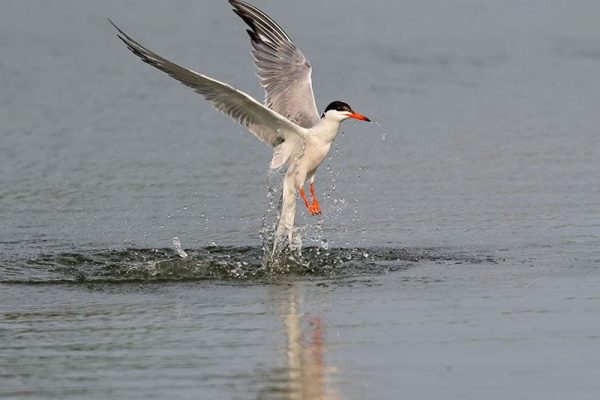
Breeding birds: 540 males
Family: Partridges, pheasants & quail
Adult male quails have brown upperparts, uppwerwings and tail with black, buff, and white streaks. Their belly and undertail coverts are pale grey and their breast and flanks are rufous with broad black and buff streaks on the flanks. Their flight feathers are grey-brown with buff mottles.
Their heads are pale brown with a yellow stipe on their crown, and a broad white supercilium that extends to the nape. They have a short narrow dark brown submoustachial stripe and a black line down the centre of the throat which joins a black band across the lower throat. The throat is dark brown.
Quails have black beaks, brown eyes, and yellow-brown legs and feet.
Female quails are similar to males but duller in colour overall with a pale throat. They have no black line on the throat and there is dark spotting on the breast.
Juvenile quails resemble females but they are paler and have more spotting on the underparts.
Try our interactive bird identifier
Quails breed from April to July and may have up to 3 clutches a season. The female builds the nest which is a shallow scrape in the ground hidden amongst vegetation and lined with grass.
Quails lay 7-13 smooth white or pale yellow eggs heavily marked and spotted with brown, which are incubated by the female alone for 17-21 days. The chicks are precocial and leave the nest soon after hatching but the female continues to care for them. They fledge at about 19 days but remain with the brood for about 50 days.
Quails eat mainly seeds but will supplement their diet with insects and larvae.

Quails can be seen in the UK from April to October. They can be found in the south and east of England, low-lying areas of northern England, and parts of southern Scotland. They are difficult to see and are more likely to be heard calling from grass or cereal fields.
Britain's Birds
RSPB Handbook Of British Birds
Collins Bird Guide
If they consume certain plants the flesh of quails can become poisonous. If you were to eat the meat from a poisonous quail you could become sick with coturnism which can lead to muscle breakdown, kidney failure, and death.