Family:
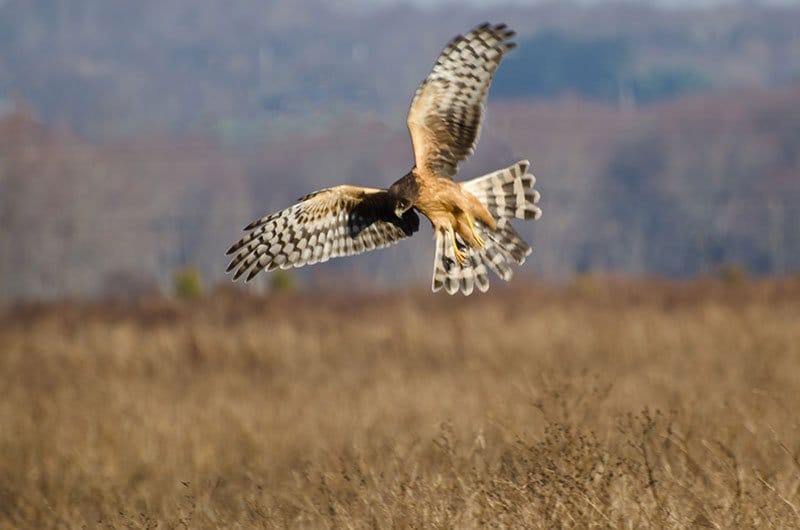
The Northern harrier, also known as the marsh hawk and the ring-tailed hawk, was formerly considered a subspecies of the hen harrier, and is its American counterpart. It is a medium-sized bird of prey with long, broad wings, a long, rounded tail, and a flat, owl-like face.
The male has grey upperparts with a dark trailing edge on the wings, black wingtips, and a white patch on its rump. Its tail is grey with dark bars, while the underparts are white with grey-brown streaking on the breast. The eyes are yellow, the bill is black with a bluish base and a yellow cere, and the legs and feet are yellow.
The female is larger than the male, and has dark brown upperparts with a pale wingbar. Her tail is dark brown, marked with grey-brown bars and a narrow white terminal band. The underparts are buff-coloured with dark brown streaking.
Try our interactive bird identifier
Northern harriers primarily feed on small mammals, such as voles, rabbits, and squirrels, but they will also take small birds, amphibians, and insects.
They hunt by flying low over fields with their wings held in a characteristic V-shape, scanning the ground for movement. They have been known to subdue larger prey by drowning them.
The Northern harrier is found throughout Canada and the northern United States. During winter, it migrates south to the southern United States, Mexico, and parts of Central America. It favours open habitats such as prairies, grasslands, marshes, wet meadows, swamps, and open countryside.