Family:
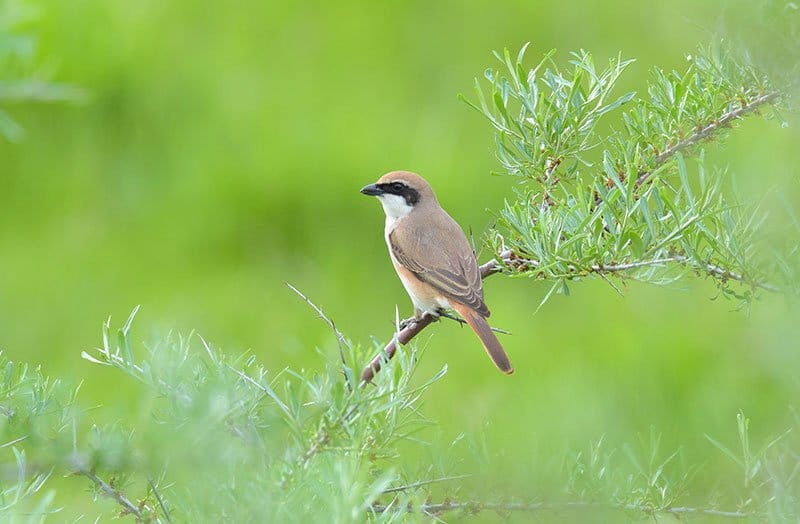
The Turkestan shrike, also known as the red-tailed shrike is a small, plain shrike very similar to the Daurian shrike. It has dark brown upperparts and white underparts with a rusty rump and tail and a rufous wash on the flanks. The wing feathers are edged with white and there is a white primary patch. On the head, the crown is rufous and there is a clear white stripe above the black face mask that continues over the bill. The grey bill is short and stout, the eyes are black, and the legs and feet are grey.
The female resembles the male but the white stripe on the head is duller.
It was until recently considered conspecific with the Daurian shrike but is now classified as a species in its own right.
Try our interactive bird identifier
Turkestan shrikes eat mainly large insects, as well as larvae, spiders, beetles, and termites hunting from prominent perches. They will also take small birds, chicks, small mammals, and lizards.
Like other members of the shrike family, they often impale their prey on thorns or barbed wire before returning to eat it.
The Turkestan shrike breeds in Siberia and central Asia including Kazakhstan, Iran, Afghanistan, and Pakistan. It can be found in open woodland, scrub, savanna, and farmland, as well as rural gardens. It migrates south to spend the winter in the Middle East, east and northeast Africa, making stopovers in northwest India.