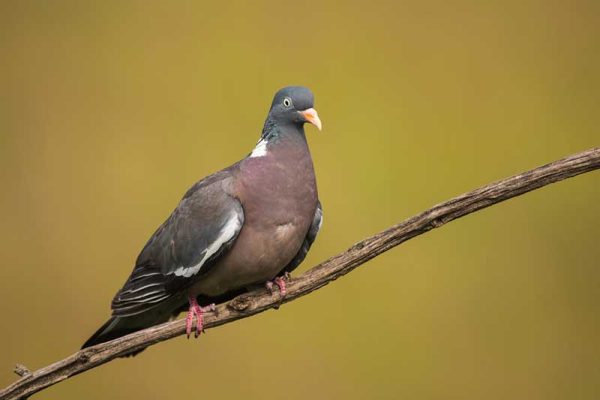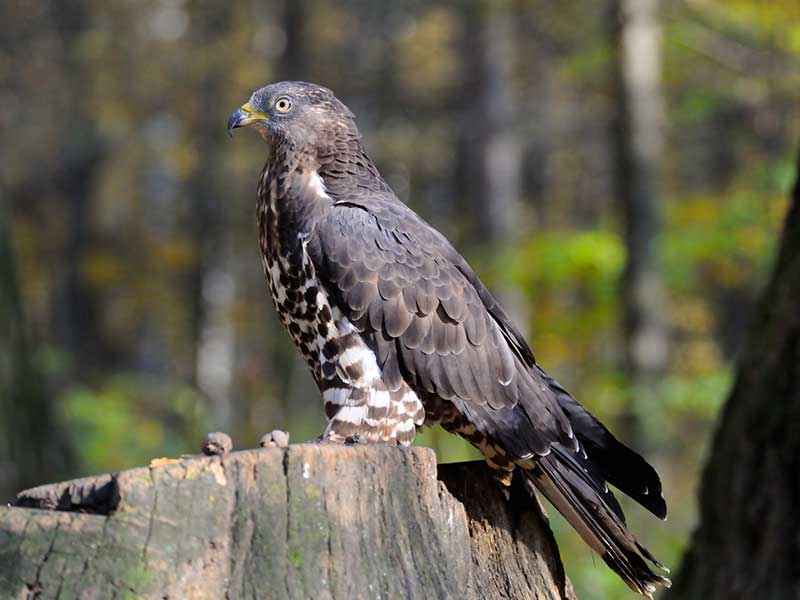
The European honey buzzard is a rare breeding bird in the UK, distinguishable from the much more numerous common buzzard by its larger size, longer wings, and longer tail.
It is a long-distance migrant, but avoids crossing large expanses of open water where soaring is not possible. Consequently, large numbers of honey buzzards can be seen migrating over the narrowest stretches of the Mediterranean, such as the Strait of Gibraltar, the Strait of Messina, and the Bosphorus Strait.
Breeding pairs: 41
Family: Hawks, Eagles, And Kites
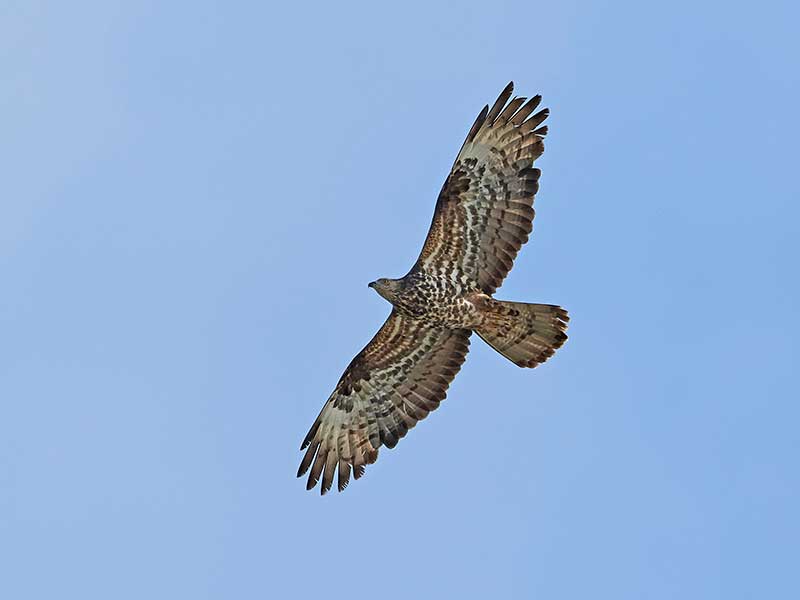
The honey buzzard displays varied plumage, but it is typically a reddish-brown colour. Its most distinctive features are three dark bars on the tail and barred underwings, which range in shade from white to dark brown.
The male honey buzzard has a grey head with golden eyes. the pointed bill has a black tip, while the legs and claws are yellow. The thighs are feathered, and the feet are scaled for added protection.
The female honey buzzard is larger than the male, and differs somewhat in appearance, an unusual trait among large birds of prey where sexes often look similar, with a darker head and upperparts and amber-coloured eyes.
In pale morphs, the plumage is generally lighter, though the darker patches on the underwings remain distinct.
Juvenile honey buzzards lack the bold plumage patterns of adults, with less prominent barring and subtler markings overall, and their eyes are yellow or brown.
Try our interactive bird identifier
The honey buzzard is monogamous, forming lifelong pair bonds and producing one brood per season. They typically breed in woodland areas, returning to the same site each year. Fiercely territorial, males perform aerial displays, known as sky dancing, to assert dominance over their territory. During courtship, they also perform a mating display consisting of a series of wing claps.
Honey buzzards lay 1–3 white eggs with brown spots at two-day intervals. Both the male and female share incubation duties, which last for 30–35 days. The chicks are altricial and are covered in grey-white down on their upperparts and yellow down on their head and neck. At around 15 days, their primary feathers begin to emerge.
Chicks remain in the nest for 33–45 days, during which time both parents are actively involved in feeding them. The male brings food to the nest, tears it into smaller pieces, and passes it to the female, who then feeds the chicks. Once the chicks are strong enough, they leave the nest and climb onto nearby branches, where they begin to develop their strength and agility. During this stage, they can become aggressive toward potential predators.
The chicks become independent at around 55 days but remain in their natal woodland for a further 20 days before embarking on their migration back to Africa. Honey buzzards reach sexual maturity at two years of age.
Honey buzzards are specialist feeders, with their diet primarily consisting of bees, wasps, and their larvae. They are known to raid nests, digging into the ground to access the combs. Occasionally, they will also consume worms, spiders, small amphibians, reptiles, and mammals, as well as nestlings. During the summer, they supplement their diet with fruit and berries.
Honey buzzards are believed to have a chemical deterrent in their feathers that protects them from wasp stings.
Honey buzzards are a rare summer visitor and a scarce autumn migrant, and can be spotted in southern and eastern England, Wales, and northern Scotland from mid May to mid August. Look out for them in forests, woodland, and parks during the summer, and near coasts in the autumn.
Britain's Birds
RSPB Handbook Of British Birds

Collins Bird Guide
In the 19th century, the honey buzzard was regarded as a winter delicacy in Europe. Historical accounts note that it was often caught during the winter months and described as “fat and delicious” to eat.