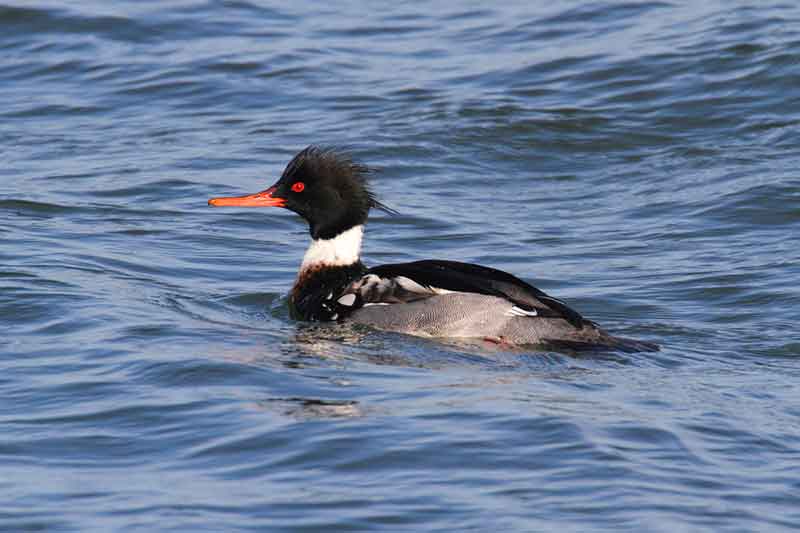
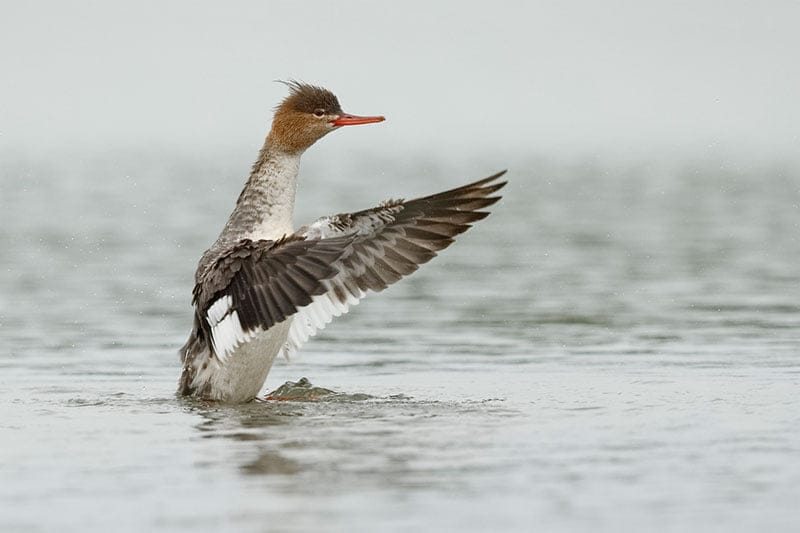
The red-breasted merganser is a medium-sized diving duck that belongs to a group known as sawbills. It is an elegant streamlined bird with a body shape adapted well for swimming, and a long serrated bill that helps it catch and hold on to fish, which make up the majority of its diet. It is similar to the goosander but can be distinguished by its thinner bill, reddish-brown breast, and green crest along the top of its head.
Breeding birds: 2,800 pairs
Wintering birds: 9,000
Family: Ducks, Geese, And Swans
In breeding plumage, the adult red-breasted merganser has black and white upperparts, with a black hind neck, mantle, and back. A broad white stripe runs along each side of the body, while the rump, uppertail coverts, and tail are grey, with pale feather edges creating a scale-like effect. The tail is tipped with a black terminal band.
The upperwings has a bold black and white pattern, with broad white wing patches tipped in black. The scapulars are black with white spots.
The underparts are white, with reddish-brown mottling on the breast, grey flanks marked by wavy black lines, and a prominent white collar around the neck. The head, chin, nape, and upper neck are a glossy dark green, with a dark green crest on the crown and nape. It has a slender red bill, and deep red eyes, legs, and webbed feet.
The female red-breasted merganser is smaller than the male and has a grey body with a dark reddish-brown head and a white chin, throat, and breast. The upperwing has less white, and the scapulars are grey. The bill, eyes, legs, and feet are a duller red compared to the male.
Males in eclipse plumage resemble females but have a darker mantle and white wing coverts.
Juveniles also resemble females but have duller plumage and a shorter crest.
Try our interactive bird identifier
Red-breasted mergansers breed from April to June, either as solitary pairs or in loose colonies. Courtship displays involve males showing off their bright plumage and bill while emitting soft grunts to attract a mate. The species is monogamous during the breeding season, though copulation outside the pair sometimes occurs.
The female builds the nest on the ground, typically near water, and sometimes in rocky crevices. It is a shallow, concealed depression covered with grass and lined with down plucked from her breast.
A typical clutch consists of 8–10 olive or buff-coloured eggs, which the female incubates alone. Other females may lay eggs in the same nest, resulting in clutches of up to 24 eggs. The incubation period lasts 28–35 days.
The chicks are precocial, hatching fully covered in brown and white down. They leave the nest within 24 hours of hatching and fledge 60–65 days later. Red-breasted mergansers reach sexual maturity at around two years of age.
Red-breasted mergansers are opportunistic feeders, primarily preying on fish up to 10 cm in length. Their diet also includes crustaceans, worms, aquatic insects, and amphibians such as tadpoles and small frogs.
They typically hunt by diving and swimming underwater. However, they are also known to forage for underwater invertebrates by submerging their heads, and occasionally take prey directly from the water’s surface.
Red-breasted mergansers can be seen all year round but population numbers reach a peak in December and wintering birds return to their breeding grounds in March. They are resident in the north-west of Scotland, England, Wales and parts of Ireland, and during the winter can be found in most coastal areas.
Britain's Birds
RSPB Handbook Of British Birds
Collins Bird Guide
The red-breasted merganser holds the record for the fastest airspeed of a duck while being pursued by an aeroplane, reaching speeds of 100 mph (161 km/h).