


The tiny Eurasian wren is the UK’s most common bird, though it is secretive and shy, making it difficult to spot. It is constantly on the move, typically staying close to the ground, but occasionally it will hop up a tree trunk or flit away using its short, rounded wings.
Its scientific name comes from the Greek word troglodytes meaning ‘cave-dweller,’ a reference to its tendency to disappear into crevices and cavities in search of food or a place to roost. During cold weather, multiple wrens often roost in dark, snug holes, huddling together for warmth.
Breeding birds: 8,600,000 territories
Family: Wrens
The adult wren has reddish-brown upperparts with fine, darker brown bars on its wings, tail, and rump. Its underparts are pale brown, marked with dark brown and black streaks on the flanks and belly. The short, rounded tail is chestnut-coloured, with dark brown streaks.
The head and nape are darker brown, with fewer streaks, and a pale supercilium extends from the base of the bill to behind the eye. The slender, slightly downward-curved bill has a black upper mandible and a yellow lower mandible. The eyes are dark brown, while the legs and feet are pale brown.
Males and females are similar in appearance.
Juvenile wrens have redder plumage than adults, with darker underparts streaked with dark brown. The head and nape are streaked, with black edges to the feathers.
Try our interactive bird identifier
Wrens breed between April and July, producing one or two broods each season. They may be either monogamous or polygamous with bigamy and trigamy the most common forms of polygamy. They nest in a variety of habitats, including moorlands, fields, woodlands, and gardens, typically in old stumps, woodpecker holes, abandoned nests, rock crevices, brambles, and hedges.
The male builds 3 or 4 dome-shaped, bulky nests made from sticks, moss, lichen, and dead leaves, each with an entrance hole to one side. The female selects one of these nests and helps line it with feathers and hair.
The female lays 4-7 white eggs, each with reddish-brown spots, and incubates them alone for 12-13 days. The chicks are altricial, covered with sparse grey down on their heads and backs, and are cared for by the female who feeds them insects and spiders. They fledge 15-20 days after hatching, and both parents continue to feed them for another 40 days. The young wrens reach sexual maturity at one year.
Wrens primarily eat insects, including caterpillars, flies, beetles, aphids, and larvae, as well as spiders, seeds, and berries. They will also consume small vertebrates such as tadpoles, young frogs, and small fish.
They forage on the ground or along the banks of streams and rivers.
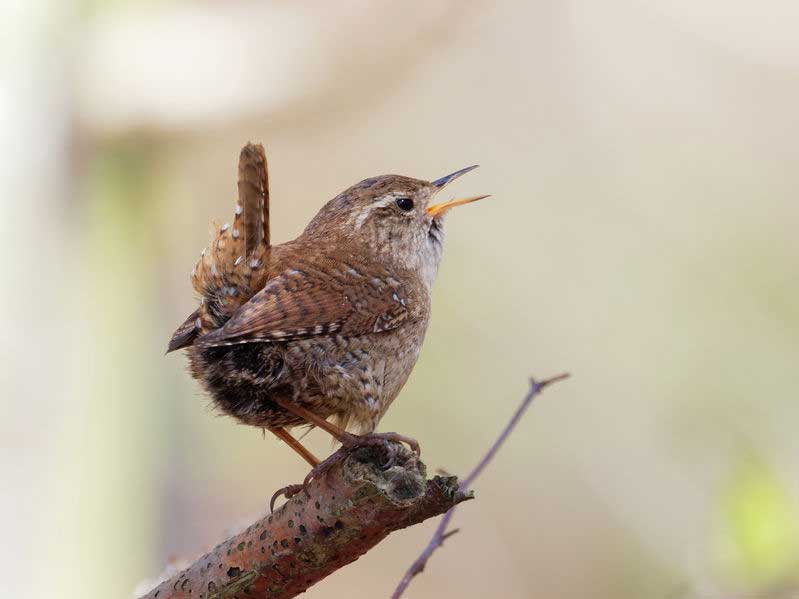
Wrens can be found throughout the UK and are a regular visitor to gardens. They can also be spotted on farmland, heathland, moorland, woodland, and coastal cliffs.
Britain's Birds
RSPB Handbook Of British Birds

Collins Bird Guide
The Eurasian wren is the only species of wren found outside the New World, which is home to no fewer than 95 recorded species of wrens.
The name “wren” is also used for some unrelated bird species, such as the New Zealand wrens and Australian wrens.


