Breeding birds: 5,300 pairs
Wintering birds: 16,000 birds
Family: Grebes
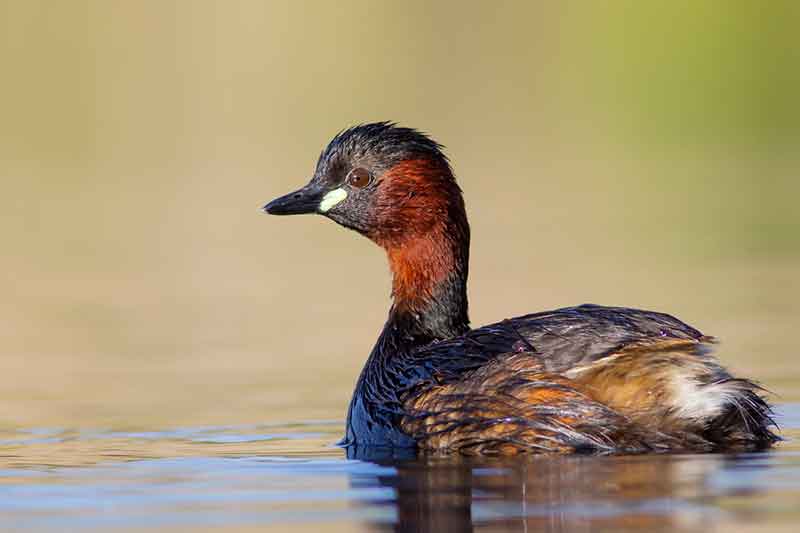
In breeding plumage little grebes have dark brown upperparts and upper wing coverts. The flight feathers are grey-brown and some white on the secondaries and the base of the inner flight feathers which shows as a white patch on the wing. The rump is white and often fluffy.
The underparts are dark brown with fluffy feathers and a chestnut wash on the flanks, and a white wash on the belly and base of the tail. The undertail and underwing coverts are white with dark tertials.
The crown and hindneck are dark, and the cheeks, throat and foreneck are bright chestnut-coloured. There is a conspicuous pale yellow patch at the base of the bill which is black with a yellow tip. The eyes are dark brown, and the legs and feet are dull green.
In non-breeding plumage little grebes are paler with grey-brown upperparts and buff flanks. The chestnut areas are buff or yellowy-brown, and the chin and the throat are white. The patch at the base of the bill is pale green. Male and females are similar but the female is smaller and duller.
Juveniles look like non-breeding adults with some dark marks on the face. The bill is yellow and gets darker as they mature.
Try our interactive bird identifier
Little grebes breed between February and September in small colonies. The nest is situated at the water’s edge, and is a floating structure made from decaying plant material anchored to aquatic plants or the branches of nearby shrubs and bushes.
Little grebes lay 3-5 white eggs which become stained from the nest material as incubation progresses. Both adults incubate the eggs for 2-25 days. Chicks are covered in dark down with pale stripes. They can swim soon after hatching, becoming independent at 30-40 days, and can fly at 44-48 days.
Little grebes eat insect larvae, crustaceans, amphibians, molluscs, and small fish. They pursue their prey underwater and catches it at the water’s surface.
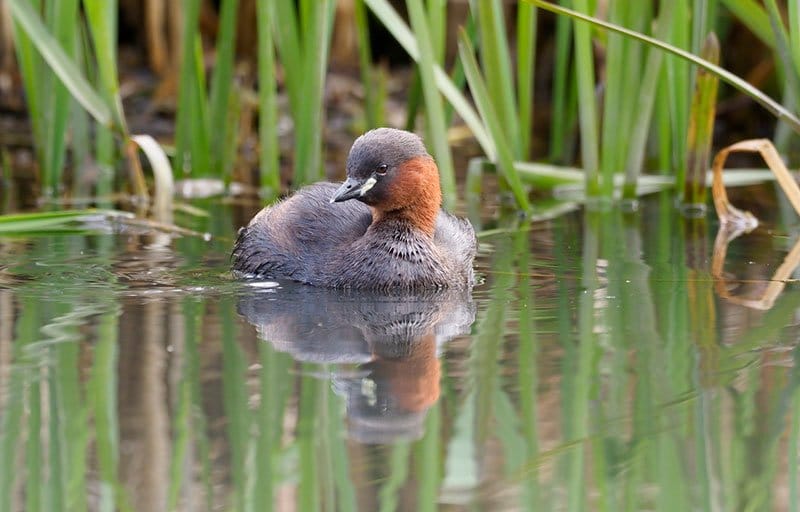
Little grebes can be seen all year round and all over the UK, except for upland areas. Look out for them in lakes, gravel pits, canals, and rivers, where there is a lot of vegetation. In winter they are also found in estuaries and on sheltered coasts.
Britain's Birds
RSPB Handbook Of British Birds
Collins Bird Guide
The little grebe is also known as the dabchick. The name dates from the middle of the 16th century and is from an obsolete word ‘dop meaning ‘dive’, ‘dip’, or ‘dabble’.