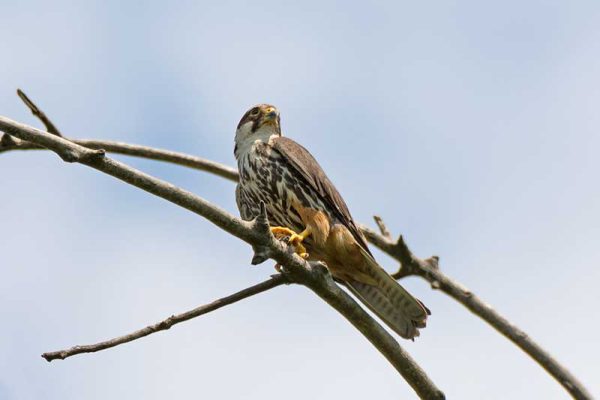
The common buzzard is the UK’s most widespread bird of prey. It spends its time perched on high poles or flying in the open, gliding over forests and fields. It has a fairly slow, clumsy take-off, but once in flight soars easily with few-wing beats, using thermals to reach a great height. Buzzards can be identified by their mewing call which sounds similar to that of a cat.
Breeding birds: 57,000 – 79,000 pairs
Family: Hawks, Eagles, And Kites
The adult buzzard typically has dark brown upperparts contrasting with much paler underparts with brown and reddish streaks on the belly. A distinctive pale band spans the breast, while the primaries are almost black, with a darker trailing edge. Its short, broad tail is grey-brown, marked with narrow bars and a dark terminal band.
The head is predominantly brown, with some white on the throat. It has yellow eyes, a black bill with a yellow cere and gape, and yellow legs and feet.
Males and females share similar plumage, but the female is larger.
Buzzards exhibit a variety of colour morphs and plumage patterns, which can make identification challenging. In south west England, for example, much paler buzzards are fairly common, appearing almost whitish. On the other hand, dark morphs can look almost black, distinguished by white streaks on the nape.
Juvenile buzzards resemble adults but are generally paler. Their underparts are streaked, and the head features white or yellow streaks, while the wings and back have reddish edges. The tail often lacks the terminal band seen in adults, and the eyes are typically grey rather than yellow.
Try our interactive bird identifier
Before breeding, buzzards engage in spectacular aerial displays to maintain territories and attract mates. This courtship ritual, known as sky-dancing, involves pairs circling high in the sky, spiralling upwards, and then diving sharply downwards with their wings closed.
Buzzards breed between March and May. They are monogamous and produce one brood per season. Nests are built in tall trees, often in the fork of a branch close to the trunk. The nests are flat and bulky, constructed from sticks, twigs, and small branches, and lined with green leaves for comfort.
They lay 2–5 smooth eggs, typically white with purple patches. The eggs are incubated for 33–35 days, predominantly by the female, while the male hunts for prey to feed her and guards the nest territory.
Buzzard chicks are covered in dull brown down on their upperparts, with white underparts and a dark patch around the eye. Both parents feed the chicks during the first few days, but the male primarily focuses on hunting and bringing food back to the nest. Unfortunately, the smallest chick in the nest often does not survive, sometimes being crushed by its larger siblings.
Chicks fledge approximately 50–55 days after hatching but remain dependent on their parents until late summer. Buzzards reach sexual maturity at around 2–3 years of age.
The buzzard is a generalist predator, feeding on a wide variety of prey. Its diet includes small to medium-sized mammals such as voles, mice, rats, young rabbits, and hares. It also hunts birds, ranging in size up to pigeons, pheasants, and partridges, as well as small reptiles, amphibians, insects, including beetles, crickets, and locusts, and worms. Occasionally, buzzards will take small fish and scavenge on carrion, with their diet varying depending on the season and their habitat.
Buzzards typically hunt by scanning the ground from a perch before swooping down to catch their prey. They may also glide over open countryside in search of food or stalk prey directly on the ground.
Outside of the breeding season, small flocks of buzzards are sometimes seen foraging together in fields, searching for food.

Buzzards are best seen in Scotland, Wales, the Lake District and South West England but breed across the whole of the UK.
They can be found across the countryside including woodlands, moorland, pastures but will also venture into villages and even city centres perching on fence posts and pylons as they scan for prey.
Britain's Birds
RSPB Handbook Of British Birds
Collins Bird Guide
Buzzards are not widely favoured by falconers, as they are often regarded as too lazy or slow to be effectively trained to pursue live prey. Their hunting style is less dynamic and aggressive compared to other raptors like hawks or falcons, and their ability to forage on the ground further contributes to their reputation as unsuitable for traditional falconry.