Breeding birds: 47,000 pairs
Family: Old World Flycatchers
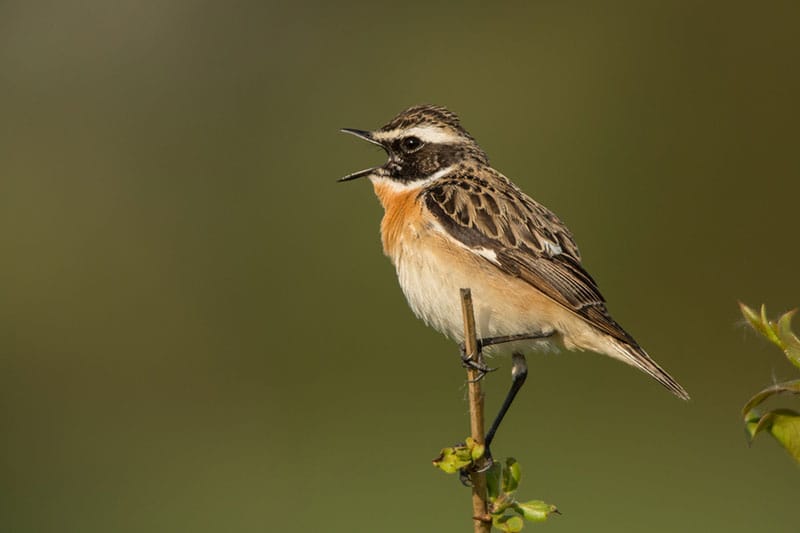
In breeding plumage adult male whinchats have buff upperparts streaked and spotted with black. Their upperwings are black with buff edges to their feathers and white alula. The throat and breast are orange with a white belly and undertail coverts. They have a short black tail with white edges.
The sides of their heads are black with a white supercilium and they have a black crown streaked with buff. There is a narrow white line from the chin to the neck.
Whinchats have dark brown eyes and black bill, legs, and feet.
Out of breeding plumage whinchats have a lighter head and dark stippling on the breast.
Females are similar to males but with a less distinctive pattern. She has a brown face and belly, and less white on the wings and tail.
Juveniles look like females but with dark mottles on the breast and flanks.
Try our interactive bird identifier
Whinchats breed between the middle of April and early August. They build their nests on the ground or in a low bush. It is cup-shaped and made from grass, leaves, and moss, and lined with finer plant material and hair.
Whinchats lay 2-7 pale blue-green eggs with reddish-brown markings which are incubated by the female alone for 12-15 days. The chicks are fed by both parents and fledge at 13-14 days and are able to fly at 17-19 days. They still depend on their parents for a further 15-18 days.
Whinchats eat mainly invertebrates including insects, bees, dragonflies, spiders, worms, and grasshoppers.
In autumn they will also eat seeds and berries.

Whinchats can be seen from April to September on the uplands of northern and western Britain.
Britain's Birds
RSPB Handbook Of British Birds
Collins Bird Guide
The whinchat used to be classified as a thrush but is now placed in the Old World flycatcher family.