Breeding birds: 87,000 pairs
Family: Swifts
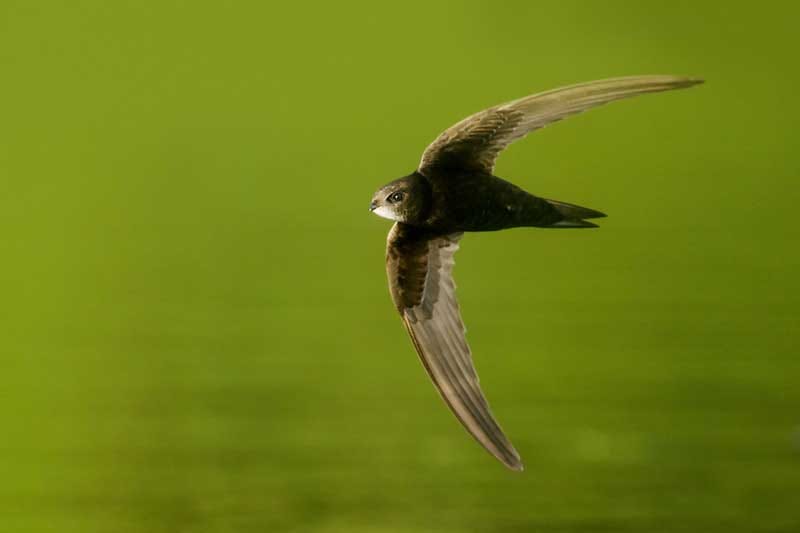
Swifts are quite large, slender birds with overall blackish-brown plumage except for a small white throat patch. The under and inner wing are slightly paler as are the rump and forehead.
Swifts wings are long and very pointed and their tails have a deep fork. Their bills are black with a large gape evolved to catching insects as they fly, and they have dark brown eyes. Their feet have strong claws for gripping onto vertical structures.
Juvenile swifts are blacker than adults and has a larger white throat patch and some white feathers on the forehead.
Try our interactive bird identifier
Swifts mostly nest in colonies of up to 40 pairs although some pairs will remain solitary. Nests are built about 1 metre apart at a site chosen by the male.
The cup-shaped nest is made with vegetation and feathers held together with the swift’s saliva. They build their nests in buildings, rock crevices and tree hollows.
Swifts lay 1-4 pear-shaped eggs which are smooth, glossy and white. Both male and female swifts incubate the eggs for 19-20 days. The chicks are naked when hatched but fully feathered at one month and fledge between 37 and 56 days after hatching.
Both adults and juvenile swifts are able to enter a state of topor which means they can live without food for up to 15 days.
Swifts feed on insects that they catch flying in the air but avoid stinging insects. They drink by flying low over water scooping up the water with a wide open mouth.

Swifts can be seen between April and August. They are seen all over the UK except the far north west of Scotland but you will need to look up into the sky to see them in flight; they do not perch on wires as swallows do.
At dusk they may form flocks flying low over rooftops.
Britain's Birds
RSPB Handbook Of British Birds
Collins Bird Guide
Common swifts can sleep on the wing and will even mate while flying. Young swifts may spend up to 3 years permanently in the air before they need to land for their first breeding season.