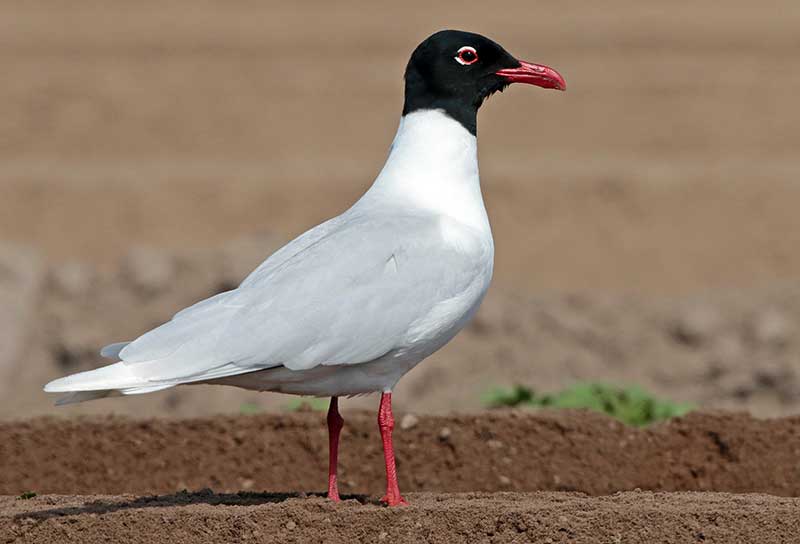
The Mediterranean gull was once a rare sight in the UK but since the 1960s its numbers have been steadily increasing. It can often be found living near its close relative the black-headed gull and inter-breeding has been known. It is slightly larger and heavier and can be distinguished by its black rather than dark brown head and white wing-tips.
Breeding birds: 600 – 630 pairs
UK wintering: 1,800 birds
Family: Gulls, Terns, And Skimmers
Mediterranean gulls in breeding plumage have a pale grey mantle and snowy-white underparts. The wings are pale grey with white tips to the primaries. The head is black except for distinctive white crescents around the eye, The bill is red with a black band towards the tip, dark red-brown eyes, and red legs and feet.
Out of breeding plumage Mediterranean gulls have the same plumage on the body but the head is not black and only shows a dark grey mask around the eyes. Males and females are similar.
Juveniles resemble adults in non-breeding plumage but have dark areas on the upperwngs, and a black terminal band on the tail. The bill and legs and feet are duller.
Try our interactive bird identifier
Mediterranean gulls for monogamous pair bonds. They nest in colonies sometimes with other black-headed gulls in coastal lagoons and estuaries in sparsely vegetated areas, marshes, or reedbeds. Both male and female build the nest which is a scrape on the ground lined with grass and feathers.
Mediterranean gulls lay 2-4 smooth, cream or buff-coloured eggs with dark reddish-brown spots which are incubated by both parents for 23-25 days. Chicks are precocial and fed by both parents. They fledge 30-42 days after hatching
Mediterranean gulls are opportunistic feeders and will eat mainly insects during breeding season while in the winter will take fish, worms, offal, and carrion, as well as discarded food scraps.
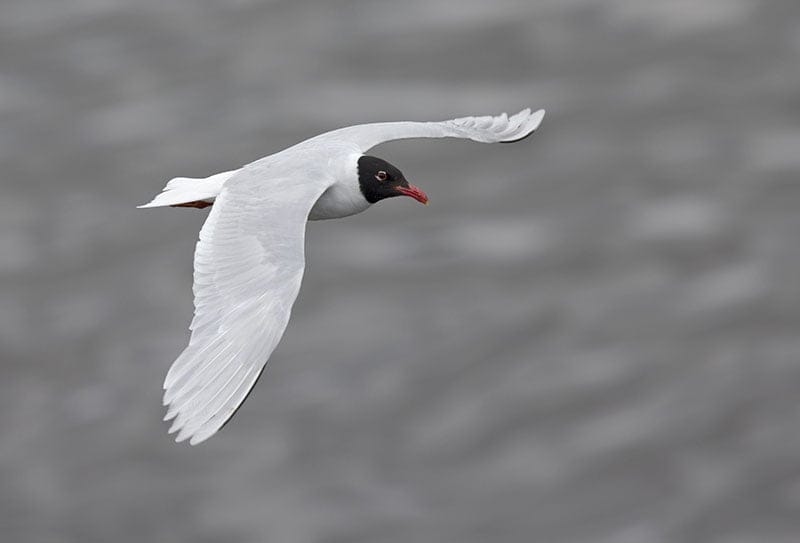
Mediterranean gulls can be seen all year round in the UK. In breeding season they can be found on coastal wetland in East Anglia and the north west of England. During winter they can found all around the coast except the very north of Scotland and and also be spotted inland around reservoirs.
Britain's Birds
RSPB Handbook Of British Birds
Collins Bird Guide
Mediterranean gulls are not pelagic birds which means they spend most of their time inland or near the coast rather than out at sea.