

Breeding birds: 1,100 pairs
Wintering birds: 3,400 birds
Family: Ducks, geese & swans
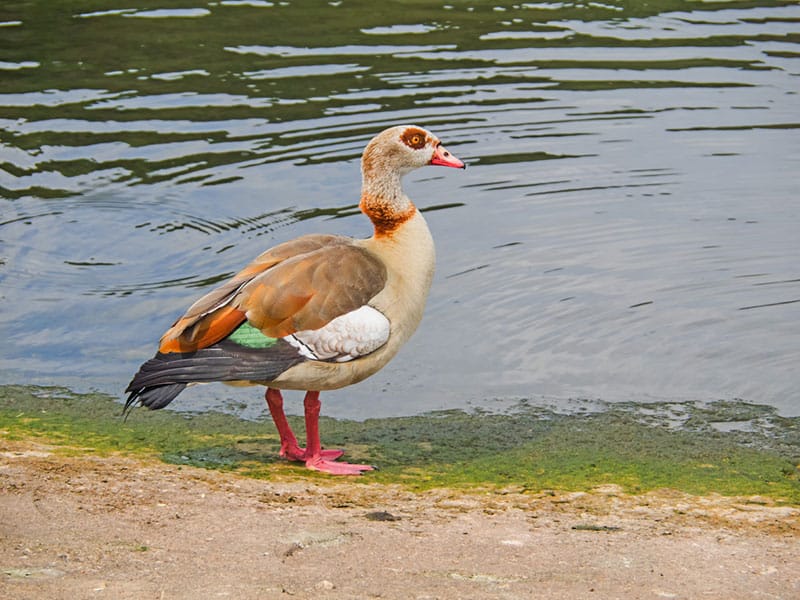
The Egyptian goose has varied plumage but usually has dark brown upper parts with lighter brown scapulars. Its breast and belly is grey or dull yellow with a dark patch. It has white wings crossed by a narrow black line, black primaries, metallic green secondaries, and chestnut coloured tertials. The rump and tail are black with cinnamon undertail coverts.
The head is buff-grey with a black line that starts from the bill and continues up to surround the eye with a broad dark band. There is a brown stripe that forms a fine collar on the lower neck towards the nape. The eyes are brown, and the bill and legs are dark pink.
Male and female Egyptian geese look similar but the male is larger than the female.
Juvenile Egyptian geese do not have the brown marks around the eyes or on the belly. The wings are more grey and the bill and legs are dull yellow.
Try our interactive bird identifier
Egyptian geese start breeding in spring and pairs remain together for life. They build their nest on the ground sheltered in vegetation, in abandoned nests of other species in a tree, or on a ledge. The nest is made from roots, leaves, and grass, and lined with down from the female’s breast.
Egyptian geese lay 5-11 creamy white eggs which are incubated by the female alone for 28-30 days. Both parents feed and care for the chicks which fledge at about 60-75 days after hatching. They remain with the parents for several more weeks or months and reach sexual maturity at about 2 years.
Egyptian geese eat grass, seeds, leaves, and stems from various plants, as well as grain, potatoes, and other vegetables. It will also supplement its diet with worms.

Egyptian geese can be seen all year round in the UK. They are found on ornamental ponds, gravel pits, lowland lakes, and wetlands. The largest populations are on the north Norfolk coast.
Britain's Birds
RSPB Handbook Of British Birds
Collins Bird Guide
Egyptian geese are actually ducks and are believed to be closely related to shelducks. It is the only extant member of the genus Alopochen which also contains prehistoric species and the relatively recently extinct Madagascar shelduck and Mauritius sheldgoose.




One Response
We live in Florida and have the privilege of having these beautiful ducks in our lakes year round. Right now we have a pair with seven babies that are around 3 weeks old. The mom and dad are such good parents. I love watching them.