Breeding birds: 0
Family: Pheasants, partridges & quail
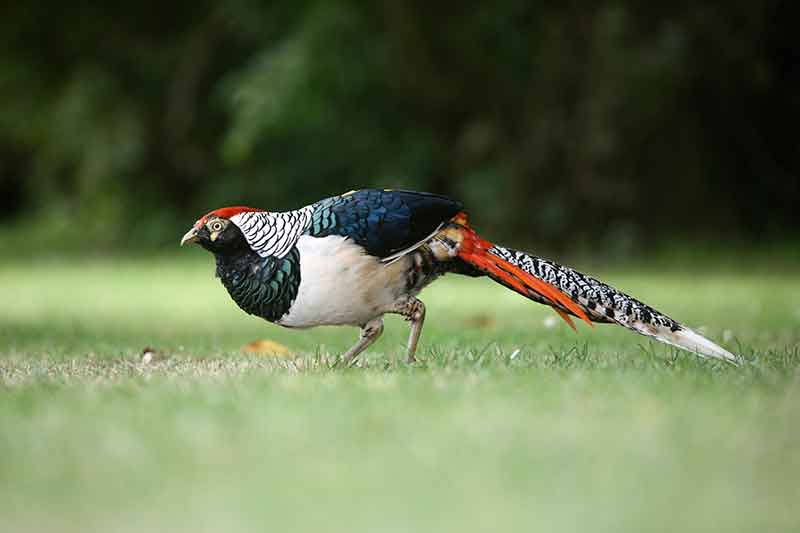
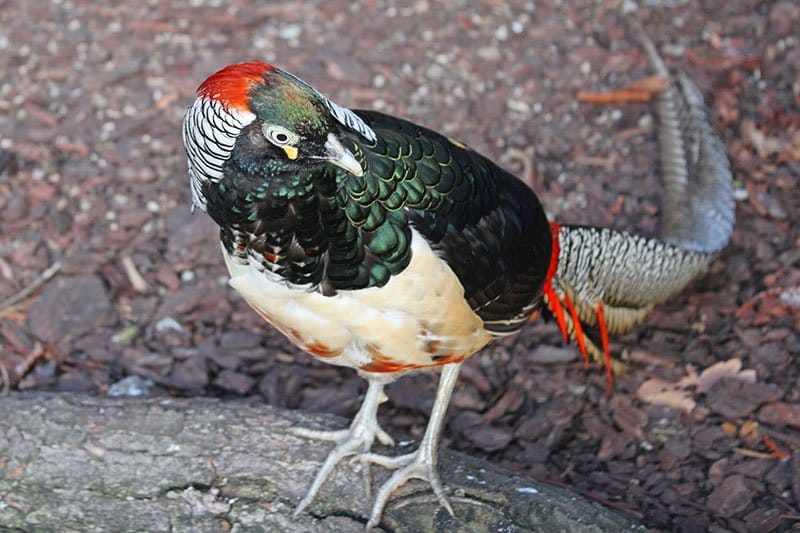
Male Lady Amherst’s pheasants have a dark blue-green mantle, back, scapulars, and breast with black scales. They have a yellow rump with blue-green bars. The belly is white and the vent and undertail coverts are white with black bars. Their uppertail coverts are black and white with some orange and red feathers. The longer feathers have pointed orange tips. Their throat and neck are black.
They have a dark blue-green face, chin, and forecrown and there is a bright red crest on the back of the crown that ends in a point on the nape. They have a black-scaled neck-ruff.
Their bill are blue-grey an the eyes are white with a pale blue eye-ring with a small yellow wattle under each eye. Their legs and feet are pale blue with spurs.
Female Lady Amherst’s pheasants have rust-coloured plumage with heavy black bars. The underparts are paler. The crown is reddish and they have a dark grey nape. The tail is rufous with black bars and shorter than the male. Their eyes are brown with a grey eye-ring and they have no spurs on their legs.
Juveniles are similar to females but they are paler and the bars are less conspicuous.
Try our interactive bird identifier
Lady Amherst’s pheasants build their nest on the ground under a bush or dead branches. It is a shallow depression lined with dead leaves.
Lady Amherst’s pheasants lay 6-12 cream-coloured eggs which are incubated by the female alone for 24 days. The chicks are precocial and leave the nest soon after hatching. They can feed themselves and are led away by the female who does not return to the nest again.
Lady Amherst’s pheasants eat spiders and small insects from the ground, as well as plant matter such as fern fronds.
Lady Amherst’s pheasants have not been spotted in the UK since 2016 and it is thought that they are now extinct.
Britain's Birds
RSPB Handbook Of British Birds
Collins Bird Guide
Lady Amherst’s pheasants were introduced from China by Sarah Amherst, Countess Amherst, a British naturalist and botanist. She released them on to an estate near the Duke of Bedford’s family seat Woburn Abbey.