

UK breeding birds: 0 – 11 females
UK wintering birds: 820 birds
Family: Sandpipers & allies
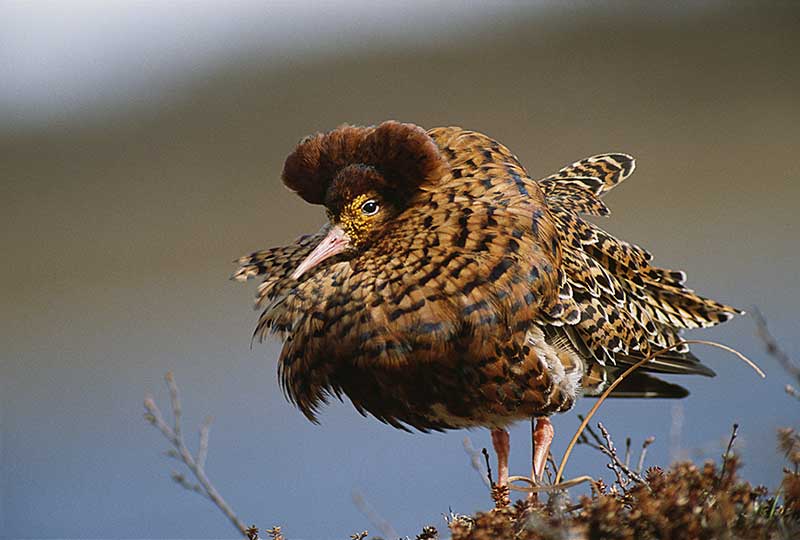
In breeding plumage, the adult male ruff has grey to brown upperparts and tail streaked with black bars. The mantle and scapulars vary between black, brown, chestnut, ochre, and white. On the underparts, the upperbreast is dark while the lower belly, underwing, and undertail are white.
The head and nape are grey-brown with darker streaks on the crown, and the throat is white with orange streaking. They have head tufts and ruffs which are highly variable in colour including buff, chestnut, dark purple, black, and white often with bars and flecks, and facial warts which can be grey, yellow, orange, or rust-coloured. The bill is brown or orange, the eyes are dark brown, and the legs and feet are yellowy-green.
When moulting male ruffs have black blotches on the breast and the head is white.
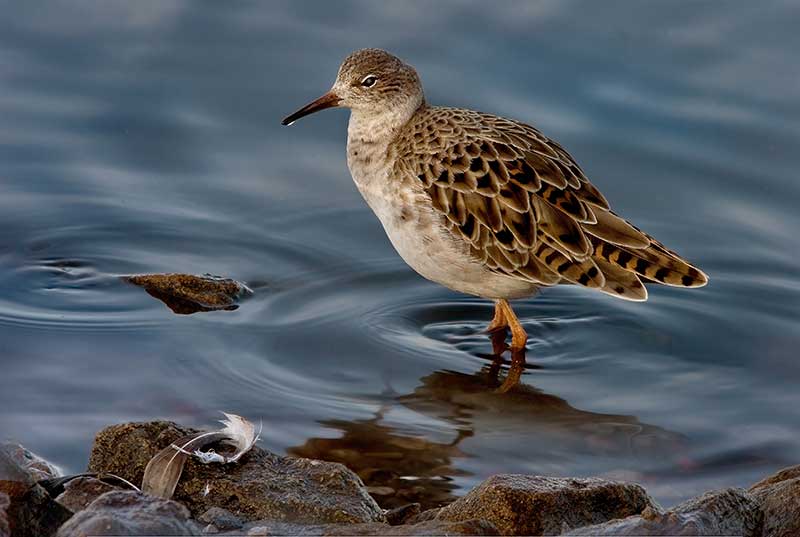
Out of breeding season, they lose the ornamental plumage and have pale grey-brown upperparts, a buff tinge to the breast, and the lower face is white. The bill is dark and the legs and feet are duller.
Female ruffs are similar to males in non-breeding plumage but are much smaller. They are heavily scaled on the breast, neck and head, and the feathers on the upperparts, breast sides, and flanks have black centres. The bill is black, and the legs and feet are orange, green, or grey.
Juveniles have dark upperparts with buff fringes on the feathers. The breast, belly, and foreneck are rufous, the throat is paler, and the face is buff.
Try our interactive bird identifier
Ruffs begin breeding in early May and produce 1 brood a season. They are polygynous and do not form pair bonds. They nest in solitary pairs or in loose colonies with nests spaced widely apart. The nest is placed on the ground and is hidden amongst marshy vegetation. It is a shallow scrape built by the female and lined with grass and leaves.
Ruffs lay 2-4 olive, green, or buff eggs with brown markings which are incubated by the female alone for 20-23 days. Chicks have yellow-orange down streaked with black on the upperparts and buff underparts. They leave the nest soon after hatching but are cared for by the female for a few days before leaving them before they fledge at 25-28 days. They reach sexual maturity at 2 years.
Ruffs eat mainly insects, such as flies, and beetles and other invertebrates, as well molluscs, crustaceans, small fish, frogs, worms, and spiders. During migration and winter, they also eat seeds.
They forage in wet grassland and mud, probing for prey with their beak or by sight.
Ruffs can be seen all year round in the UK, but are best looked for during spring and autumn when on passage migration. They are found mainly on the south and east coasts in wetlands, lagoons, and marshy areas.
Britain's Birds
RSPB Handbook Of British Birds
Collins Bird Guide
Female ruffs are called reeves which was an old name for the species. Prior to that, the original English name was ree which dates back to at least 1465, and is thought to be derived from a word meaning “frenzied”.


