Breeding birds: 50 pairs
Family: Finches, Euphonias, And Allies
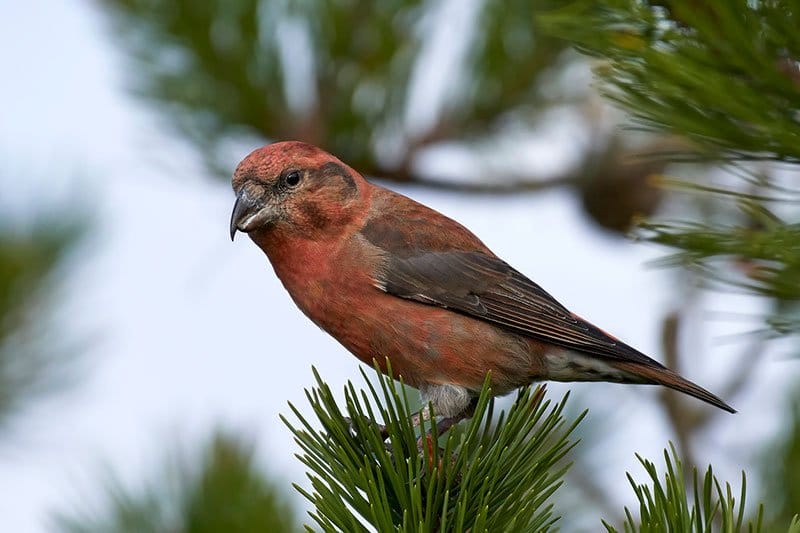
In breeding season, the adult male parrot crossbill has brick-red upperparts, often washed or flecked with darker tones or crimson mottling. Its mantle is reddish-brown, the rump is reddish-pink, and the tail is black with fine reddish-brown edges. The upper wing is dark olive-brown with rufous-brown median coverts, while the greater coverts and secondaries are fringed with pink or olive-brown. The underparts and throat are dark red, with an olive wash on the sides of the breast, and the undertail coverts are white with fine dark streaks.
The head is brick-red with dark lores and a grey stripe extending to the ear coverts. The eyes are dark brown, the bill is grey with paler cutting edges, and the legs and feet are pinkish-brown.
Outside of breeding season, the male becomes duller overall, with a grey or brown wash on the upperparts, while the underparts brighten to a more vivid red with grey or brown feather bases. The eyestripe becomes broader and greyer.
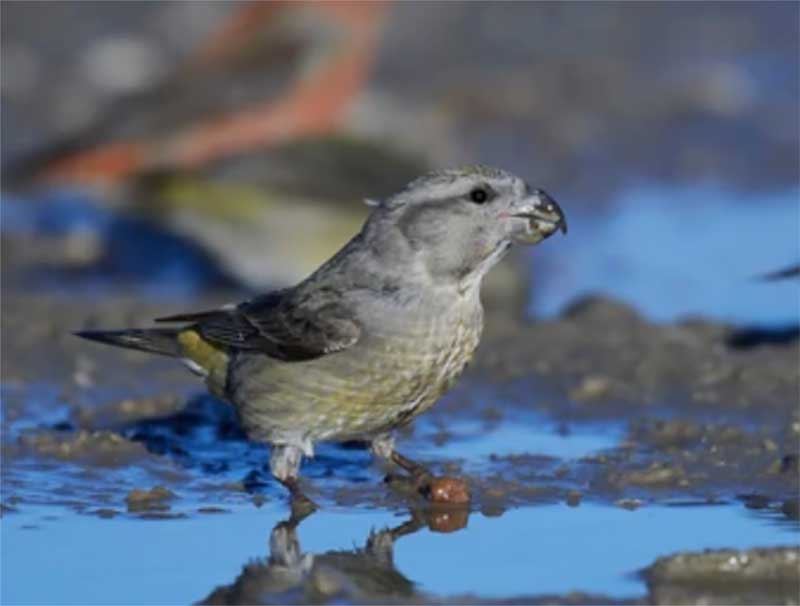
The female parrot crossbill has olive-grey upperparts with dusky feather bases on the mantle, darker olive-green scapulars, and a yellowish-green rump. Her underparts range from olive-yellow to yellowish, with a green or grey wash on the sides of the breast and flanks. The belly and undertail coverts are whitish with grey streaks. Her head is olive-grey, and her bill is smaller than that of the male.
Juveniles have dark olive or grey-green upperparts with dark streaking, while their underparts are pale buff-grey with dark streaks, except on the belly. Their head is dark olive.
Try our interactive bird identifier
The parrot crossbill breeds between March and April, timed with the availability of pine seeds. It is monogamous and produces one or two broods per season. It usually nests alone, or occasionally in loose colonies. During the nesting period, males frequently engage in courtship feeding, providing food to the female both during nest building and throughout incubation.
Parrot crossbills breed in pine forests, constructing their nests around 20 metres above the ground, either on a branch or in the fork of a tree. The female builds the nest, which is a cup-shaped structure made from dry conifer twigs, bark, pine needles, grass, leaves, moss, and lichen, and lined with softer materials such down, animal fur, and feathers.
The female lays 3–4 eggs, which are white to pale blue-green with fine dark markings. She incubates the eggs alone for 14–16 days. Once the chicks hatch, both parents feed them regurgitated conifer seeds. The chicks fledge about three weeks after hatching but remain dependent on their parents for an additional six weeks until their mandibles are fully crossed and functional. Parrot crossbills reach sexual maturity at one year of age.
Parrot crossbills primarily feed on seeds, buds, and shoots, with a strong preference for Scots pine, but also spruce, larch, poplar, and alder. They also eat crowberries, bilberries, and lingonberries, as well as cereals, and occasionally insects in the breeding season.
Their stout, crossed bill is specially adapted to extract seeds from conifer cones. After detaching a cone, the bird secures it with one foot while skilfully using its bill to extract the seeds.
A small resident population of parrot crossbills can be found all year round in Scotland’s Caledonian pine forests.
Occasionally, they may also be spotted during migration along the east coast of England and in the far north of Scotland.
Britain's Birds
RSPB Handbook Of British Birds
Collins Bird Guide
The firest part of the scientific name Loxia derives from the Ancient Greek word loxos, meaing “crosswise”, while pytyopsittacus combines the Greek words pitus or pituos, meaning “pine”, with psittakos, meaning “parrot”.