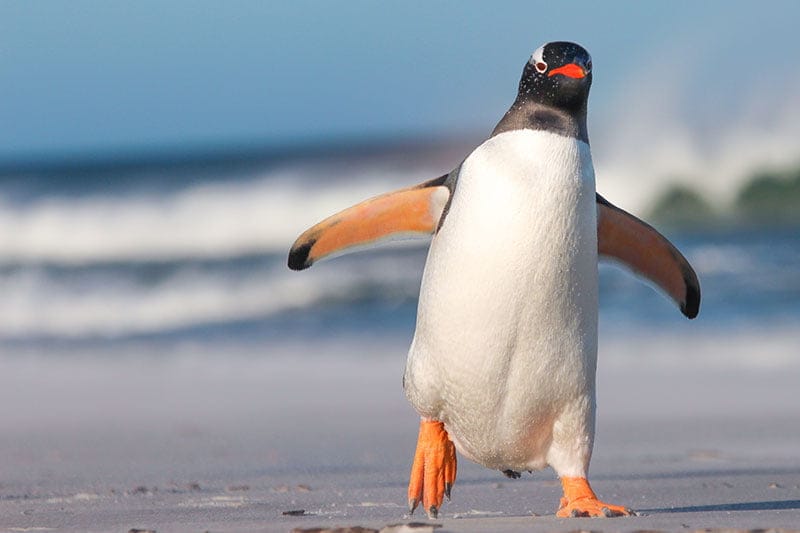
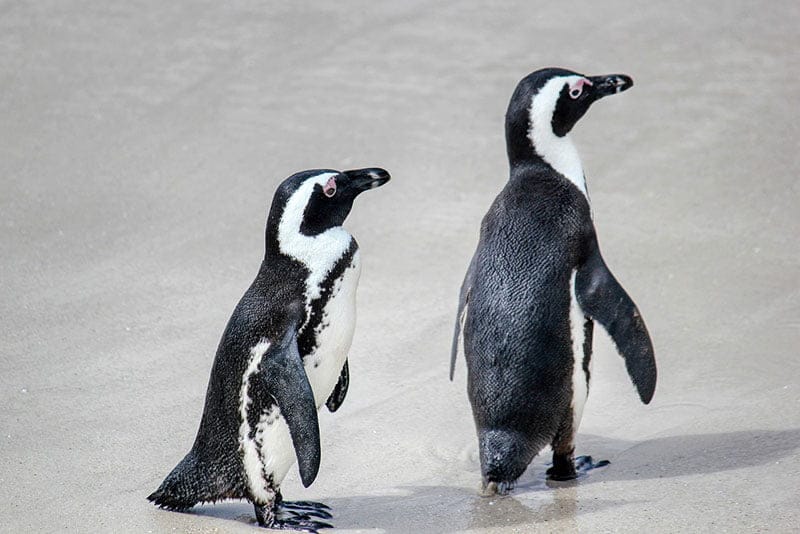
The bones of Waimanu are flatter than flighted birds but less flattened than modern penguins, which have highly compressed wing bones that make them like rigid paddles. The shape of the hind leg bones is very similar to living penguins and the feet are short and stubby, which shows that Waimanu had the same upright stance and waddling gait as today’s penguins.
In other words, Waimanu walked like a modern penguin on land, but was not as efficient in water.
Scientists believe Waimanu, probably evolved from a puffin-like flying bird, but because a fossil of this ancestor hasn’t yet been discovered it’s impossible to pinpoint the exact date when penguins abandoned flight.
For many years scientists believed that penguins as we know them originated in Antarctica. But the discovery of Waimanu and other penguin fossils shows that they actually originated from near what is now Australia and New Zealand about 22 million years ago. They then dispersed to South America, Africa, and Antarctica as bodies of water opened up as the Earth went through glacial changes.
There are many flightless birds in New Zealand and one of the reasons is that until humans arrived about 1,000 years ago there were no land mammals that preyed on birds. Flying uses a lot of energy, and without predators, birds could safely live and nest on the ground, and had no need to take off into the air to escape.
A lack of land predators is one possible explanation for why penguins evolved without flight, although at points where they enter the ocean, they are targets of leopard seals and sea lions. Without flight, penguins must also walk vast distances over land. Emperor penguins, for example, leave the sea before the breeding season and walk over 100 km in freezing conditions to their rookeries, which seems to be a poorly adapted behaviour.
However, there is a hypothesis which scientists think gives a compelling answer to the complex puzzle of why penguins can’t fly, and shows why the discovery of Waimanu was so important.
The biomechanical hypothesis put forward in 2013 says that a bird cannot have wings that are good at both swimming and flying, so as penguins started to swim more in search of food or new habitats, they lost the ability to fly.
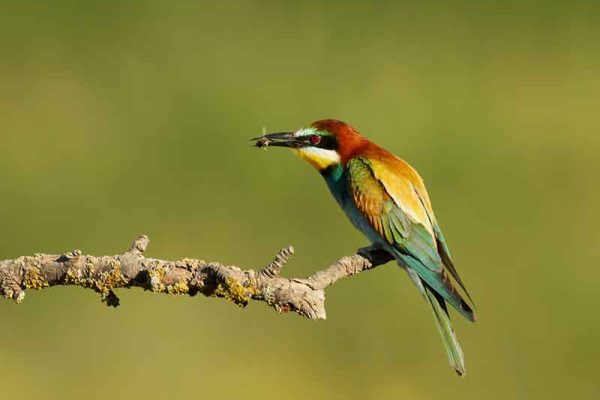
To test the theory an international team of scientists looked at a close relative of penguins, the thick-billed murre (Uria lomvia), also known as Brünnich’s guillemot, and a member of the auk family.
Like penguins, murres are black and white deep-diving sea birds that feed on crustaceans and fish. Their diving ability is comparable to penguins and although they can fly, they have small wings compared to their big bodies which means they have high wing-loading. To propel themselves through the water they flap their wings similar to how penguins use their flippers.
Thick-billed murres at a colony in Nunavut, Canada were injected with doubly labelled water, so the researchers could measure their metabolic rate, and fitted with devices so they could record their movements, such as the speed and depths of their dives, and their temperature.
The scientists also looked at the pelagic cormorant (Urile pelagicus), another large seabird, but one that propels itself through water using its webbed feet. Birds that use their feet to swim rely on drag-based propulsion, whereas wing-propelled swimmers use lift-based propulsion, and use their feet as a rudder, which makes them much better divers.
After monitoring the behaviour and physiological functions of the two groups of birds, the team compared the results to previous studies into the locomotion of penguins and geese
They found that although the murre could dive with relative ease, flying was exhausting. They had to flap their wings incredibly fast just to stay in the air, expending 31 times the amount of energy than when they were at rest, the highest recorded for any living bird.
In fact, a murre likely uses so much energy it can only just keep itself airborne, and represents the critical point at which seabirds are either able to both swim and fly or are flightless.
The flying ancestor of the penguin would have also reached such a tipping point. Evolution could then have sent it down one of two paths. It could have either kept its wings for flying and used its feet and legs for underwater propulsion, or it could have stopped flying altogether and adapted to life in the water.
With an abundance of fish and krill in the waters surrounding the ancestor’s habitat, natural selection favoured those birds with slightly shorter and stiffer wings who were able to swim better and reach food further out to sea or at lower depths.
And so over time, penguins gradually lost their ability to fly completely. Although, potentially more susceptible to predators, the trade-off was worth it. Penguins became larger – Palaeeudyptes klekowskii that lived between 37 and 40 million years ago weighed about 115 kg and measured 2 m in height – which meant better dive efficiency, and they could travel further afield in search of better habitats.

The wing bones became shorter, harder, and thicker and many of the bones fused until the elbow and wrist joints were almost one, and they became the flippers we know today.