The pigeon and dove family known as Columbidae contains 344 species divided into 50 genera, which is a group of species that have similar characteristics. 13 of these species are extinct including the dodo and the passenger pigeon.
The name “dove” is usually given to smaller species in the family while “pigeon” is reserved for larger members although this is not always consistent. However, in taxonomy, the scientific process for naming and classifying living things, there is no difference.
Historically, the common names for doves and pigeons have varied significantly. For example, the wood pigeon was once known as the ring dove, while the rock dove, the ancestor of feral pigeons, is sometimes called the rock pigeon or common pigeon.
Other examples of name variations include the shy ground dove, also known as the Tongan ground dove or friendly ground dove; the whistling dove, also called the whistling fruit dove, velvet dove, or yellow-headed dove; and the Nuku Hiva imperial pigeon, which is also referred to as the Marquesan imperial pigeon or Upe.
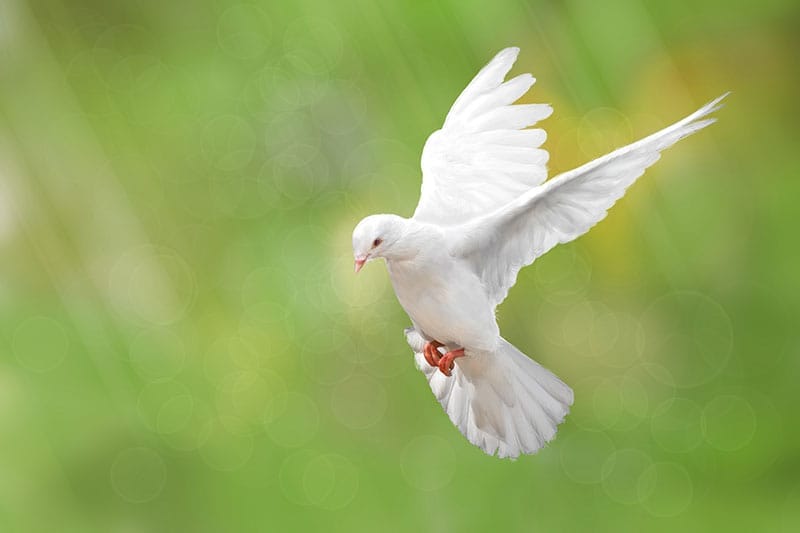
And the white doves released at weddings, funerals, and other public ceremonies, are in fact domestic homing pigeons bred for their small size and colour.
The earliest known English name for a pigeon was culufre or culfre, derived from the Vulgar Latin columbra, which itself came from the Latin columbula, a diminutive of columba. This, in turn, traces back to the Ancient Greek κόλυμβος (kolymbos), meaning diver, a name given to the rock dove by the comic playwright Aristophanes, inspired by the swimming-like motion of their wings in flight.
Evidence of this early use can be seen in the delightfully named The Gospel according to Saint Luke in Anglo-Saxon and Northumbrian versions synoptically arranged, with collations exhibiting all the readings of all the manuscripts edited by the Rev. Walter W. Skeat, late fellow of Christ’s College, Cambridge, in which Luke 3:22 has a culfre at Jesus’s baptism.
Se halega gast astah lichamlicre ansyne on hyne swa án culfre. stefen wæs of heofone geworden þus cwæð; Du eart min gecorena sunu on þe me gelicode.
The holy spirit appeared to him in the form of a dove. A voice came from heaven saying; You are my chosen son in whom I am well pleased.
Although published by Cambridge University Press in 1874, the work is written in Old English, the earliest recorded form of the English language, spoken from around 450 to 1100 AD, compiled from various Anglo-Saxon manuscripts.
By the 14th century, the word culver had begun to fall out of use. According to the Oxford English Dictionary, the earliest known citation of its replacement appears in Middle English in 1375 reproduced in the Rev. Alfred Hands Cooke The Early History of Mapledurham published in 1925.
“Thomas Blont… hath endowed Dame Isabell… with… the thridde [third] pejone of the grete dovehouse.”
The shift in terminology likely stems from the Norman Conquest of 1066, which brought a vast influx of words from Norman French and Latin into the English language. Many of these new terms were related to government, law, and aristocracy, as well as food and culture.
Although the Romans may have introduced domesticated columbae to Britain, evidenced by pigeon holes found in the ruins of a Roman town near the village of Caerwent in Monmouthshire, it wasn’t until after the Norman invasion that pigeons became widely kept, and, by the 12th century, Norman nobility had begun integrating dovecotes into their castles.
Initially, pigeons were kept solely for farming purposes, valued for their meat, eggs, feathers, and nutrient-rich droppings (guano), which served as an important fertiliser for crops. However, by the 16th century, dovecotes were increasingly built for ornamental purposes.
The Old French word for pigeon, pyjon (alternatively pigon, pigun, pigoun, pijoun, pijun) , comes from the Latin pīpiōnem, meaning chirping (or peeping) bird, derived from pīpiāre (“to chirp”). Given how the word has evolved phonetically, it’s surprising to think it has onomatopoeic origins.
The word culver continued to be used in poetry such as in Amoretti, a sonnet cycle written by Edmund Spenser and printed by William Ponsonby in 1595. The final sonnet of 89 begins:
Lyke as the culver on the bared bough
Sits mourning for the absence of her mate,
And in her songs sends many a wishful vow
For his returne, that seemes to linger late,
It was also used dialectally in the southwest and southeast of England to refer to the wood pigeon.
The word dove also originates from Middle English, with the earliest recorded use found in the Trinity College Homilies around the year 1200, as noted in the Oxford English Dictionary. In Old English, the word appears as dūfe, but only in compound forms. This evolved from the Proto-Germanic dūbǭ, which may also be linked to the word dive, though there is little concrete evidence to confirm this connection.
As seen in the excerpt above from The Early History of Mapledurham, pigeon and dove were often used interchangeably. However, it is more likely that pigeon referred to domesticated birds, while dove was used for wild ones.
Many English words for meats have French origins due to the linguistic divide between the Norman nobility and the Anglo-Saxon peasants. While the working class continued using Middle English terms for animals, the ruling class adopted French words for the meat derived from them. This distinction is evident in words like beef (from cow), veal (from calf), pork (from pig), mutton (from sheep), and venison (from deer). In some cases, the French-derived meat names were also applied to the live animals, particularly in poultry, such as poultry itself (from Old French poule), capon (for castrated roosters), and mallard (for wild drakes). The word pigeon, as we use it today, may be an example of this.