Breeding birds: 5,400,000 pairs
Family: Pigeons And Doves
The adult male wood pigeon has predominately blue-grey plumage which appears slightly duller on its wings. Its breast is a soft pink or mauve shade, and its belly is creamy-white. On the wings, it has black flight feathers edged with white, and a distinctive white band which is visible when the wings are open. The tail is grey with a white terminal band.
The head is blue-grey, and it has iridescent purple and green feathers on the neck along with a white patch on each side. The bill is red with a yellow tip, the eyes are green or golden, and the legs and feet are red.
The female closely resembles the male, but she has smaller patches on her neck, and a duller-coloured breast.
The juvenile wood pigeon is paler overall with a light, rust-colour breast. It lacks the iridescent neck feathers and the white patches seen in adults, and its eyes are dark grey with a subtle yellow tinge.
Try our interactive bird identifier
The wood pigeon can breed at any time of the year, although its main breeding season is from late April to early September, typically producing 2 or 3 broods annually. It is monogamous during the breeding season, although some pairs form lifelong bonds.
The nest is usually placed in the fork of a tree or on a branch, or occasionally on the ledge of a building, about 2 metres from the ground. It is constructed from twigs and lined with grass and leaves, and often appears flimsy and precarious.
Both parents participate in nest-building, with the male gathering materials and the female weaving them into the nest. Wood pigeons often reuse their nests each year, gradually adding to the structure until it becomes bulkier over time.
The wood pigeon lays 1–3 white eggs, which are incubated by both parents for 16–27 days. For the first four days after hatching, the chicks are fed regurgitated crop milk by both parents. They then switch to seeds for the next five days before being introduced to an adult diet of seeds, fruit, and some insects. The young birds fledge 26–29 days after hatching and reach sexual maturity at 1 year of age.
Wood pigeons eat mainly plant matter such as leaves, buds, flowers, seeds, and berries. They will also feed on invertebrates such as worms, beetles, spiders, slugs, and snails.
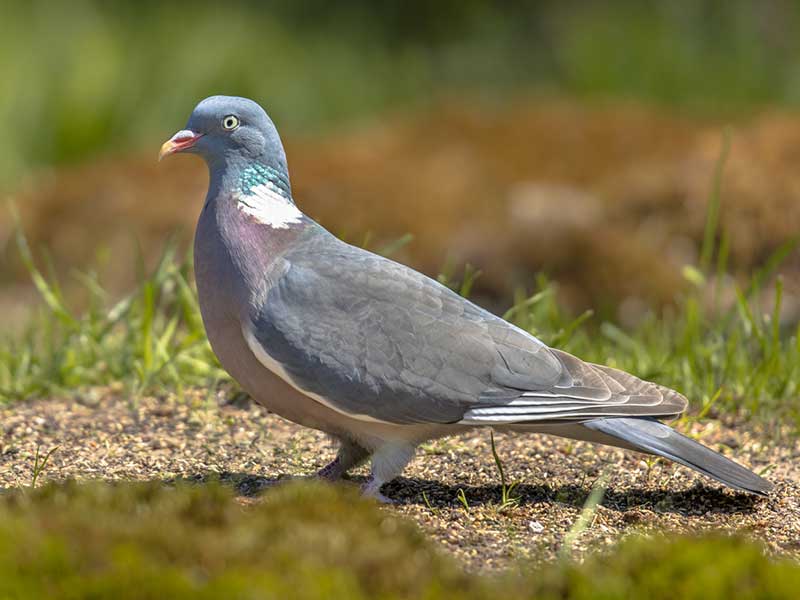
Wood pigeons are found across the UK in fields and woods, as well as parks and gardens in towns and cities.
Britain's Birds
RSPB Handbook Of British Birds
Collins Bird Guide
The wood pigeon’s crop can hold up to 15 acorns.