Breeding birds: 11,000 pairs
Family: Gulls, Terns, And Skimmers
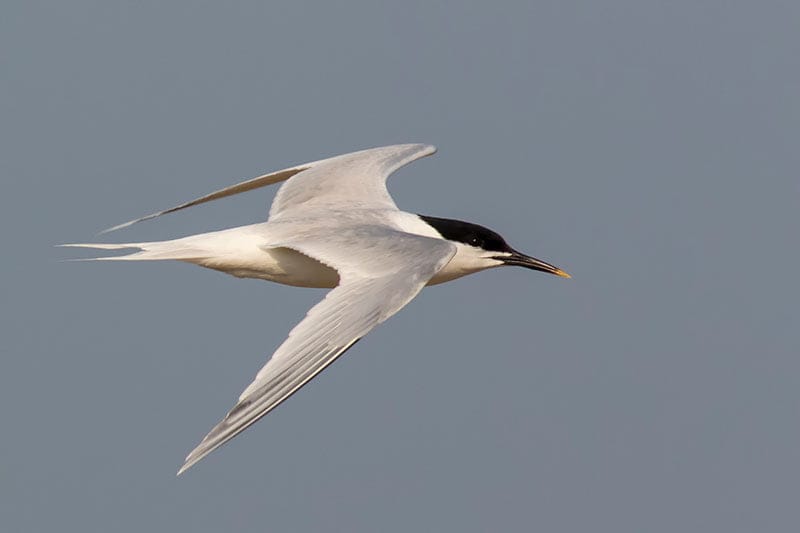
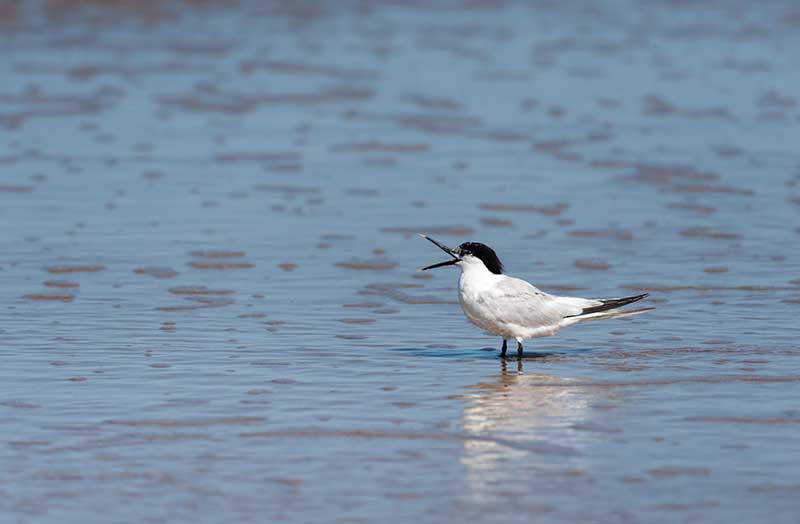
Sandwich terns in breeding plumage have a pale grey back and upperwing, and a white rump and forked tail. The underparts are white with a pale pink tint. The wings are long and pointed and the primaries have white inner webs and silvery-grey outer webs.
On the head, the crown is black with a shaggy crest, and the sides of the head, chin, and throat are white. The long, thin bill is black with a yellow tip, the eyes are black, and the legs and webbed feet are black. Male and female sandwich terns look similar.
Out of breeding plumage they have a white head and forecrown.
Juveniles have black and white scaling on the upperparts, and a dark band on the tail. On the head the forecrown in spotted, and the bill is black and shorter than the adults.
By the first winter it resembles the adult but some black markings on the tertials may remain until spring.
Try our interactive bird identifier
Sandwich terns breed in May and June, in dense colonies often with other species, in particular black-headed gulls, on open beaches and sandy islands.
The nest is a shallow depression on the ground that is excavated by both male and female. They make the hole by pushing their breasts into the ground and scraping away the sand behind with their feet. The nest is lined with shells, vegetation, and droppings which is added to during incubation.
Sandwich terns lay 1-2 white eggs with black markings, which are incubated by both parents for 25 days. Chicks have pale buff down with black speckles, and may form creches cared for by a few adults. They fledge at 28-35 days after hatching but still depend on their parents until the first winter.
Sandwich terns eat mainly fish such as sprats, whiting, and sardines, as well as small shrimps. They will also take worms and sometimes the chicks of other shorebirds including the avocet.
It forages by diving headfirst into the water and emerges quickly holding the prey in its bill.
Sandwich terns arrive in the UK in March and leave in October. They can be found in colonies on the coast, except the very far north of Scotland.
Britain's Birds
RSPB Handbook Of British Birds

Collins Bird Guide
The sandwich tern is named after the town of Sandwich where they were first discovered by the ornithologist John Latham in 1787. They were originally in the genus Sterna but have recently been moved to Thalasseus.