UK breeding: 100 birds
Family: Bustards
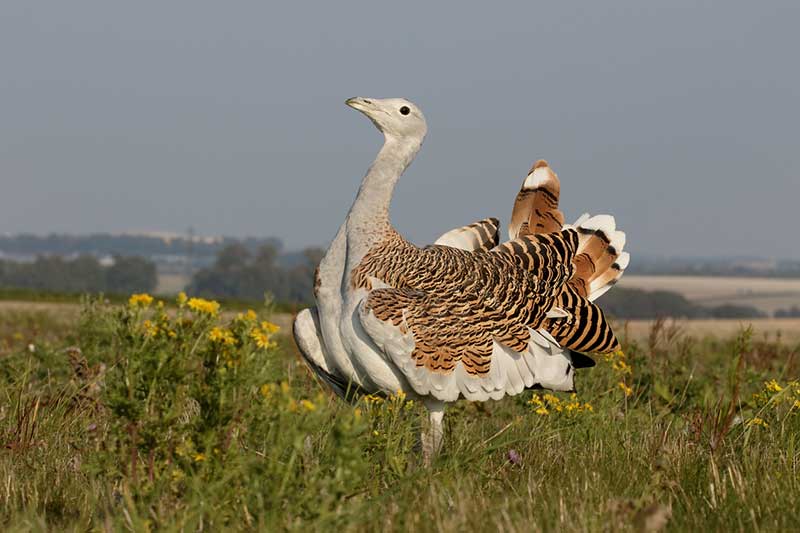
In breeding plumage, adult male great bustards have barred black and gold upperparts with a broad white patch on the wings. The tail has a white tip and wide black subterminal band. The underparts are white with bright chestnut on the breast and lower neck.
The head and foreneck are pale blue-grey that fades to white. On each side of the bill there are long white barbs. The bill is grey, the eyes are dark brown, and the legs and feet are olive brown or grey.
Out of breeding season, male great bustards do not have the barbs and the neck and breast are pale grey.
Females are duller and much smaller than males.
Juvenile great bustards are similar to females, but the bars are less obvious on the upperparts, and the head and neck are buffy-coloured.
Try our interactive bird identifier
Great bustards start breeding in spring and lay eggs in May or June. They are polygamous and males may mate with up to 5 females a season. The nest is a shallow scrape on the ground situated on dry slopes or plains and concealed among tall grass, occasionally lined with plant matter.
Great bustards lay 2-3 glossy, olive or tan eggs with darker markings, which are incubated by the female alone for about 25 days. Chicks are precocial and covered in pale buff, streaked down to camouflage them on the ground. They leave the nest immediately after hatching and are raised by the female alone. They fledge 30-35 days after hatching, reach full size between 80-120 days, but depend on their mother for about 10 months.
Females reach sexual maturity at 2-3 years, while males reach theirs at 5-6 years.
Great bustards are omnivorous but eat mainly vegetation including grass, legumes, crucifers, grains, and flowers. They will also take small mammals, such as rodents, chicks of other bird species, worms, butterflies, larvae, and large insects, as well as lizards and frogs.

Great bustards have been reintroduced to the UK on Salisbury Plain in Wiltshire. The public are not allowed to access them directly, but they can often be spotted at dusk when they gather in flocks on the crests of hills.
Britain's Birds
RSPB Handbook Of British Birds
Collins Bird Guide
Great bustards are one of the most sexually dimorphic of all bird species in terms of size. Adult males are about 2.5 times as heavy as females. Only green peafowl show a higher dimorphism with males weighing up to 4 times as much as females.