Family:
Wilson’s warbler is a small New World warbler with a relatively long tail that is named after the ornithologist Alexander Wilson, who formally described it in 1811. There are three recognised subspecies.
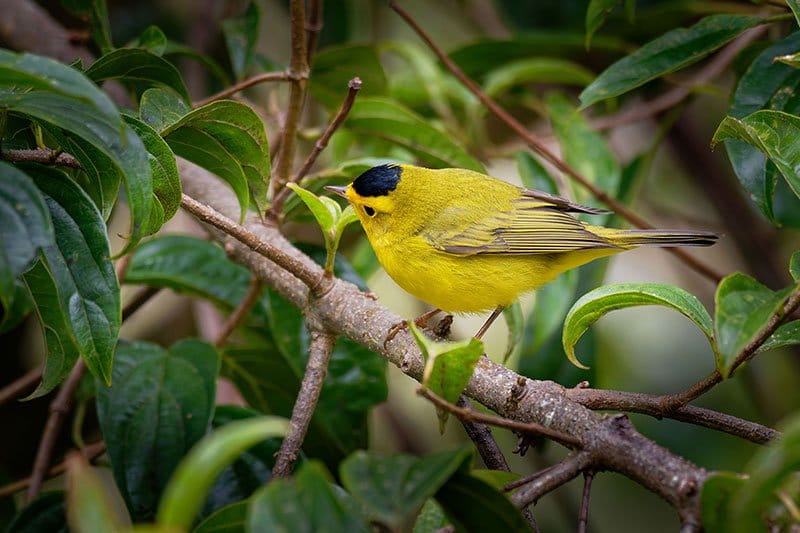
It has olive-green upperparts, bright yellow underparts, and an olive-brown tail. The head is bright yellow with a distinctive black cap. Its eyes are black, and its legs and feet are pink with yellow soles. Males and females are similar.
Its loud song is a chattering series of descending notes, while its call is a flat chirp. It has little fear of humans and can be seen searching the outsides of leafy branches while flicking its wings or moving its tail up and down or in a circular motion as it searches for food.
Wilson’s warblers are frequent hosts for the parasitic brown-headed cowbird.
Try our interactive bird identifier
Wilson’s warblers eat mainly spiders and insects, in particular leafhoppers, as well as bees, beetles, and caterpillars. In winter it will supplement its diet with berries.
Wilson’s warbler breeds in North America from Alaska to Newfoundland, Ontario, and Nova Scotia, and along the west coast to California. It spends the winter in southern California, and the Gulf Coast to Mexico.
It can be found in damp thickets in woodlands, wet scrub, willow thickets, and along streams and in bogs.