

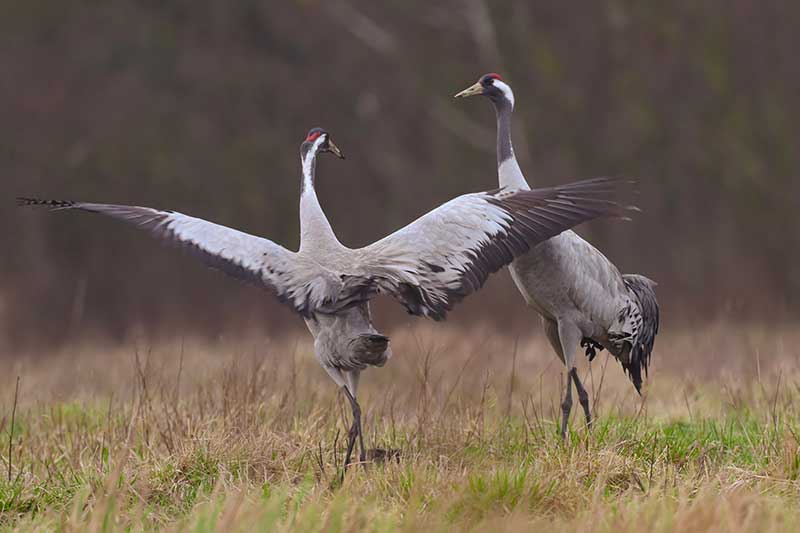
Once a common sight across the British countryside, the species faced a dramatic decline in numbers over the centuries, driven largely by habitat destruction and hunting. By the 17th century, cranes had disappeared entirely from the UK. However, thanks to decades of dedicated conservation efforts, they have made a remarkable comeback. In the early 21st century, the first successful breeding pair in over 400 years was recorded in the Norfolk Broads with further reintroduction in the Somerset Levels. There are now a few hundred individuals scattered across the marshes and wetlands of the British Isles.
The courtship ritual of the common crane begins with a series of intricate dances, in which both the male and female engage in coordinated movements, often in open, flat areas where they can show off their agility and strength.
The dance begins with the male following the female in a dignified, march-like walk. The female then pauses, standing tall with her head raised, before lowering it and letting out a high-pitched call. The male responds with a loud scream, mirroring her posture.
The pair may then engage in bowing, where they lower their heads while raising their bodies, a clear display of mutual respect and attention. This is often followed by a series of high leaps, as the cranes spring into the air, flapping their wings enthusiastically as they touch their feet to the ground. Their dances are not only beautiful but serve to demonstrate the physical fitness of each partner.

Other moves include bob and pirouettes, while displays of aggression involve ruffling their wing feathers, tossing grass, feathers, moss, and small twigs into the air, and directing the bare red patch on their heads toward one another.
Vocal duets are also an integral part of crane courtship. Both the male and female call in unison, their deep, bugling calls echoing across the landscape. These vocalisations serve to bond the pair, helping them to communicate and reinforce their connection, but they also act as a declaration to other potential mates or rivals of their unity.
Research has shown that birds who form pair bonds have more success raising their young and tend to live longer. Paired mates provide mutual protection against predators and, in some cases, work together to find food.
In 2017, scientists studying pair bonds in whooping cranes found that many pair up even before they are old enough to mate.
The team of researchers from the U.S. and Germany discovered that most (62%) breeding pairs began forming connections at least 12 months before their first breeding season. Among these, 16 out of 58 pairs started getting together more than two years before first breeding, and for most pairs, these early associations with future breeding partners started to differ from social interactions with other birds about a year before breeding.
60% of the pair formed before at least one partner had reached sexual maturity. Most pairs began their associations in late spring after arriving at their summer grounds, while pairings at other times of the year were uncommon.
Crane courtship rituals play an important role in strengthening the lifelong bonds between partners. While these elaborate dances and vocal duets are often associated with the breeding season, they can occur throughout the year, serving to strengthen the connection between the two birds at any time. The physical displays and vocal interactions help both partners assess each other’s fitness, ensuring that only the most compatible individuals stay together. This bond is essential for the survival of their offspring, as cranes work together throughout the breeding season to build nests, incubate eggs, and care for their chicks.
However, adults in established pairs rarely dance, suggesting that while dancing may serve as a form of social behaviour, its primary purpose in subadults is unlikely to be socialisation or pair formation.
Cranes’ dancing behaviour is both innate and learned with some cranes starting to dance when they are just 2 days old. Dancing is a natural part of a crane’s behavioural repertoire, but it can also be influenced and refined through social interactions and practice.
Cranes are born with a natural inclination to perform dance-like movements, including bowing, jumping, running, and tossing objects into the air. These behaviours have been observed even in young cranes raised in isolation, suggesting an instinctive basis.
Social interaction plays a key role in enhancing and refining a crane’s dancing skills. Very young crane colts observe and mimic the movements of their parents or other cranes, gradually improving their coordination and learning the subtleties of specific displays.
All 15 species of cranes worldwide engage in dancing, though the style and intensity vary between species. The dances all include intricate sequences of coordinated bows, leaps, short flights, runs, and tossing objects into the air.
Smaller species, such as the black and grey crowned cranes and the demoiselle crane, tend to exhibit the most energetic displays. The dance of the demoiselle crane has been described as very “ballet-like” with graceful movements and fewer and less theatrical jumps.
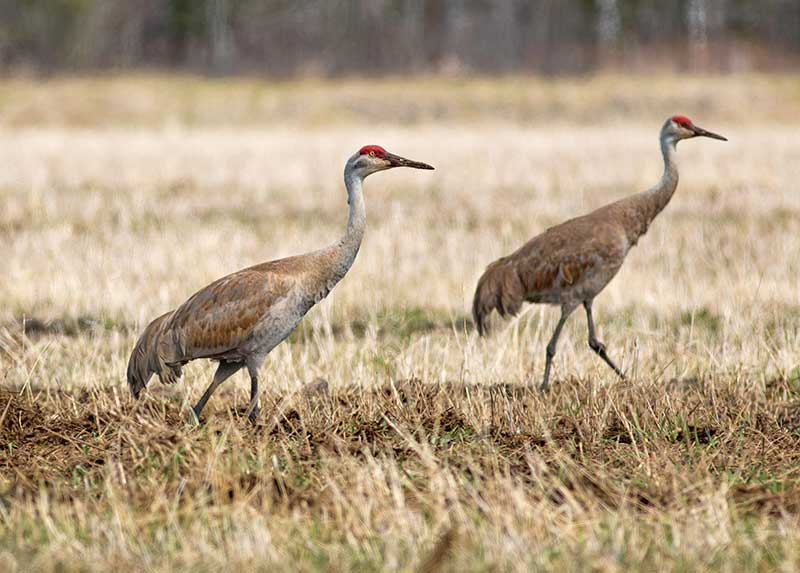
The Japanese red-crowned crane has a particularly distinctive dance, which begins with rhythmic head bobbing followed by deep bows, wing spreading, leaping with flapping wings, and often circling its partner after landing, while blue cranes are renowned for their long courtship displays, which can last anywhere from 30 minutes to an impressive four hours.
Among the Gruinae species, dances tend to be more deliberate, punctuated by high, flapping leaps that showcase their elegance.
You can see common cranes at Norfolk Wildlife Trust’s Hickling Broad reserve. Head to the Stubb Mill raptor roost viewpoint, where up to 20 cranes, can gather during the evening. Arrive about an hour before dusk, and you might also spot marsh harriers, hen harriers, barn owls, and bitterns, along with Chinese water deer grazing in the nearby fields.
The Slimbridge Wetland Centre in Gloucestershire is another great place to spot wild cranes. Birds released in Somerset as part of the Great Crane Project often fly up the Severn Estuary to Slimbridge, with several making it their permanent home. Throughout the year, you can see cranes flying overhead, feeding, and socialising near the hides.
Or try Welney Wetland Centre, located on the Norfolk/Cambridgeshire border, particularly in autumn when activity peaks. During this time, post-breeding flocks gather to feed in preparation for winter. Visitors can enjoy views of adult cranes and their juveniles, fledged during summer, from the centre and its hides.
Cranes are also regularly spotted on several RSPB reserves, including West Sedgemoor in Somerset, Lakenheath Fen in Suffolk, Nene Washes in Cambridgeshire, and Loch of Strathbeg in Aberdeenshire


