

By simulating different schedules of singing and foraging, the model produced daily patterns that closely resembled those seen in real songbirds. This suggests that the behaviours observed in nature are shaped by fundamental principles of energy management. The model’s predictions remained highly consistent, even when a wide range of factors, such as food availability and energy use, were altered. This consistency helped identify which factors are most important in shaping a bird’s daily routine.
The model suggested that the dawn chorus can arise simply due to variability in overnight energy use, rather than being driven by an internal body clock (circadian rhythm) or external environmental cues. In other words, birds may sing most at dawn not because of a biological timing mechanism, but because they wake up with different levels of energy each morning.
However, all these theories assume that males sing either to attract mates or defend their territory. They also assume that singing and foraging compete for time, meaning that a bird must choose between the two activities. However, in her doctoral thesis, Ruth Mace at Oxford University, notes that in the great tit, these assumptions do not fully apply.
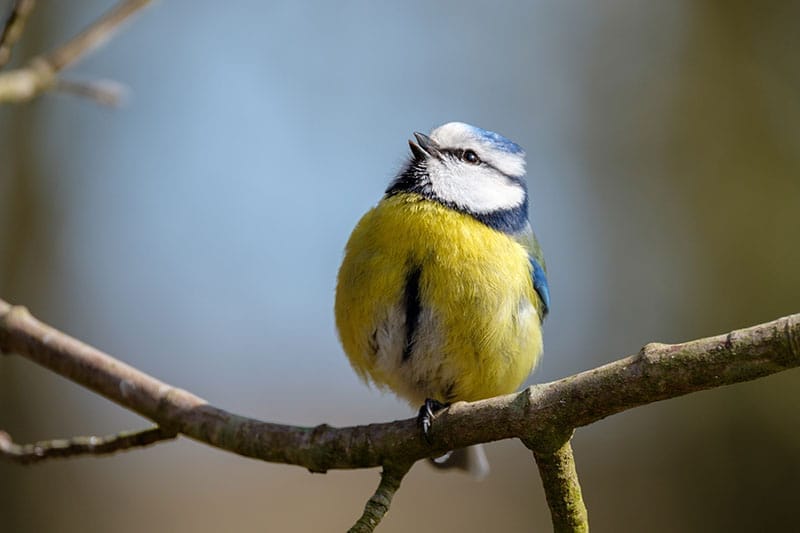
The peak in singing at dawn only appears in late spring, once territorial boundaries have already been established, and birds have paired up. This suggests that defending territory is not the primary reason for the dawn chorus. Additionally, the idea that singing and foraging compete for time does not explain why male great tits at northern latitudes, where the days are longer, roost earlier than those in the south but still sing before dawn. If time for foraging were the key factor, one would expect different patterns.
Another important observation is that the female great tit’s behaviour plays an important role. The dawn chorus comes to an end when the female emerges from her nest hole, indicating that her presence influences male singing behaviour. The study showed that the duration of the male’s dawn song is closely linked to changes in female fertility, implying that males may be adjusting their singing in response to their mate’s reproductive state rather than simply competing for territory or time.
However, a more recent study in 2020 suggested something entirely different and that birds sing at dawn as a warm-up exercise. The study examined whether practice improves vocal performance in swamp sparrows (Melospiza georgiana), a species where the physical constraints and biological importance of singing are well understood. Researchers from Duke University measured vocal deviation, a measure of song performance, in 1,527 recorded songs from 11 captive swamp sparrows. Four of these birds had experienced developmental stress as juveniles, allowing for comparisons between stressed and non-stressed individuals.
The results showed that vocal performance improved throughout the morning, influenced by both the cumulative number of songs sung and the time of day. Certain song types, particularly those with introductory syllables, showed greater improvement than more typical trilled songs. And, across all song types, birds that sang more frequently tended to show greater overall improvement. However, males with high song output also exhibited greater variability in performance, suggesting that some birds might experience fatigue from extended singing.
The researchers also found that birds that had been stressed as juveniles showed greater improvement over the morning compared to non-stressed birds. This suggests that past challenges in development might lead to greater gains in vocal performance through practice. If other sparrows pay attention to changes in song quality, then improving vocal performance throughout the day may encourage birds to sing early and often. However, the risk of fatigue could place a natural limit on how much this advantage can be exploited.
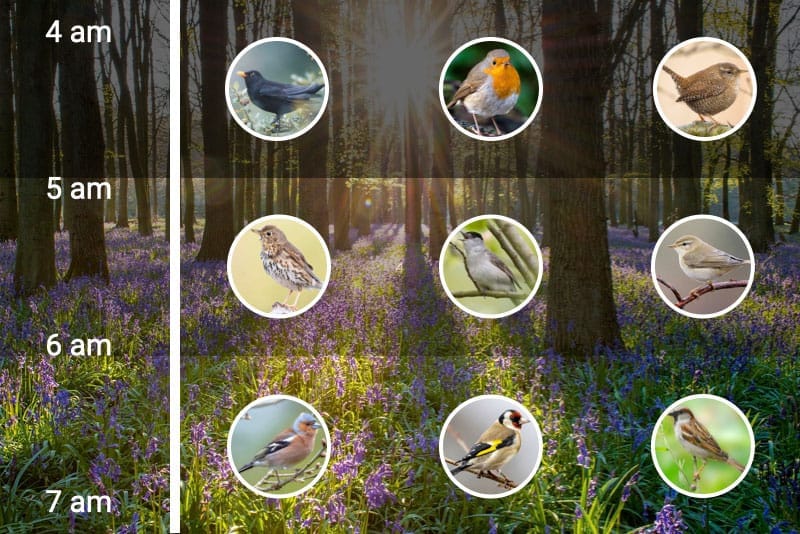
Try out our interactive dawn chorus. Click on the birds to hear them sing. You can listen to their individual songs or play them together to compose your very own dawn chorus!
Thou hearest the Nightingale begin the Song of Spring;
The Lark sitting upon his earthy bed: just as the morn
Appears; listens silent; then springing from the waving Corn-field! loud
He leads the Choir of Day! trill, trill, trill, trill,
Mounting upon the wings of light into the Great Expanse:
Reecchoing against the lovely blue & shining heavenly Shell:
His little throat labours with inspiration; every feather
On throat & breast & wings vibrates with the effluence Divine
All Nature listens silent to him & the awful Sun
Stands still upon the Mountain looking on this little Bird
With eyes of soft humility, & wonder love & awe.
Then loud from their green covert all the Birds begin their Song
The Thrush, the Linnet & the Goldfinch, Robin & the Wren
Awake the Sun from his sweet reverie upon the Mountain
William Blake – Milton


One Response
Are there synchronised gaps in the dawn chorus when all birds stop and listen?