


With its long legs, dramatic plumes, and an unmistakable stride, the secretarybird is unlike any other predator in the animal kingdom. Towering above the savannah, it commands attention as it stalks the grasslands of sub-Saharan Africa from Senegal east to Somalia and south to South Africa, all while sporting an air of elegance and deadly precision.
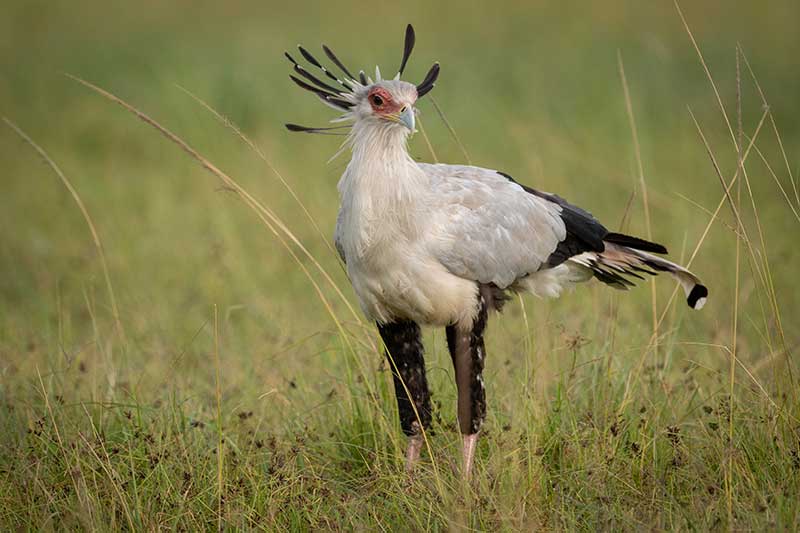
The secretarybird (Sagittarius serpentarius) is a striking bird of prey that stands at nearly one metre, making it one of the tallest birds of prey in the world. Despite a wingspan of about 2.3 meters and long, slender legs, it spends most of its life on the ground. Native to sub-Saharan Africa, secretary birds are most commonly found in open, grassy savannas, savannah woodlands, and semi-arid habitats.
Their distinctive appearance with large wings, a crest of black feathers atop their heads, and a long tail, gives them an air of elegance. They are, however, deadly hunters, using their powerful legs as tools for stomping and killing prey. Unlike many raptors, the secretary bird is primarily a terrestrial predator, hunting from the ground rather than soaring through the air.
In terms of diet, the secretary bird’s culinary preferences are wide-ranging. It feeds on insects, small mammals, frogs, lizards, and even venomous snakes, making it a highly adaptable predator. The bird’s sharp vision and ability to cover large distances allow it to spot potential prey from afar.
The secretarybird was first described in 1769 by Dutch naturalist Arnout Vosmaer, who examined a specimen sent to him by an official of the Dutch East India Company. Vosmaer noted that Dutch settlers referred to the bird as “sagittarius,” believing its distinctive gait resembled that of an archer. He also recorded that local farmers called it “secretarius,” as they had domesticated the bird to help control pests around their homesteads. In this context, “secretarius” referred to a clerk or keeper. Vosmaer speculated that “secretarius” might have been a corruption of “sagittarius,” though it’s also possible that “sagittarius” was a misheard or mistranscribed version of “secretarius.”
In 1780, French polymath Georges-Louis Leclerc, Comte de Buffon, proposed a more whimsical explanation for the name. He suggested that the bird’s long, quill-like feathers on the back of its head resembled quill pens tucked behind a secretary’s ear. While creative, there’s no evidence to suggest the term originated in French.

The secretarybird was formally assigned its own genus, *Sagittarius*, in 1783 by French naturalist Johann Hermann. Its specific epithet, *serpentarius*, derives from the Latin *serpens*, meaning “snake,” reflecting its well-documented habit of hunting and killing serpents.
Once prey is spotted, the secretarybird stands tall, using its exceptional eyesight to lock onto the target. Whether it’s a venomous snake or a small mammal, the bird doesn’t dive or pounce like other predators. Instead, it approaches on foot, wings slightly spread, and with its crest feathers sometimes erect. This display serves a dual purpose: to intimidate the prey and to shield the bird’s face from the sun as it closes in.
When the secretarybird reaches striking distance, it unleashes a flurry of precise, powerful kicks. With strikes that can occur 3-4 times per second and deliver a force up to five times its body weight, it can kill prey with astonishing speed and accuracy. Larger prey is dispatched with these lethal stomps, while smaller victims like insects are plucked with the beak. The lower legs have thick, protective scales that shield them not only as they walk across the ground but also from any prey that attempts to fight back.
Once captured, the secretarybird swallows its prey whole. Any indigestible material, such as bones or fur, is later regurgitated in the form of pellets, which can measure up to 30 cm in length. These pellets are usually dropped near the bird’s roosting sites.
Unlike birds with mixed diets, such as the kori bustard, the secretarybird has a relatively short digestive tract specialised for consuming large amounts of meat. Its foregut is adapted to process high-protein meals efficiently, with minimal need for mechanical breakdown. The crop is dilated to hold food, while the gizzard is nonmuscular, reflecting its carnivorous diet. Similarly, its large intestine includes only vestigial ceca, as there is no requirement for fermenting plant material. The secretarybird’s digestive system is a streamlined, specialised tool, perfectly suited to its role as one of Africa’s best predators.
Adult secretarybirds are rarely preyed upon, thanks to their size, speed, and formidable defence mechanisms. They are generally too large and intimidating for smaller predators like honey badgers, jackals, caracals, and baboons, yet too small to interest apex predators like lions, hyenas, or leopards. However, they are not entirely free from threats.
One notable rival is the tawny eagle, a bird renowned for its kleptoparasitic tendencies, stealing kills from other predators. Tawny eagles sometimes target secretarybirds, especially when the latter have taken down larger prey. These encounters can be dramatic, with eagles attacking either alone or in pairs. Secretarybirds don’t back down easily; they are often able to fend off the eagles, and in some cases, they have been observed knocking the birds down and pinning them to the ground.
There is some evidence that tawny eagles might go beyond stealing meals. The fresh remains of a secretarybird have been discovered in a tawny eagle’s nest. However, whether the eagle actively hunted the secretarybird or scavenged an already-dead individual remains unclear.
While direct predation on adult secretarybirds is rare, eggs and chicks in nests are more vulnerable to predators like mongooses, jackals, and even snakes. Secretarybirds rely on their sharp vigilance and nesting strategies to protect their young from these threats.
The secretary bird is a unique predator that is as remarkable for its hunting skills as it is for its striking appearance. With its powerful legs, sharp eyesight, and expert hunting techniques, it stands as one of nature’s most effective predators.


