This behaviour may be playing a role in the spread of avian flu. When a frigatebird or skua forces another bird to vomit, the stolen meal is often coated in saliva, which, if the victim bird is infected, can contain high levels of virus. Since both frigatebirds and skuas migrate long distances, crossing oceans and hemispheres, they could carry the virus far from the original source. Large gatherings at breeding or roosting sites create even more opportunity for transmission.
As well as food theft, both species also scavenge and hunt, which may further contribute to the spread of the disease.
Gulls
Gulls are another well-known example of aerial pirates, stealing food not only from other birds but from humans as well. They can be both thieves and victims of opportunistic kleptoparasitism, especially during the breeding season. The targets are often members of the same species, though smaller gulls and terns are also at risk. For instance, Heermann’s gulls and laughing gulls have been observed snatching fish from brown pelicans as they surface from dives, while great black-backed gulls have even been seen stealing from birds of prey.
Birds of prey
Raptors too engage in kleptoparasitism, with the bald eagle being one of the most notorious offenders. Benjamin Franklin once described the behaviour in a letter to his daughter, recounting how he had seen a bald eagle stealing a fish from an osprey.
You may have seen him perched on some dead tree, where, too lazy to fish for himself, he watches the labour of the fishing hawk; and when that diligent bird has at length taken a fish, and is bearing it to his nest for the support of his mate and young ones, the bald eagle pursues him, and takes it from him.
Ducks
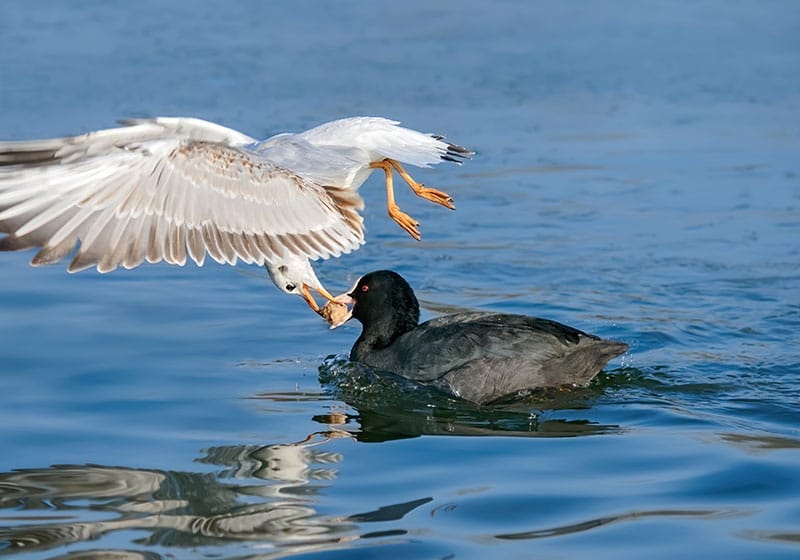
Ducks also take part in kleptoparasitism. One study in southern Spain recorded gadwalls stealing food from coots at a lagoon, but only during a year when water levels were low. In previous years, when the water was higher, this behaviour wasn’t seen. In the same study, female gadwalls were observed to steal more frequently than males.
After a coot came up from a dive with food, the gadwall would wait a few seconds before trying to steal it. This delay may help avoid triggering an aggressive response from the coot. Whether the coot reacted aggressively or not, they spent the same amount of time feeding on the surface. However, when coots did fight back, they took longer before diving again.
Gadwalls that stole food didn’t seem to get more food than those feeding normally. In fact, when a gadwall tried to steal from more than one coot at a time, it ended up getting less food. And coots that were being targeted by gadwalls actually dived more often, likely to make up for the food they were losing.
Researchers think this stealing happened because the low water levels made food harder to find. Although coots are usually aggressive birds, they didn’t often fight back against the gadwalls.
Mallards have also been observed trying to steal zebra mussels from both other mallards and coots.
The victims were most likely to be targeted when they had medium or large mussels in their beaks. If the prey was small, the chance of being attacked was almost cut in half. Attacks were also less likely to succeed when the prey was small, but more successful when the prey was medium or large.
Stealing from coots worked better than stealing from other mallards. These findings support the optimal foraging theory, which says animals try to get the most food for the least effort, backing up the idea that kleptoparasitism may be a strategy to maximise feeding efficiency.
Passerines
Although far less common, some passerines have been known to show occasional kleptoparasitic behaviour.
When Desmond Morris, best known for his 1967 book The Naked Ape, was a postdoctoral student at Oxford University, he wrote a 61-page paper titled The Snail-Eating Behaviour of Thrushes and Blackbirds. In it, he revealed that blackbirds lack the coordination needed to crack open snails on anvils, a skill mastered by their relatives, the song thrushes. Instead of doing it themselves, blackbirds take a more opportunistic approach: they watch and wait for a thrush to break open a snail, then swoop in to steal the freshly exposed flesh.
Kleptoparasitism without conflict
Kleptoparasitism creates direct competition for food and can play a role in shaping how bird communities are structured.
To explore this, a team of Spanish researchers studied four types of corvids feeding at a rubbish dump; rooks, carrion crows, jackdaws, and magpies.
They found that carrion crows were particularly focused on stealing food rather than searching for it themselves. They spent most of their time watching from the edges of the dump and then swooping in to snatch food from other birds.
During winter, when the most birds were around, each species visited the dump at different times of the day. Rooks and jackdaws came early in the morning, carrion crows appeared mid-morning, and magpies arrived in the early afternoon.
The researchers believe that kleptoparasitism influenced these time patterns. Carrion crows, for example, arrived when starlings, one of their main targets were most active, giving them more chances to steal food. Meanwhile, magpies came later to avoid the crows, which helped them avoid conflict and feed more efficiently.
This kind of time-sharing among species, called temporal segregation, is not often seen in vertebrates, but this study suggests it might be an important way for different species to coexist and share limited food sources without constant conflict.