|
|
Why Peregrine Falcons Moved Onto Cathedrals

Why Peregrine Falcons Moved Onto Cathedrals

Peregrine Falcon

High above a busy city, a sharp-eyed hunter surveys the streets and rooftops below, searching for its next meal. Spotting a pigeon, it dives at breathtaking speed, striking with precision and snatching the unsuspecting bird out of the air with its powerful talons. Back on its perch, the hunter passes the catch to its mate, who tears it apart to feed their hungry chicks, hatched on a cathedral ledge.

These extraordinary birds have not only adapted but thrived in the heart of urban life. And each year, millions of people tune in to watch them up close via live webcams to follow the unfolding drama of their lives.

Meet the peregrine falcon

The peregrine falcon is a medium-sized bird of prey found across nearly every corner of the globe, except for extreme polar regions, high mountains, and dense tropical rainforests.

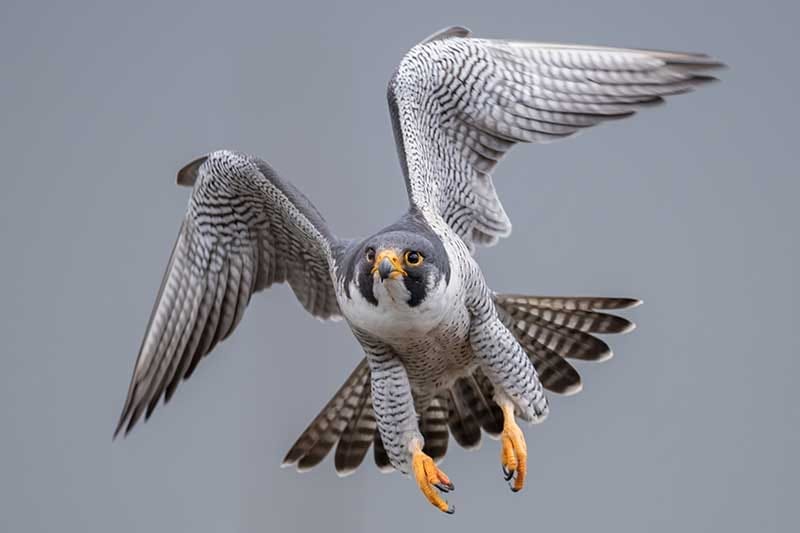
Adults have dark slate-grey upperparts with a lighter patch on the lower back. Their underparts are white, with the lower breast and belly marked with black bars. Their long, pointed wings have black and white barring, while the tail has alternating grey and white bands.

On the head, peregrines sport a black crown and nape, contrasting with their white cheeks. Their sharp, grey beaks have black tips and are accented by a yellow cere. They have piercing black eyes surrounded by yellow eye-rings, and their legs and feet are a vivid yellow. Males and females look similar, though females are larger and heavier.

Your next read

10 Record Breaking Birds
Shop Squirrel Proof Feeders And Baffles
A Hisoty Of The Common Crane In Britain
Guide To Smart Bird Feeders
Shop Smart Bird Feeders

Juveniles have brown upperparts and buff-coloured underparts streaked with black. Their feathers have pale edges, and their cere and eye-rings are duller compared to adults.

First described in 1771 by the English ornithologist Marmaduke Tunstall in Ornithologia Britannica, the peregrine falcon’s name derives from the Latin peregrinus, meaning “foreign” or “traveller.” Its modern Latin taxonomic name translates to “pilgrim falcon”, referencing the falconry practice of capturing wild, fully-grown birds during migration rather than taking them from inaccessible nests.

In the wild, peregrines typically breed on cliff edges, favouring sites with overhangs and south-facing exposures. In remote Arctic regions, steep slopes and rocky outcrops are used, while in parts of Australia and North America, large tree hollows may serve as nesting sites. Peregrines do not build traditional nests, instead laying their eggs in a shallow scrape or depression.

Peregrines fiercely defend their nesting sites from rivals and predators, including ravens, herons, gulls, and even other birds of prey like eagles, large owls, and gyrfalcons. They have been known to kill golden eagles and bald eagles in defence of their young.

Typically, peregrine falcons lay 3–4 eggs, which are white or buff with brown markings. The eggs are incubated for about 30 days, primarily by the female, with the male assisting during the day. Once hatched, the chicks, known as ‘eyases’ are covered in creamy white down and have notably large feet. Both parents hunt to provide food, and the chicks fledge approximately 40 days after hatching, although they remain dependent on their parents for up to two months.

What do peregrine falcons eat?

Peregrine falcons primarily prey on other birds, including pigeons and doves, waterfowl and waders, seabirds, gamebirds, songbirds, and parrots. It’s estimated they hunt around 2,000 bird species, nearly one-fifth of all bird species worldwide.

In addition to birds, peregrines occasionally hunt mammals such as bats, mice, rats, squirrels, voles, and young rabbits or hares. Depending on their habitat, they may also eat fish, insects, and small reptiles, including snakes, although these make up a smaller portion of their diet.

Peregrines typically hunt during dawn and dusk when their prey is most active. They search for targets from a high vantage point or while soaring over open areas like fields, marshes, or stretches of open water. Once prey is spotted, the falcon folds its wings and tail tightly against its body, tucking its feet, and begins a steep dive known as a stoop. These dives can reach speeds of up to 200 mph, making the peregrine the fastest animal on Earth.

During the stoop, the falcon strikes its prey mid-air, either stunning or killing it instantly on impact. After the strike, the falcon turns sharply to catch its prey before it falls, returning to a perch to pluck the feathers and eat. If the prey is too heavy to carry, the falcon drops it to the ground and feeds there. In some cases, pairs of peregrines hunt cooperatively, working together to flush out, chase, and capture their prey.

Driven to the brink of extinction

Until relatively recently, peregrine falcons were only found in the north and west of the UK, nesting on coastal cliffs. During the Second World War, they were shot for preying on pigeons carrying important military messages. Later, in the 1950s and 60s, their numbers plummeted dramatically due to the widespread use of organochlorine pesticides, such as DDT, which had a devastating impact on all of Britain’s birds of prey.

These pesticides accumulated in the food chain, and as apex predators, peregrines absorbed large amounts of these toxins from their prey. This caused significant breeding failures, as the pesticides reduced calcium levels in the eggshells, making them so fragile that they easily broke under the weight of the incubating bird. At the same time, peregrines also faced persecution by gamekeepers and egg collectors.
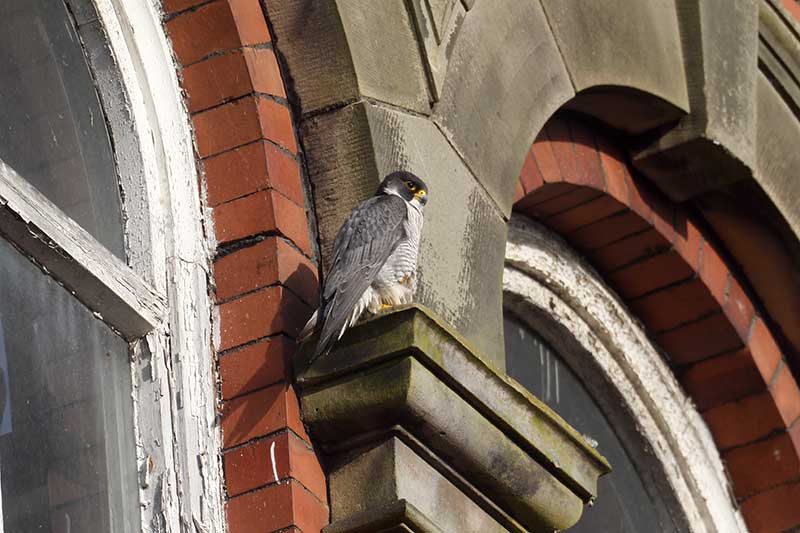
City Peregrine Falcon

In the UK, DDT was eventually banned in 1986, and the Wildlife and Countryside Act of 1981 introduced legislation to protect wild birds, their eggs, and nests.

Since then, conservation charities have made significant efforts in research, monitoring, habitat protection, and public engagement, helping peregrine falcons not only survive but thrive. As a result, the population has recovered substantially, with an estimated 1,750 breeding pairs now found across the UK, according to the BTO.

Adapting to urban living

As peregrine falcon numbers increased, they began moving from their traditional upland habitats to lowland areas in search of food. This shift also brought them into urban environments, where large populations of feral pigeons, an abundant food source, reside.

In their natural habitats, the wild ancestor of the feral pigeon, the rock dove, lives alongside peregrine falcons on cliffs and rugged landscapes. Over time, both species have evolved together and share several similar traits. Each is built for speed, with muscular bodies, strong, pointed wings, and relatively short tails. And just as the pigeon has adapted to urban life by nesting on tall buildings and structures that mimic its natural breeding grounds, the peregrine falcon has followed suit.

Peregrines nesting in cities is not a recent phenomenon. Records show peregrine falcons at Salisbury Cathedral in 1864 and St Paul’s Cathedral in London in 1921.

They have also expanded well beyond their northern range, with peregrines now found near the south coast. A genetic study on peregrines in Sussex revealed that their DNA was nearly identical to the pre-pesticide UK population, suggesting that their spread occurred naturally, without the influence of escaped domestic birds or European populations. In 1954, there were only 10 breeding pairs in Sussex, but this number has since grown to over 40 pairs.

Peregrine falcons can now be found not only on cathedrals but also on tower blocks, skyscrapers, bridges, cooling towers, and mobile phone masts.

Their diet has evolved to include common city birds such as swifts, collared doves, blackbirds, starlings, and corvids, while in North America, they prey on mourning doves, American robins, northern flickers, and house crows.

Street lighting has also enabled peregrines to extend their hunting hours, with many now hunting at night, targeting nocturnal migrants, such as redwings, fieldfares, and woodcocks.

How can I watch peregrine falcons?

Many English cathedrals actively monitor their resident peregrine falcons, offering the public a unique opportunity to view the birds through live-streamed webcam footage.

Chichester Cathedral was the first in Europe to introduce this technology in 2001. Since then, a pair of peregrine falcons has returned each year to nest in the cathedral’s southeast turret, successfully raising more than 60 chicks in total.

Cathedral peregrines also attract considerable media attention, with updates on egg-laying, hatchings, and, unfortunately, occasional losses frequently making the news.

The Association of English Cathedrals maintains an up-to-date list of peregrine falcon webcams, allowing enthusiasts to follow the lives of these magnificent birds from the comfort of their own homes.

Share your thoughts

Discover more fascinating bird behaviours

Yellow-Billed Oxpeckers
Oxpeckers, The Birds That Drink Blood
Starling Murmuration
The Science Of Starling Murmurations
Common Cranes Dancing
The Crane’s Elaborate Courtship Ritual
Singing Wren
The Dawn Chorus
Superb Lyrebird
The Superb Mimicry Of The Lyrebird
Killdeer With A Broken Wing
Killdeers And The Broken Wing Act

Secure your bird watchig break for just £10

Secure your bird watchig break for just £10

Secure your bird watching break for just £10