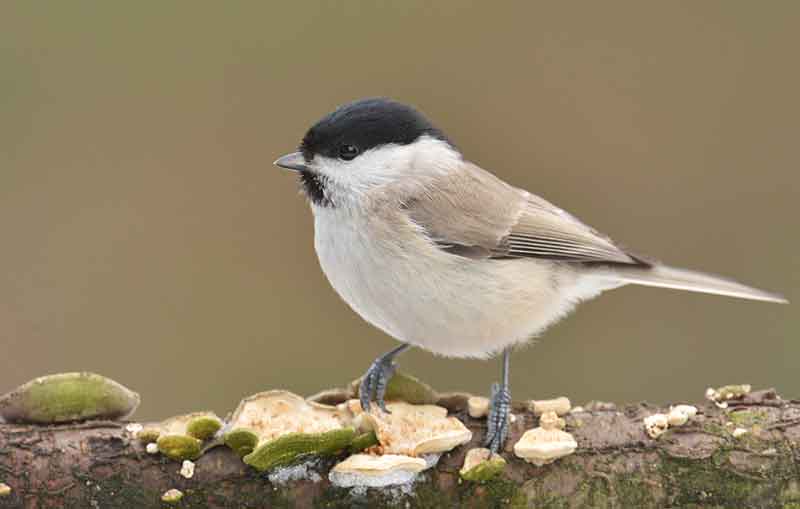
Marsh tits and willow tits are small black and white birds that inhabit the same areas, making them difficult to tell apart. Many of the differences in appearance are subtle and can overlap, so the best way to identify them is by their calls and songs.
Like all tits, they have a variety of calls, but each produces distinct notes that help with identification.
The marsh tit has a sharp, sneeze-like “pitchou” call, while the willow tit emits a nasal “zee-zur-zur-zur.” In terms of song, the marsh tit’s is a rapid, ringing “swe swe swe swe swe swe,” whereas the willow tit’s is a more melancholy, slightly descending “pew pew pew pew pew pew”.
Willow tit

Larger, less well-defined bib
1 of 4Matt black cap
2 of 4Pale wing bar
3 of 4 More white on the cheek 4 of 4The willow tit is a bulky bird with a bull-shaped head and scruffier plumage compared to the marsh tit. Its cap extends down the nape, the white on its cheeks sweeps behind the eyes, and its black bib has diffused eges. Some willow tits have a buff-coloured face rather than pure white. The tail has rounded corners.
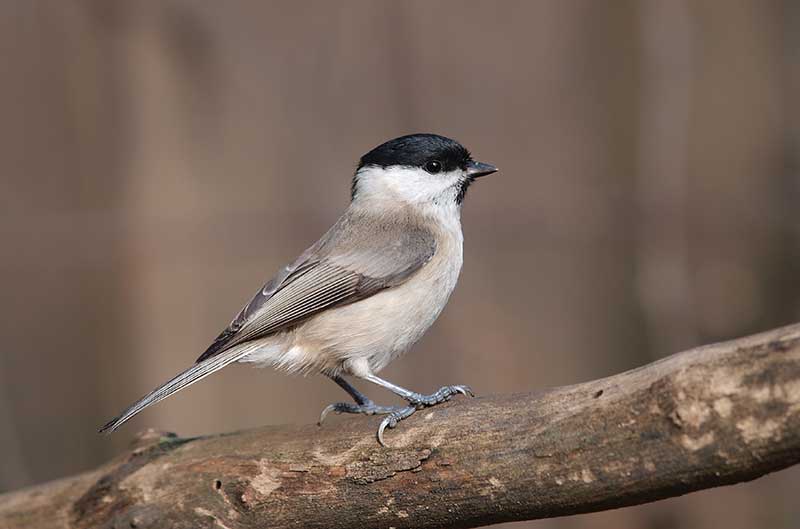
Unlike the marsh tit, which uses existing tree holes, the willow tit excavates its own nest hole in rotting wood.
Marsh tit

Cap is glossy
1 of 4Small neat bib
2 of 4 Square tail 3 of 4 Pale spot on upper mandible 4 of 4Despite its name, the marsh tit typically inhabits deciduous woodlands, foraging low in the understory, whereas the willow tit is found in wet woodlands, often higher up in the treetops.
It has a glossy black cap (although this is not always reliable) which doesn’t extend as far down the nape, so the cap looks more like a cap. It has a small, neat black bib, with a pale spot on the upper mandible. The tail is relatively blunt at the tip.